

Key takeaways
- The best sergers for beginners and home sewing are the Brother 1034DX for value, the Janome 8002D for straightforward setup, and the Juki MO-654DE for frequent sewing and heavier fabrics. The right choice depends less on the maximum stitch-per-minute figure…
The best sergers for beginners and home sewing are the Brother 1034DX for value, the Janome 8002D for straightforward setup, and the Juki MO-654DE for frequent sewing and heavier fabrics. The right choice depends less on the maximum stitch-per-minute figure than on threading help, differential-feed control, cutting-width adjustment, workspace, and how often you will clean and rethread the machine.
Our top picks


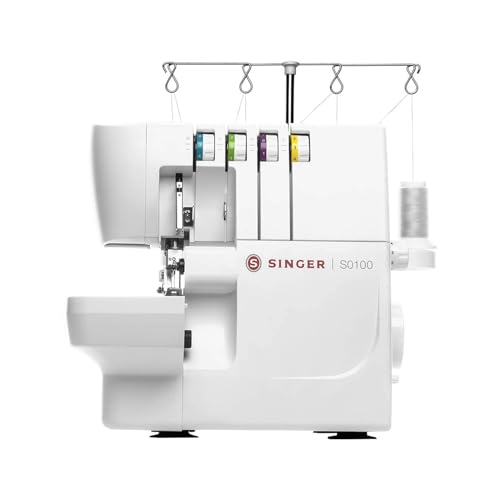
As an Amazon Associate we earn from qualifying purchases at no extra cost to you. Ratings are shown as listed on Amazon.
Best sergers at a glance
| Model | Best for | Threading and stitches | Speed | Approx. weight | Key limitation |
|---|---|---|---|---|---|
| Brother 1034DX | First-time users on a budget | 3- or 4-thread overlock; color-coded guides | Up to 1,300 spm | About 11 lb | Less substantial on thick, bulky layers |
| Janome 8002D | Simple home alterations | 3- or 4-thread overlock; built-in rolled hem | Up to 1,300 spm | About 12.5 lb | Fewer convenience features than premium machines |
| Juki MO-654DE | Frequent sewing and mixed fabrics | 2-, 3-, or 4-thread overlock; wide stitch range | Up to 1,500 spm | About 15.4 lb | Threading is less beginner-oriented |
| Bernette b44 | Beginners wanting more stitch choice | 2-, 3-, or 4-thread overlock; multiple overlock and rolled-hem options | Up to 1,300 spm | About 17.6 lb | Takes more table space and costs more |
Published dimensions, weight, included feet, and regional model names can vary, so check the manufacturer’s specification sheet before ordering. Speed is a maximum, not a recommendation for every fabric.
Our picks by sewing situation
| Your situation | Best fit | Why |
|---|---|---|
| Under roughly $250 and learning basic seams | Brother 1034DX | Accessible controls, color-coded threading, differential feed, and common 3- and 4-thread stitches |
| You want the least intimidating first machine | Janome 8002D | Clear threading path and uncomplicated controls for alterations and seam finishing |
| You sew several times a week or use denim and fleece | Juki MO-654DE | More stable construction, stronger fabric handling, and higher maximum speed |
| You want many overlock variations without moving to a coverstitch machine | Bernette b44 | Broad stitch selection and useful 2-, 3-, and 4-thread configurations |
| You mainly sew lightweight knits and want easy fabric control | A model with differential-feed adjustment and a free-arm option | Those controls matter more than top speed when preventing wavy hems and stretched seams |
Brother 1034DX: best budget serger for beginners
The Brother 1034DX is a sensible starting point for someone who wants professional-looking seam finishing without learning a complicated industrial-style machine. Its color-coded threading guides reduce the chance of putting a thread through the wrong looper, and the machine supports the common 3- and 4-thread overlock stitches used for garment seams, edge finishing, and basic rolled hems.
Its differential feed is especially useful for jersey and other stretchy knits. A setting near 1.0 is a normal starting point; raising the ratio can help gather or control a stretched edge, while lowering it can reduce puckering on some woven fabrics. Always test on a scrap because fabric thickness and fiber content change the result.
The trade-off is a lighter build and a more compact cutting area than on sturdier premium machines. It is suitable for clothing repairs, children’s garments, light-to-medium woven fabric, knits, and occasional fleece. It is not the first choice for continuous heavy canvas work or for someone who wants unusually quiet, vibration-free operation.
Janome 8002D: easiest path to basic overlocking
The Janome 8002D suits home sewists who value a predictable learning curve over a long list of specialty stitches. It provides the essential 3- and 4-thread configurations, a built-in rolled-hem setting, differential feed, adjustable stitch length, and a color-coded threading route.
Setup is relatively approachable, but “easy” does not mean instant. The lower looper still has to be threaded in the correct order, and a partially seated thread can produce skipped stitches or a thread chain that breaks as soon as you begin sewing. The instruction manual’s threading sequence is more important than the color labels alone.
This model is a good match for hemming knits, finishing seam allowances, sewing lightweight-to-medium garments, and learning how cutting width affects seam allowance. It offers less presser-foot clearance and fewer convenience features than more expensive machines, so thick layered intersections may need slower feeding and manual assistance.
Juki MO-654DE: best for frequent home sewing
The Juki MO-654DE is the stronger choice when the serger will be used regularly rather than stored between projects. It supports 2-, 3-, and 4-thread stitches, reaches about 1,500 stitches per minute, and has a more substantial feel than many entry-level machines. The extra stability can make long seams more comfortable and helps when sewing several layers of medium-weight fabric.
Its main beginner drawback is threading assistance. The machine has color-coded areas and a clear layout, but it does not eliminate the need to follow the looper path carefully. A user who changes between stitch types often may prefer a slower, more guided machine, while a user who settles into a few reliable settings will benefit from the Juki’s solid fabric handling.
Cutting-width control is important here. A narrow cut can preserve fabric and produce a close edge finish; a wider cut can accommodate a larger seam allowance or a less stable edge. Make a test seam after every width change because the needle position, thread tension, and visible loop coverage change together.
Bernette b44: best wider-feature beginner option
The Bernette b44 is worth considering when you want more stitch variety than a basic entry-level overlocker provides. Its 2-, 3-, and 4-thread choices cover narrow and wide overlock seams, rolled edges, and several finishing options. It also provides differential-feed adjustment and a color-coded threading layout.
Its larger, heavier body takes more room but can feel planted during faster sewing. The additional stitch choices are useful only if you are willing to label or photograph your tension settings. Otherwise, changing from a 4-thread seam to a rolled hem can become slower than expected because you must change needles, thread paths, tension, stitch length, and cutting width.
What to compare before buying
Threading assistance
Color-coded paths are standard at this level, but a true air-threading system is different: it uses air pressure to move thread through the loopers. Air-threading machines cost considerably more, but they can save time for users who reconfigure stitches often or find looper threading difficult. Needle threaders help with the needles; they do not automatically solve every looper problem.
Stitch options
A 4-thread overlock is the practical default for construction because it combines a seam with edge finishing. A 3-thread stitch uses less thread and works well for finishing a seam allowance. A 2-thread stitch is useful for lightweight edge finishing on compatible machines. Do not confuse an overlocker with a coverstitch machine: a serger trims and encloses an edge, while a coverstitch machine creates the parallel-needle hem commonly seen on T-shirts.
Differential feed
Look for two feed dogs with an adjustable ratio, not merely a basic feed mechanism. Differential feed is the control that most directly affects wavy knit hems, stretched armholes, and controlled gathers. It does not replace correct presser-foot pressure, needle choice, or fabric testing.
Cutting width and fabric range
Most home sergers handle light and medium wovens, jersey, fleece, and garment knits. A wider adjustable cutting range gives you more control over seam allowance and loop coverage. Very thick denim, leather, upholstery fabric, and multiple bulky layers are outside the comfortable range of many beginner machines, even when the motor can turn the blade.
Noise and presser-foot clearance
All sergers make more noise than a straight-stitch sewing machine because several loopers, feed dogs, and a blade operate at once. A heavy machine with rubber feet usually vibrates less than a lightweight one. Presser-foot clearance matters at crossings such as waistbands, elastic, and fleece seams; if the foot rises only a small amount, forcing a thick area can cause uneven stitches or damage the needle.
Setup that prevents most beginner problems
-
Install fresh needles. Use the needle type and size specified for the fabric. A bent or worn needle is a common cause of skipped stitches.
-
Raise the presser foot before threading. This opens the tension discs. Threading with the foot down can leave a thread sitting outside the tension system.
-
Thread in the manufacturer’s order. On many sergers, the loopers must be threaded before the needles. Pull each thread under the presser foot and leave a long tail.
-
Chain off on scrap fabric. Run a 5- to 8-inch chain before the project. It confirms that every thread is seated and that the loopers are interlocking.
-
Test differential feed and cutting width. Sew a sample using the actual fabric, number of layers, and thread. Adjust one control at a time so you know which change solved the problem.
Ownership costs and maintenance
Budget for replacement needles, upper and lower loopers, cutting blades, lint brushes, and four matching thread cones. A four-thread seam consumes more thread than a conventional straight seam: if a project uses 10 yards of finished seam, it may consume roughly 35 to 45 yards of combined thread depending on stitch length, width, and tension. That is why large cones are usually more economical for regular sewing.
Lint accumulates beneath the needle plate and around the loopers, especially with fleece and brushed knits. Brush or vacuum the accessible area after each substantial project, unplugging the machine first. Replace a dull blade when it begins pushing fabric instead of cutting cleanly. If the machine becomes unusually noisy, the handwheel feels rough, or timing appears inconsistent, stop sewing rather than compensating with extreme tension settings; service may be cheaper than damaged loopers or a bent needle bar.
Final recommendation
Choose the Brother 1034DX if price and guided threading are the priority. Choose the Janome 8002D for uncomplicated alterations and a gentle learning curve. Move to the Juki MO-654DE if you sew often, need steadier handling, or work with more demanding medium-weight fabrics. Choose the Bernette b44 when broader stitch selection is worth paying for and you have enough permanent table space. In every case, prioritize differential feed, a clear manual, usable presser-foot clearance, and accessible replacement parts over a headline speed number.

Write Your Review
No reviews yet. Be the first to share your experience!