

Key takeaways
- Best general target: 18/8 stainless steel with a polished or brushed finish.
- Good sign: smooth edges around the jigger, spoon, and shaker opening.
- Inspect carefully: welded handles, strainer springs, and the seam where a muddler handle meets its head.
- Use caution with coatings: black, copper, or gold finishes can scratch and may require hand-washing.
- Avoid unclear claims: “premium steel” without a grade or care instructions tells you little.
The best bar tool sets with stands for most home bars are compact 5- to 10-piece stainless-steel sets with a weighted stand, while frequent cocktail makers should step up to a 12-piece set only when the extra tools will replace separate purchases.
Our top picks

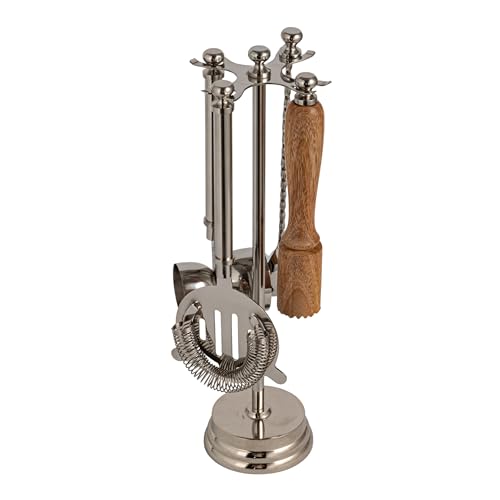
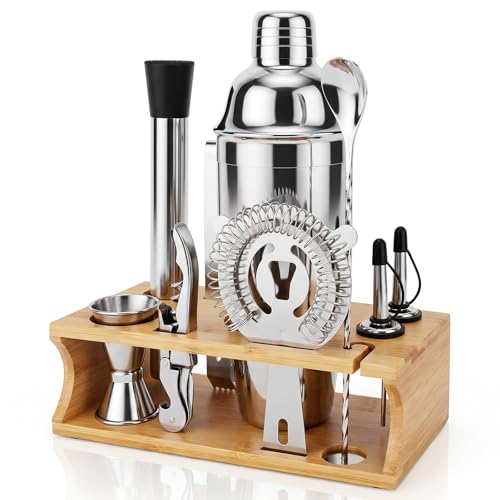

As an Amazon Associate we earn from qualifying purchases at no extra cost to you. Ratings are shown as listed on Amazon.
Quick picks by home-bar situation
| Situation | Best configuration | What to prioritize | Expected price range |
|---|---|---|---|
| Occasional drinks and limited space | 5-piece set with stand | Shaker, jigger, strainer, bar spoon, bottle opener | $25–$50 |
| Regular home cocktail making | 8- to 10-piece set with stand | 18/8 stainless steel, Hawthorne strainer, muddler, mixing spoon | $45–$90 |
| Small bar serving guests | 10- to 12-piece professional-style set | Weighted shaker, reliable jigger, spring strainer, stable stand | $80–$160 |
| Very shallow counter or cabinet | Wall-mounted or low-profile stand with separate tools | Footprint under 7 inches deep and removable storage | $35–$100 |
Best overall: a compact 8- to 10-piece stainless-steel set
For the widest range of home use, choose a set containing a 24- to 28-ounce cobbler or Boston shaker, a double-sided jigger, Hawthorne strainer, bar spoon, muddler, bottle opener, ice tongs, and a stand. This arrangement covers sours, highballs, stirred drinks, and basic muddled cocktails without filling a drawer with duplicate tools.
Brands such as Barfly, Cocktail Kingdom, Viski, and OXO offer recognizable barware lines, but the individual set matters more than the logo. Look for 18/8 stainless steel, smooth welded joints, a firmly attached shaker cap, and a stand that supports each tool without forcing handles against one another.
A stand around 10 to 12 inches tall and 6 to 8 inches wide usually provides enough capacity without overwhelming a home bar. Avoid sets that add novelty accessories—such as plastic pourers or multiple bottle stoppers—while omitting a proper strainer or a comfortable jigger.
Best budget choice: a 5-piece set with only the essentials
A five-piece set is the sensible choice for someone who makes cocktails once or twice a month. The useful minimum is a shaker, jigger, strainer, bar spoon, and bottle opener. Some sets count the shaker lid and body as separate pieces, so check the contents rather than relying on the advertised number.
Budget stainless sets can work well, but thin metal is more likely to dent and transmit cold quickly enough to make the shaker uncomfortable. A practical target is a shaker with metal walls around 0.5 to 0.8 millimeters thick and a jigger with clearly marked 1-ounce and 2-ounce sides. Measurement markings are more valuable than an extra garnish tool.
The main compromise is storage. A five-piece stand is often stable because it carries little weight, but it may not leave room for a muddler or a second strainer later. If you expect to expand your bar, a stand with two or three spare slots is worth a small premium.
Best for frequent use: a professional-style 10- to 12-piece set
Frequent cocktail makers benefit from a weighted Boston shaker, a separate mixing glass, a Hawthorne strainer, a fine-mesh strainer, a long bar spoon, a muddler, jigger, citrus peeler, ice tongs, and bottle opener. This is not automatically a better purchase: it is better only if you regularly make stirred drinks, clarified drinks, or cocktails that need fine straining.
Professional-style sets from barware specialists such as Barfly and Cocktail Kingdom generally emphasize replaceable or separately available components. That matters because springs, shaker tins, and strainers are the parts most likely to wear or become misplaced. A two-piece Boston shaker also avoids the vacuum-like sticking that can occur with inexpensive cobbler lids.
The trade-off is a larger storage footprint. A stand loaded with ten tools can occupy approximately 8 by 10 inches of counter space, and the tallest spoon or muddler may rise 13 inches or more. Measure the space beneath cabinets before buying.
Stainless-steel quality: what the label does and does not tell you
“Stainless steel” covers a wide range of construction quality. For bar tools, 18/8 stainless steel—commonly associated with 304-grade steel—is a useful target because it resists ordinary drink acids, salt, and dishwashing better than unmarked low-cost alloys. 18/0 steel can still be serviceable, but it is more prone to surface staining and may feel lighter.
- Best general target: 18/8 stainless steel with a polished or brushed finish.
- Good sign: smooth edges around the jigger, spoon, and shaker opening.
- Inspect carefully: welded handles, strainer springs, and the seam where a muddler handle meets its head.
- Use caution with coatings: black, copper, or gold finishes can scratch and may require hand-washing.
- Avoid unclear claims: “premium steel” without a grade or care instructions tells you little.
Weight is not a perfect quality test, but it helps reveal thin construction. A complete stand-and-tool set weighing roughly 2.5 to 4.5 pounds usually feels more substantial than a very light novelty set. Excessive weight is not useful if the stand becomes difficult to move or the tools are awkwardly thick.
Stand stability and footprint matter more than most listings explain
A stand should resist tipping when you remove the shaker or return a tool with one hand. The useful measurements are the base width, base depth, total loaded weight, and distance from the base to the center of the tallest tool. A narrow stand carrying a long muddler can tip even when the metal is high quality.
| Stand characteristic | Suitable target | Why it matters |
|---|---|---|
| Base depth | 6–8 inches | Fits most counters while resisting front-to-back tipping |
| Base width | 6–10 inches | Provides lateral stability for a loaded set |
| Tool capacity | 5–12 tools | Prevents unused slots from adding unnecessary bulk |
| Clearance below cabinets | At least 14 inches | Allows tall spoons and muddlers to be removed vertically |
| Base construction | Weighted metal or metal with non-slip feet | Reduces sliding and tipping on polished counters |
For a small bar, footprint can be calculated before purchase. If a stand is 8 inches wide and 7 inches deep, it uses 56 square inches of counter space. A 12-by-18-inch tray uses 216 square inches, nearly four times as much. The larger tray may look tidier when serving several bottles, but the upright stand is more efficient for a compact setup.
Decision matrix: which set fits your routine?
| Experience | Use frequency | Available space | Recommended choice |
|---|---|---|---|
| Beginner | Monthly | Very limited | 5-piece set, under 7 inches deep |
| Beginner to intermediate | Weekly | Moderate | 8- to 10-piece set with 18/8 steel |
| Experienced | Several times per week | Moderate to generous | Boston shaker set with separate mixing glass and fine strainer |
| Host or small bar operator | Multiple drinks per session | Generous | 12-piece set, plus replaceable shaker and strainer components |
Ownership realities: what wears first
The first failure is often not rust. It is a stretched Hawthorne spring, a loose shaker lid, a bent jigger rim, or a stand slot that no longer holds a tool securely. Fine-mesh strainers can also clog with citrus pulp and become difficult to clean. These are reasons to favor standard shapes and brands that sell individual replacement pieces.
Rinse tools soon after use, especially after citrus, syrup, dairy, or egg-based drinks. Wash shaker parts separately so residue does not remain beneath a lid gasket. Dry tools before placing them in the stand; trapped moisture can leave mineral spots and eventually discolor crevices. If a set is dishwasher-safe, use the manufacturer’s guidance, and hand-wash decorative finishes.
Do not use a bar spoon as a lever, force a stuck shaker apart against a countertop, or put a coated muddler in a harsh dishwasher cycle. A stuck shaker is usually easier to release with a light tap near the seam than with twisting that can dent the tin.
What to buy
Choose the compact 8- to 10-piece stainless-steel set if you want one dependable setup for most home cocktails. Select the five-piece version when counter space and price matter more than versatility. Choose the professional-style 10- to 12-piece configuration only if you will use a Boston shaker, fine strainer, and mixing glass regularly.
The most important checks are 18/8 stainless steel, clearly marked jigger measurements, comfortable edges, a replaceable or durable strainer spring, and a stand with a base large enough for its tallest tools. Those details have more effect on years of use than the headline tool count.
Frequently asked questions
Is a larger bar tool set always better?
No. Extra tools increase cost and storage footprint. A well-made five-piece set is more useful than a poorly made 15-piece set filled with duplicates.
Should a home bar use a cobbler shaker or Boston shaker?
A cobbler shaker is simpler for beginners because it has an integrated strainer. A Boston shaker is faster and easier to maintain for frequent use, but it requires a separate strainer and usually a little practice.
Can stainless-steel bar tools go in the dishwasher?
Many plain stainless tools can, but check the care instructions. Hand-washing is safer for coated finishes, wooden components, glued handles, and tools with narrow cavities.



Write Your Review
No reviews yet. Be the first to share your experience!