

Key takeaways
- Shaker: Choose a two-piece Boston shaker for fast service and easy cleaning, or a three-piece cobbler shaker for simpler beginner use.
- Jigger: A double-ended 25/50 ml or 0.75/1.5 oz jigger is more useful than a decorative single cup. Interior measurement lines improve repeatability.
- Strainer: A Hawthorne strainer should have a stable coil and a spring that fits securely. A julep strainer suits stirred drinks but is less versatile.
- Bar spoon: Look for a 25–30 cm spoon with a twisted shaft and balanced bowl. An excessively light spoon feels imprecise when stirring.
- Muddler: A smooth nylon or stainless-steel end is safer for glassware than aggressive teeth, which can damage herbs and scratch some mixing vessels.
The best copper bar tool sets for most home bars are five- to seven-piece kits with a weighted shaker, integrated strainer, 25/50 ml jigger, long-handled spoon, and a copper finish protected by clear lacquer or stainless-steel construction beneath the plating.
Our top picks

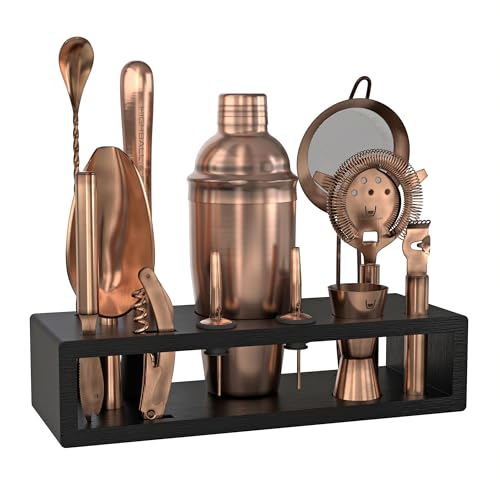

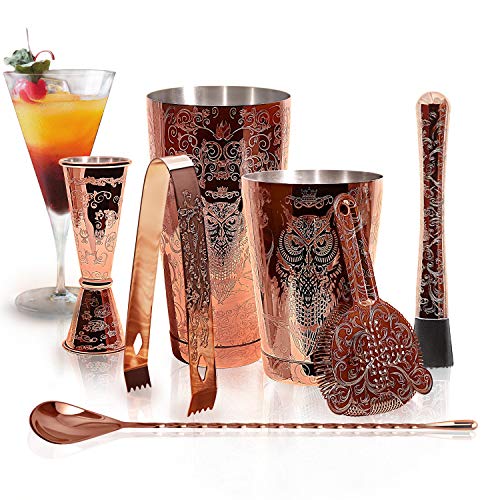
As an Amazon Associate we earn from qualifying purchases at no extra cost to you. Ratings are shown as listed on Amazon.
Best Copper Bar Tool Sets by Situation
| Best for | Recommended set type | Typical tool count | Typical market range | Why it fits |
|---|---|---|---|---|
| First home bar | Weighted Boston shaker kit | 5–7 pieces | $45–$90 | Good control, useful essentials, and fewer redundant tools |
| Occasional entertaining | Cobbler shaker set | 3–5 pieces | $25–$60 | Compact and easy to use without a separate strainer |
| Frequent cocktail mixing | Professional-style copper-plated set | 7–10 pieces | $80–$160 | Heavier construction, replaceable parts, and better workflow |
| Small apartment bar | Nesting compact set | 4–6 pieces | $35–$75 | Stores inside or around the shaker and needs little counter space |
| Traditional stirred drinks | Mixing-glass-focused set | 5–8 pieces | $60–$130 | Prioritizes a bar spoon, mixing glass, julep strainer, and accurate jigger |
What a Good Copper Set Should Include
Tool count matters, but a large box is not automatically better. A practical core set contains a shaker, jigger, strainer, bar spoon, and muddler. A cocktail pick, ice tongs, and bottle opener are useful additions; a dozen-piece kit may simply add decorative accessories that spend most of their life in a drawer.
- Shaker: Choose a two-piece Boston shaker for fast service and easy cleaning, or a three-piece cobbler shaker for simpler beginner use.
- Jigger: A double-ended 25/50 ml or 0.75/1.5 oz jigger is more useful than a decorative single cup. Interior measurement lines improve repeatability.
- Strainer: A Hawthorne strainer should have a stable coil and a spring that fits securely. A julep strainer suits stirred drinks but is less versatile.
- Bar spoon: Look for a 25–30 cm spoon with a twisted shaft and balanced bowl. An excessively light spoon feels imprecise when stirring.
- Muddler: A smooth nylon or stainless-steel end is safer for glassware than aggressive teeth, which can damage herbs and scratch some mixing vessels.
Head-to-Head: Copper-Plated Stainless Steel vs Solid Copper
Most attractive copper bar sets are copper-plated stainless steel rather than solid copper. That is usually an advantage. Stainless steel provides structural strength, resists acidic ingredients, and is less reactive with spirits, citrus, and juice. The copper layer supplies the appearance but is not expected to carry the mechanical load.
| Construction | Typical wall or tool behavior | Durability outlook | Maintenance | Best use |
|---|---|---|---|---|
| Copper-plated stainless steel | Rigid, commonly 0.6–1.0 mm for shaker bodies | Best all-round choice; plating can wear at rims and contact points | Hand wash and dry immediately | Regular home mixing |
| Solid copper | Warm feel and rapid temperature response | Can dent, react with acidic liquids, and develop patina quickly | More frequent polishing; avoid prolonged liquid contact | Display-focused bars and traditional presentation |
| Clear-coated copper finish | Bright appearance with a barrier over the copper | Resists tarnish until the coating is scratched or breached | No abrasive polish; gentle washing only | People who want low-maintenance shine |
| Uncoated copper finish | Patinas naturally and shows fingerprints | Appearance changes quickly but can be renewed | Occasional copper polish and thorough drying | Users who like an aged, lived-in look |
For a working set, stainless steel with copper plating is generally the safer purchase. Confirm that the interior is stainless steel rather than copper, especially for a shaker or jigger. If a product description only says “copper finish,” treat that as a color description, not proof of solid-copper construction or plating thickness.
Ergonomics That Matter More Than Decoration
A copper finish cannot compensate for awkward tools. A shaker should have a smooth rim without sharp transitions, enough weight to feel stable, and a lid that seals without excessive force. A useful 700–900 ml shaker can make two cocktails without becoming difficult to shake or clean. Smaller 500–600 ml shakers save space but limit batch size.
The jigger deserves particular attention. A narrow, tall cup can be difficult to fill accurately, while a wide cup encourages overpouring. Markings at half and quarter measures are valuable for recipes that use 7.5 ml, 15 ml, or 22.5 ml portions. The bar spoon should rotate comfortably between the fingers; a twisted shaft with a well-shaped top is more controllable than a thick, purely ornamental handle.
Decision Matrix: Which Set Makes Sense?
| Your situation | Prioritize | Avoid | Best choice |
|---|---|---|---|
| Mixing once or twice a month | Simple cleaning and compact storage | Large accessory bundles | Three-piece cobbler set with a good jigger |
| Learning classic cocktails | Accurate measurements and versatile straining | Unmarked jiggers and flimsy springs | Five-piece Boston set |
| Making four or more drinks at a time | Large shaker, durable joints, separate strainer | Small novelty shakers | Seven-piece weighted set |
| Very limited storage | Nesting tools and a hanging stand | Oversized mixing glasses and duplicate strainers | Compact four- to six-piece kit |
| Display is as important as use | Consistent finish and a stable stand | Unprotected coating that marks easily | Clear-coated copper-plated set |
How to Protect the Finish and Extend Ownership
The first parts likely to show wear are the shaker rim, jigger edges, strainer spring, and areas where tools touch a metal stand. This is normal contact damage, not necessarily a structural failure. Copper plating can also darken from oxygen, moisture, skin oils, and residue from citrus or syrup.
- Rinse immediately: Empty the shaker and rinse away citrus, salt, sugar, and egg residue before they dry.
- Hand wash: Use lukewarm water, mild dish soap, and a soft cloth. Do not use scouring pads, powdered cleaner, or a dishwasher unless the manufacturer explicitly permits it.
- Dry completely: Water left around the shaker seam or inside a strainer spring accelerates spotting and tarnish. Dry each tool before storage.
- Separate wet tools: Do not place a damp spoon or jigger inside a closed shaker. Trapped moisture can affect the finish and create unpleasant odors.
- Polish selectively: Use copper polish only on uncoated copper. On clear-coated tools, polishing compound can cloud or remove the protective layer.
Avoid shaking hot liquids, storing spirits inside the shaker, or leaving ice to melt in the vessel. Do not use acidic household cleaners such as vinegar solutions on a coated finish without checking the maker’s care instructions. If the plating has chipped through to the base metal, polishing may improve appearance but will not restore the original coating.
Worked Value Calculation
Suppose a $72 five-piece set is used twice per week. Over three years, that is approximately 312 uses, or about $0.23 per use before replacement parts and cleaning supplies. A cheaper $35 set used only once per month for three years costs about $0.97 per use. The more expensive set is better value only if its heavier construction, accurate jigger, and comfortable workflow lead you to use it more often. For occasional entertaining, a smaller set can be the rational choice.
Final Buying Advice
Choose the best copper bar tool set by construction and handling rather than by the number of accessories. For most buyers, that means a copper-plated stainless-steel Boston set with five to seven genuinely useful tools, a 25/50 ml or equivalent marked jigger, a stable strainer, and a finish described as clear-coated if low maintenance matters. Pick a cobbler set when simplicity and storage are more important than speed. Whichever style you buy, hand washing, immediate drying, and sensible storage will do more for long-term tarnish resistance than an extra muddler or decorative stand.

Write Your Review
No reviews yet. Be the first to share your experience!