

Key takeaways
- Leg locks: Folding legs should open to a repeatable position and stay there. Loose wing nuts or undersized bolts can make one board sit higher than the other.
- Foot design: Wide rubber or capped feet reduce sliding and protect decks. Narrow bare wood ends dig into grass and wear quickly.
- Frame bracing: At least one cross-support under each board helps prevent racking. Press lightly on opposite corners; excessive twisting signals a weak frame.
- Fasteners: Screws should sit flush and should not protrude through the top. Bolted hinges are easier to tighten and replace than permanently stapled hardware.
- Board alignment: Set both boards on the same surface and compare their heights. A warped board can make otherwise accurate throws behave unpredictably.
Best Cornhole Boards: Durable Sets for Backyard Fun
The best cornhole boards for most backyards are regulation-size 4-by-2-foot sets with a rigid 1/2-inch or thicker playing surface, folding legs, weather-resistant paint, and hardware that can be tightened or replaced.
That combination matters more than a decorative graphics package. A board can look excellent on day one but become frustrating if it flexes under weight, rocks on uneven grass, absorbs water through its edges, or has legs that loosen after repeated setup. The right choice depends on how often you play, how far you carry the set, and whether it will live indoors or outdoors.
Our top picks


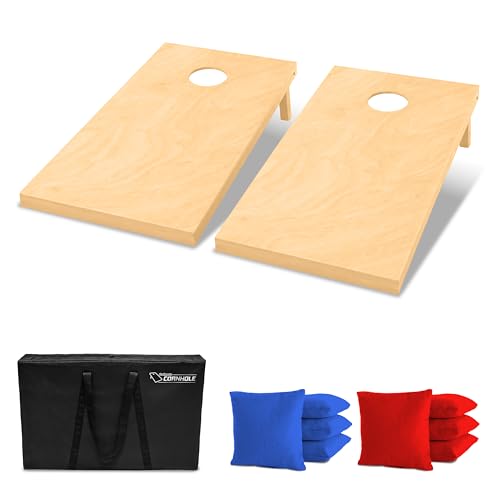

As an Amazon Associate we earn from qualifying purchases at no extra cost to you. Ratings are shown as listed on Amazon.
What counts as a regulation-size cornhole board?
A regulation board is 48 inches long and 24 inches wide, with a 6-inch-diameter hole. The center of the hole is normally 9 inches from the top edge and 12 inches from each side. The front edge is raised about 3 to 4 inches, while the rear edge is about 12 inches high when the board is set up.
These dimensions create the familiar playing angle and allow consistent scoring. Compact boards measuring 3 by 2 feet are easier to store and transport, but they change the throwing distance and target size. They are a sensible choice for children, small patios, or casual games, but they are not a full-size substitute.
| Board type | Typical size | Surface material | Approximate set weight | Best use |
|---|---|---|---|---|
| Regulation wood set | 48 x 24 inches | 1/2- to 3/4-inch plywood | 35-55 lb | Frequent backyard games and tournaments |
| Regulation composite or plastic set | 48 x 24 inches | Molded plastic or composite panel | 20-40 lb | Easy transport and occasional outdoor use |
| Compact recreational set | 36 x 24 inches or smaller | Thin plywood, MDF, or plastic | 15-30 lb | Children, apartments, and limited storage |
| Premium tournament-style set | 48 x 24 inches | 3/4-inch plywood or multilayer construction | 45-70 lb | Stable play and high-frequency use |
Best choices by playing situation
Best for frequent backyard play: a heavy regulation wood set
Choose 3/4-inch plywood or a well-braced 1/2-inch plywood top if the boards will be used every week. A heavier frame resists bouncing and sliding when bags land near the edge. Look for a 2-by-4 or similarly substantial perimeter frame, cross-bracing underneath, and legs that fold flat without scraping the playing surface.
Wood also gives you the easiest long-term repair path. A loose screw, chipped corner, or worn finish can usually be fixed with basic woodworking supplies. The tradeoff is weight: a 45-pound pair is less convenient to carry than a thin plastic set.
Best for portability: a folding composite or plastic set
For tailgates, camping, and frequent transport, prioritize a carrying handle, folding legs, and a pair weight closer to 25 to 35 pounds. Plastic or composite boards do not absorb water as readily as unfinished wood, and they are easy to wipe clean.
Check the underside before buying. Lightweight boards often rely on narrow legs or shallow molded supports. They may be perfectly adequate on a flat driveway but rock on grass. A set with broad feet, positive leg locks, and a rigid underside is preferable to one that is merely light.
Best for a tight budget: a basic wood recreational set
Entry-level wood sets can be good value when they have the correct 48-by-24-inch footprint and a sealed top. The compromises are usually thinner panels, lighter frames, simpler hinges, and less durable graphics rather than a different game.
Inspect the edges carefully. Exposed end grain and unsealed screw holes allow moisture to enter plywood, where swelling and delamination start. A modest set with sealed edges is a better purchase than a visually elaborate set with raw wood underneath.
Best for children or limited space: a compact set
Compact boards reduce carrying and storage demands, and a shorter throwing distance can work well for younger players. Choose them knowingly: the smaller target makes the game different, so they are best for informal play rather than regulation practice.
Board material: plywood, MDF, or plastic?
Plywood is usually the best all-around material. It has a good strength-to-weight ratio and can be refinished. Exterior-grade plywood is preferable, although even exterior plywood needs a protective coating because its edges and fastener holes remain vulnerable.
MDF produces a smooth, inexpensive playing surface, but it is less tolerant of moisture. If the finish is scratched or water reaches an exposed edge, MDF can swell permanently. Treat MDF sets as covered-storage equipment, not as boards that can remain on a damp lawn.
Plastic and composite panels are convenient and often easier to clean. They can resist occasional rain better than unfinished wood, but thin panels may flex and become noisy or unstable. Examine the support structure rather than judging durability from the top surface alone.
Leg stability and construction details to inspect
- Leg locks: Folding legs should open to a repeatable position and stay there. Loose wing nuts or undersized bolts can make one board sit higher than the other.
- Foot design: Wide rubber or capped feet reduce sliding and protect decks. Narrow bare wood ends dig into grass and wear quickly.
- Frame bracing: At least one cross-support under each board helps prevent racking. Press lightly on opposite corners; excessive twisting signals a weak frame.
- Fasteners: Screws should sit flush and should not protrude through the top. Bolted hinges are easier to tighten and replace than permanently stapled hardware.
- Board alignment: Set both boards on the same surface and compare their heights. A warped board can make otherwise accurate throws behave unpredictably.
Finish durability: what survives outdoor play?
For wood, look for sealed top, bottom, and edges rather than a coating on the playing face alone. Exterior polyurethane, spar urethane, or a comparable outdoor coating provides a moisture barrier, but no finish makes a wood board weatherproof when left uncovered year-round.
Gloss level affects play as well as appearance. A very slick surface may let bags slide farther, while a rough or heavily textured finish can slow them unexpectedly. A smooth, even satin or semigloss coating is a practical middle ground. Painted graphics should be under a clear protective coat; otherwise, repeated bag impacts wear the design near the hole and front edge.
The areas that usually wear first are the front corners, hole rim, leg hinges, and underside feet. These receive impact during carrying and setup. A padded storage bag helps prevent edge damage, but it should not be used to seal wet boards inside. Let boards dry completely before covering them.
A simple ownership and storage routine
- Inspect before setup. Tighten loose leg bolts and check for lifted splinters, cracked edges, or a warped panel.
- Use a level surface. Grass, compacted soil, and pavement produce different amounts of rocking. Place the feet evenly rather than forcing one leg into an awkward position.
- Keep boards off standing water. A damp lawn is acceptable for a short game, but puddles around the underside accelerate swelling and rust.
- Clean with a soft cloth. Remove dirt with mild soap and water, then dry the surface. Avoid abrasive pads that change the finish.
- Dry before storage. Store boards vertically or flat in a dry garage or closet, with spacers if needed to allow air circulation.
- Repair small damage promptly. Seal exposed wood, sand sharp splinters, and replace rusty hardware before moisture reaches the frame.
How much does durability change the value?
Suppose a basic set costs about $100 and lasts three summers with 20 uses per summer. That is 60 uses, or roughly $1.67 per use before repairs. A sturdier $250 set lasting eight summers at the same frequency provides 160 uses, or about $1.56 per use. The more expensive set costs more upfront, but its value improves when you play often and keep it protected.
For only five uses per summer, the calculation changes: the $100 set costs about $6.67 per use over three years, while the $250 set costs $6.25 per use over eight years. This is why finish quality and storage matter as much as initial price.
Final buying recommendation
For most buyers, choose full-size 48-by-24-inch wood boards with at least a 1/2-inch top, a braced frame, folding legs with secure hardware, sealed edges, and a storage solution. Spend more on thickness and construction before paying for custom graphics. Choose composite or plastic when portability and quick cleanup matter most, and choose compact boards only when storage or player age makes regulation dimensions impractical.
The best cornhole boards are not simply the heaviest or most colorful. They are the ones that remain flat, stable, and protected through repeated setup, outdoor play, drying, and storage.

Write Your Review
No reviews yet. Be the first to share your experience!