

Key takeaways
- Flat, fully supported construction: The board should sit without rocking on a level counter.
- Sound glue joints: Hairline gaps, raised seams, and dark open cracks can collect food and worsen with moisture.
- Moderately rounded edges: A small bevel is comfortable and less likely to chip than a sharp corner.
- Non-slip feet: Useful on smooth counters, but they reduce the ability to use both sides and can complicate flattening.
- No unnecessary juice groove: A groove contains liquids but removes usable cutting area and can be difficult to clean. It is more useful for carving meat than for general chopping.
- Useful working dimensions: Leave at least 2 inches of clear counter around the board where possible, and make sure it fits through the sink or dishwasher opening even though it should not go in the dishwasher.
The best end grain cutting boards for most kitchens are 2 to 3 inches thick, made from hard maple, walnut, or cherry, and sized large enough to keep food on the board without forcing your knife onto the counter.
Our top picks

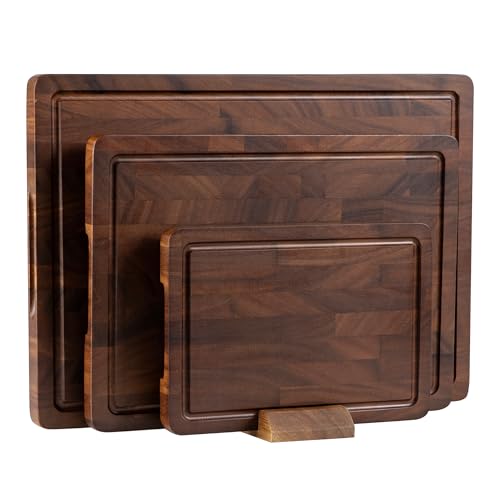


As an Amazon Associate we earn from qualifying purchases at no extra cost to you. Ratings are shown as listed on Amazon.
What makes an end grain board durable?
End grain is the cut surface where the wood fibers point upward, rather than running lengthwise across the board. When a knife enters the surface, it separates fibers between the grain instead of slicing across many fibers. This usually creates fewer visible scars and reduces edge wear compared with a flat-grain or edge-grain board.
That advantage does not make end grain indestructible. Durability depends on three related decisions: the wood species, the board’s thickness, and the quality of its glue joints. A dense species resists dents, adequate thickness limits cupping and twisting, and properly aligned blocks help the board absorb repeated cutting without opening seams.
Best end grain cutting boards by situation
| Situation | Recommended specification | Why it fits | Typical market range |
|---|---|---|---|
| Small kitchen or occasional use | 16 x 12 x 1.5 inches; maple or walnut | Manageable weight and storage without giving up end-grain construction | $70–$140 |
| Daily home cooking | 18 x 14 x 2 inches; maple, walnut, or cherry | A useful work area with enough mass to stay stable | $120–$250 |
| Frequent chopping and meal preparation | 20 x 15 x 2.5 inches; hard maple or a maple-walnut blend | More room, stronger resistance to movement, and greater resurfacing allowance | $180–$350 |
| Heavy prep or professional-style use | 24 x 18 x 3 inches; hard maple | Excellent stability and a thick surface that can be flattened repeatedly | $300–$600 or more |
| Lowest weight and easier lifting | 16 x 12 x 1.25–1.5 inches; walnut | Walnut is relatively light for its size and easier to move than a thick maple board | $80–$180 |
Prices vary with joinery, edge treatment, feet, juice grooves, and whether the board is made by a small shop or a large manufacturer. Treat these ranges as buying guidance, not a guarantee of current pricing.
Wood species: hardness versus knife friendliness
Hard maple: the practical all-rounder
Hard maple, also called sugar maple, is a leading choice for a workhorse board. It is hard enough to resist deep knife marks while remaining less abrasive to an edge than very hard exotic woods. Its pale color makes stains and food residue easy to spot, though it can show discoloration sooner than walnut.
Choose hard maple when durability, sanitation visibility, and long-term resurfacing matter more than appearance. A thick maple board is often the safest choice for someone who chops frequently or expects to flatten the surface after years of use.
Walnut: lighter, darker, and gentler in feel
Black walnut is somewhat softer than hard maple, so it may acquire marks sooner, but it is still suitable for normal kitchen cutting. Its dark brown color hides many stains and gives a board a furniture-like appearance. Walnut boards are often easier to lift at the same dimensions because walnut is less dense than maple.
Walnut is a strong choice for cooks who move the board to a sink or storage area regularly, or who prefer a slightly softer cutting surface. Avoid judging durability only by hardness: an extremely hard board can be less pleasant for knives and more tiring to chop on.
Cherry: warm color with moderate hardness
Cherry starts with a reddish-brown color that deepens with light exposure. It is generally softer than hard maple and may show knife marks more clearly, but it remains a sound choice for home preparation. Cherry suits buyers who prioritize appearance and a comfortable cutting feel over maximum dent resistance.
Teak and tropical hardwoods: proceed carefully
Teak is naturally resistant to moisture, but its high oil content can complicate gluing and finishing. Some tropical species are so dense that they can feel hard on knife edges, and their sourcing may require closer attention. If choosing teak or another exotic, look for a board explicitly made for food contact, clear species identification, and responsible sourcing information.
Do not choose a board solely because it has a high hardness rating. Very hard woods, reclaimed lumber with unknown treatment, and open-grained or oily species can create maintenance or knife-care compromises.
Thickness and grain orientation trade-offs
A 1.25- to 1.5-inch board can work well when counter space and lifting weight are priorities. It is less expensive and easier to store, but it has less material available for future flattening. It also has less mass to resist sliding and less thickness to absorb seasonal movement.
Two inches is the best compromise for many households. It provides a stable base, enough working height to feel substantial, and some allowance for sanding or planing later. At 18 x 14 x 2 inches, a typical hardwood board contains 504 cubic inches of wood before accounting for rounded edges and feet.
A 2.5- to 3-inch board is more stable and can survive several flattening operations, but the weight rises quickly. A 20 x 15 x 3-inch board contains 900 cubic inches of wood—about 79 percent more material than an 18 x 14 x 2-inch board. That extra stability is useful, but it also makes daily washing, drying, and storage less convenient.
End grain itself is not a guarantee against warping. Wood expands and contracts mainly across its width as humidity changes. A well-made board uses blocks with consistent moisture content, balanced construction, and grain patterns that distribute movement. A board with dramatic alternating patterns can look attractive but may contain many glue joints and differing grain directions.
Features that matter more than decoration
- Flat, fully supported construction: The board should sit without rocking on a level counter.
- Sound glue joints: Hairline gaps, raised seams, and dark open cracks can collect food and worsen with moisture.
- Moderately rounded edges: A small bevel is comfortable and less likely to chip than a sharp corner.
- Non-slip feet: Useful on smooth counters, but they reduce the ability to use both sides and can complicate flattening.
- No unnecessary juice groove: A groove contains liquids but removes usable cutting area and can be difficult to clean. It is more useful for carving meat than for general chopping.
- Useful working dimensions: Leave at least 2 inches of clear counter around the board where possible, and make sure it fits through the sink or dishwasher opening even though it should not go in the dishwasher.
Maintenance determines whether the board lasts
Clean the board promptly with warm water, mild dish soap, and a soft brush or sponge. Do not soak it, leave it in standing water, or place it in a dishwasher. Heat and prolonged moisture can cause end-grain blocks to swell unevenly, loosen glue joints, or produce cracks.
Dry both faces and all edges immediately, then store the board on its edge or on feet where air can circulate. Do not leave one face against a wet counter. This simple habit reduces uneven drying, one of the common causes of cupping.
Apply a food-safe mineral oil when the surface looks pale, feels dry, or absorbs a small drop of water quickly. Flood the top, bottom, edges, and end-grain areas, allow the oil to penetrate for several hours, then wipe away the excess. A food-safe board wax containing beeswax can add water resistance, but it does not replace oil inside the wood.
When resurfacing is worthwhile
Light knife marks are normal and do not require immediate sanding. Resurface when grooves trap debris, the board rocks, or a small area remains permanently rough after cleaning. A cabinetmaker or experienced woodworker can flatten a board with a planer, wide-belt sander, or careful hand methods. Repeated aggressive sanding removes thickness, so a 2.5- or 3-inch board has a meaningful ownership advantage over a thin board.
For a board used five times per week, a $200 board used for five years costs about $0.15 per use: $200 divided by approximately 1,300 uses. That calculation assumes proper maintenance and does not include professional resurfacing, but it shows why a stable, repairable board can be better value than repeatedly replacing thin boards.
Common buying mistakes
- Buying the largest board that fits the counter without considering its lifting weight.
- Assuming a heavier species is automatically kinder to knives.
- Choosing a decorative pattern with excessive end-grain color variation and no information about moisture control.
- Putting the board in a dishwasher or leaving it beside the sink overnight.
- Using it for raw meat and then failing to wash it promptly.
- Buying reclaimed wood without confirmation that it is untreated and free of paint, chemical contamination, or embedded metal.
Bottom line
For most buyers, the best end grain cutting boards are a 2-inch-thick hard maple, walnut, or cherry board around 18 x 14 inches, with tight joints, a flat base, and no needlessly deep groove. Choose hard maple for maximum workhorse durability, walnut for lower weight and a softer feel, and cherry for balanced performance with a warmer appearance. Go thicker only when you chop frequently and can comfortably manage the added weight; otherwise, careful drying and regular oiling will matter more than another inch of wood.

Write Your Review
No reviews yet. Be the first to share your experience!