

Key takeaways
- Face orientation: On a miter saw and table saw, cut with the decorative face up, since the teeth exit upward on those machines. On a hand-held circular saw, cut with the face down, because the teeth exit through the top on that tool.
- Tape the line: Painter’s tape along the cut helps hold fibers in place.
- Support the plank: Unsupported ends vibrate and chip. Clamp or support both sides of the cut.
- Dust: Laminate dust is fine and contains resin and abrasive particles. Use a dust extractor, eye protection and a mask or respirator rated for fine dust, and cut outdoors where you can.
- Saw fit: Match blade diameter, arbor size and maximum rpm to the saw’s label. Do not force a blade onto a saw not designed for it.
- Cord and battery saws: Thin-kerf blades reduce load on battery tools, which helps when cutting many planks.
For clean cuts in laminate flooring, an 80-tooth carbide blade with a negative or low hook angle, such as the Makita A-93681 or Freud’s 10-inch 80-tooth blade on a miter saw, suits most installers, while a polycrystalline diamond blade suits big jobs and tear-out of old floors where cut finish matters less than blade life. Small circular saws do better with a fine-tooth 7-1/4 inch finishing blade used with the good face down.
Our top picks


As an Amazon Associate we earn from qualifying purchases at no extra cost to you.
Why laminate is hard on blades
Laminate planks have a thin, brittle decorative layer on top of a fiberboard core, and a wear layer that contains aluminum oxide particles. Bob Vila’s blade roundup notes that those particles can wear down a cutting edge quickly. The brittle surface also chips along the cut line if the tooth geometry pulls upward. Two blade traits matter most: how many teeth contact the surface at once and how the teeth are ground.
Reviewers who write about laminate cutting generally converge on the same advice. A fine-tooth carbide blade, usually in the range of 60 to 100 teeth on a 7-1/4 to 10 inch blade, gives the smoothest finish. Fewer teeth cut faster but tend to chip. Diamond-tipped blades with only a handful of teeth last much longer in abrasive board and are used where speed and life count more than a polished edge.
Key traits to compare
Tooth count and tooth grind
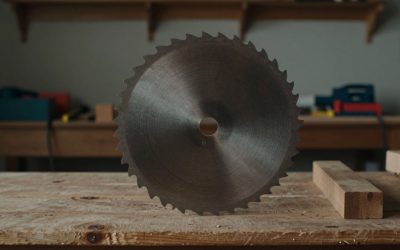
Tooth count scales with diameter, so a 40-tooth blade on a small 5-3/8 inch saw is comparable to a higher count on a ten-inch blade. Grind matters too. Alternate top bevel teeth slice cleanly in wood but can chip a brittle surface. Triple chip grind and high-ATB designs with a low hook angle shear the surface more gently. One roundup specifically suggests a finishing blade of 60 to 80 teeth with a triple chip grind for laminate.
Kerf
A thin kerf removes less material and needs less push force, which helps on a battery saw. A thin plate can flex in a hard cut, which is why Bob Vila notes the thin profile on the Concord 5-3/8 inch blade can need more pressure.
Hook angle
Low or negative hook angles reduce the aggressive bite that lifts the top layer. The Bosch DCB1080 is described by reviewers as having a negative hook design intended to limit tear-out on a miter saw.
Heat and vibration control
Laser-cut expansion slots help the plate stay flat as it heats. Several blades in the roundup list slots, and a nonstick coating to reduce resin and glue build-up from the board core.
At a glance: blades reviewers cover
| Blade | Best for | Key stated specs | Limits |
|---|---|---|---|
| Makita A-93681 | Precision cuts on a 10-inch miter saw | 10 inch, 80 carbide teeth, 0.091 inch kerf, 5/8 inch arbor, 5-degree tooth angle, five expansion slots | Costs more than budget blades |
| Freud 10-inch 80-tooth | Splinter-free miter cuts | 10 inch, 80 teeth, laser-cut slots, high ATB design, nonstick coating | Matching arbor and saw size required |
| Bosch DCB1080 Daredevil | Miter saw work with minimal chipping | 10 inch, 80 teeth, extra-thin kerf, four expansion slots, negative hook | Thin plate needs a steady feed |
| Bosch DCB1072 | Slightly coarser finish at a lower tooth count | 10 inch, 72 teeth as listed by roundups | Less polished than 80 or 100 tooth blades |
| Freud Diablo D12100X | Longer jobs, nails and hardware strikes | 12 inch, 100 teeth, 1 inch arbor, nonstick coating, shock-resistant teeth | Premium tier, needs a 12-inch saw |
| Concord WCB0538T040HP | Compact circular saws | 5-3/8 inch, 40 teeth, low hook angle, 5/8 inch arbor | Thin profile can require more push pressure |
| Diablo D0740A | General 7-1/4 inch circular saw finishing | 7-1/4 inch, 40 teeth, thin kerf, ATB with cobalt carbide per Bob Vila | Not a laminate-specific design; tear-out risk without good-face-down technique |
| Freud 7-1/4 inch Ultimate Plywood and Melamine | Veneered and laminated panels on a circular saw | 60 teeth, high ATB, titanium-cobalt carbide | Premium tier, not for softwood framing |
| Norske NCSBP284 or WEN BL0704 diamond | Demolition, volume cutting, long life | Polycrystalline diamond teeth, 8-tooth 12 inch (Norske) and 4-tooth 7-1/4 inch (WEN) as listed | Rougher finish, can chip fine cuts |
Tooth counts and prices vary by retailer listings, so match the exact blade diameter and arbor to your saw using the model’s manual.
Picking by budget tier
Budget tier
A 7-1/4 inch or 10 inch carbide blade with 60 teeth fits a one-room job. Forum users report clean cuts with a 60-tooth blade on a circular saw when planks are cut face down. Expect shorter life, because the wear layer dulls carbide quickly. If you have several rooms, this is a poor value.
Mid-range tier
The 80-tooth 10-inch miter saw blades from Makita, Bosch and Freud sit here. They are the typical answer for flooring installers who make a lot of end cuts. They handle crosscuts across the plank with tidy edges, and they last longer than budget blades when the coating and carbide are good.
Premium tier
The Diablo D12100X, large diamond blades and specialty laminate blades fall in this group. Diamond makes sense if you are removing floors or cutting large quantities, because the cost per cut drops even though the blade itself costs more. The trade-off is the rough edge on visible cuts.
Cutting technique and safety notes
- Face orientation: On a miter saw and table saw, cut with the decorative face up, since the teeth exit upward on those machines. On a hand-held circular saw, cut with the face down, because the teeth exit through the top on that tool.
- Tape the line: Painter’s tape along the cut helps hold fibers in place.
- Support the plank: Unsupported ends vibrate and chip. Clamp or support both sides of the cut.
- Dust: Laminate dust is fine and contains resin and abrasive particles. Use a dust extractor, eye protection and a mask or respirator rated for fine dust, and cut outdoors where you can.
- Saw fit: Match blade diameter, arbor size and maximum rpm to the saw’s label. Do not force a blade onto a saw not designed for it.
- Cord and battery saws: Thin-kerf blades reduce load on battery tools, which helps when cutting many planks.
Matching the blade to the saw you own
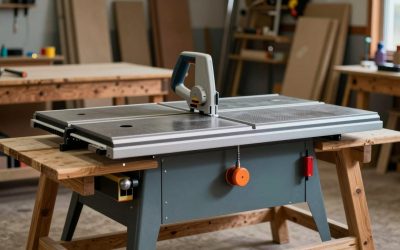
The blade is only half of the system. A 10-inch miter saw is the tool most installers reach for, because the fence and the downward cutting motion keep the plank steady and the decorative face visible. A table saw works for long rips of the last row, where a full-size blade with a fine tooth count helps keep the edge crisp. A handheld circular saw is the most flexible and the least forgiving, since the base plate can scratch the surface and the teeth can lift the top layer if the plank is face up. Compact trim saws with a 5-3/8 inch blade give control for undercutting door casing, but their small diameter limits cut depth, which is rarely a problem on thin planks.
When you buy, think about how many planks you will cut. A small bedroom may need only a few dozen cuts, and a fine carbide blade will survive it. A whole floor with many rooms, closets and door frames calls for either a premium carbide blade or a diamond option, because the abrasive wear layer dulls ordinary teeth quickly. A dull blade burns the core, widens the chip line and forces you to push harder, which raises the risk of a slip. Replace or sharpen it when the cut quality drops.
Pick X if you need this
| Pick | If you need |
|---|---|
| Makita A-93681 | Reliable end cuts on a 10-inch miter saw |
| Freud 10-inch 80-tooth | Laser-cut slots and a nonstick coating for long cutting sessions |
| Bosch DCB1080 | Thin kerf and negative hook on a miter saw |
| Concord 5-3/8 inch | Control on a compact trim saw |
| Freud Plywood and Melamine 7-1/4 inch | A circular saw blade built for laminated panels |
| Diamond-tipped blade | Tear-out and large volume, not showpiece edges |
Alternatives to a power-saw blade
Laminate cutter
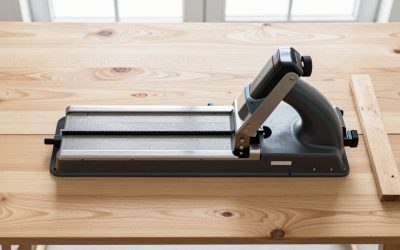
A manual laminate cutter shears planks with a lever and creates no dust. It is quick for straight crosscuts and suits indoor work where noise and dust are a concern, although it cannot make notches or curves.
Jigsaw blades
Fine-tooth jigsaw blades such as the Bosch T503 and T128BHM3 sets suit curves, door jambs and plumbing cutouts. Reviewers say they are better for details than for straight cuts.
Fine hand saws
A fine-tooth pull saw cuts door casing undercuts and small trims with no power and little noise. It is slow for large quantities.
Frequently Asked Questions
How many teeth should a laminate blade have?
Most reviewers point to 60 to 100 teeth for a clean edge, scaled to the blade diameter. A 10-inch blade often has 80 teeth, while a 7-1/4 inch blade for a circular saw commonly has 40 to 60. More teeth give a smoother cut but cut slower.
Can I use a regular wood blade on laminate flooring?
You can, but it may chip the surface and will dull faster. The wear layer is abrasive, and coarse ATB teeth tend to lift the brittle top. A finishing or laminate blade gives better results.
Which side of the plank should face up?
It depends on the saw. On a miter or table saw, keep the decorative face up. On a circular saw, put the decorative face down. The rule follows the direction the teeth exit the material.
Are diamond blades worth it for laminate?
They last far longer in abrasive boards and suit demolition and high-volume work. Reviewers note they may chip or tear on fine cuts, so they are not the best choice for visible edges.
Do I need a special blade for a cordless saw?
Not special, but a thin-kerf blade is easier on battery power. Pick the diameter your saw’s label lists and a tooth count that fits the finish you want.
How do I keep dust under control?
Use a dust extractor, cut outdoors if possible, and wear eye protection and a mask rated for fine dust. Laminate dust includes resin and abrasive particles. Follow the saw maker’s manual for guards and dust ports.



Write Your Review
No reviews yet. Be the first to share your experience!