

For most home woodworkers who need a saw that rolls out of a garage and still cuts full sheets, the DeWalt DWE7491RS is the usual starting point, while the DeWalt DWE7485WS suits people who prioritise a light, one-person carry, the Bosch GTS15-10 suits those who want the widest stock stand-mounted rip, and the SawStop Jobsite Saw Pro suits shops where flesh-sensing safety matters more than anything else. The sections below explain how those four compare, what a stand really changes, and where budget saws fit in.
A note on sourcing: figures below come from the makers’ own listings or from retail spec sheets that repeat them, and where outlets disagree the article says so. Roundup sites for this category are mostly affiliate-driven, so their ranking language is treated as opinion, not measurement. Check the owner’s manual for any saw before use, and wear eye and hearing protection every time.
Our top picks


As an Amazon Associate we earn from qualifying purchases at no extra cost to you.
Portable table saws with stands at a glance
| Model | Best for | Key stated specs | Limits |
|---|---|---|---|
| DeWalt DWE7491RS | All-round jobsite and garage work | 10 in blade, 15 amp motor, 4,800 rpm no-load, 32-1/2 in rip to the right, 3-1/8 in cut at 90 degrees, 2-1/4 in at 45 degrees, rolling stand | Tool weight listed around 90 lb; heavy on stairs |
| DeWalt DWE7485WS | Light carry and tight storage | 8-1/4 in blade, rack and pinion fence, rip capacity reported near 24-1/2 in, stand included in this variant | Reviewers note no dado support and a basic miter gauge |
| Bosch GTS15-10 | Widest rip and deepest cut in this group | 10 in blade, 15 amp, rip about 32-1/8 in right, depth 3-9/16 in at 90 degrees and 2-1/2 in at 45 degrees, Gravity-Rise wheeled stand | Weight figures differ by source, roughly 91 to 103 lb |
| SawStop Jobsite Saw Pro | Safety-first buyers | Rip 25-1/2 in right and 9-3/4 in left, 3-1/8 in depth at 0 degrees, saw alone 84 lb, about 113 lb with cart | Narrower rip than the DeWalt and Bosch; premium tier |
| SKIL TS6307 | Budget buyers with a folding stand | Described by reviewers as a budget model with a folding stand | Fewer verified specs in the sources reviewed; expect a lighter-duty fence |
What a stand actually changes
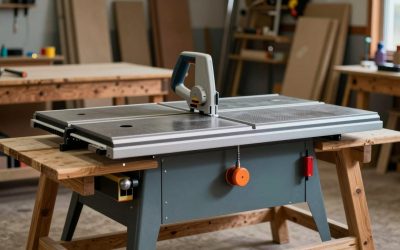
A portable table saw on a bench is a different tool from the same saw on its own stand. A stand sets table height near the hip, which is more comfortable for ripping and keeps the saw stable under the pull of long boards. It also lets you collapse and roll the saw to a corner, so you do not need to lift roughly 90 lb every time you use it.
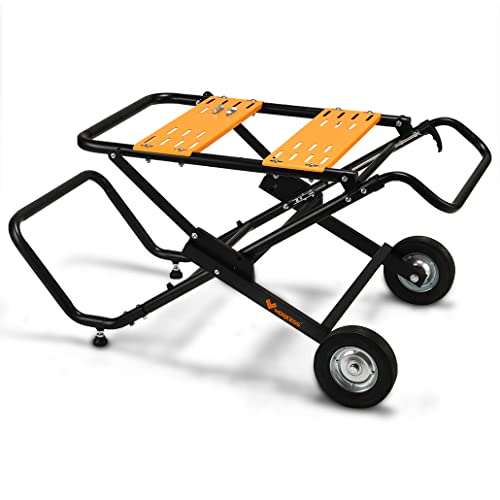
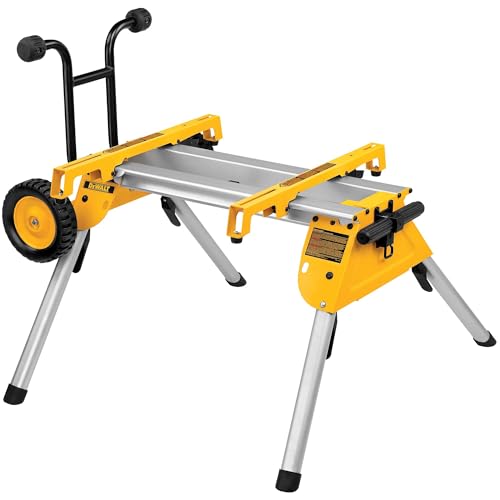
There are three common stand styles. The first is a rolling, fold-flat frame like the one bundled with the DWE7491RS, which opens into a base with large wheels. The second is the Bosch Gravity-Rise design, which raises the saw as you unfold the legs, so you do not have to lift the saw onto the frame. The third is a cart with small wheels, such as the one SawStop sells with the Jobsite Saw Pro, which is more garage friendly but less rugged on gravel or stairs.
When comparing stands, ask how the saw locks to the frame, how much the stand flexes when you push a long board, and whether the wheels cope with the surface you really work on. Reviewers who handle these saws frequently mention that a stand with larger wheels is easier outdoors, while smaller casters are fine on a flat shop floor.
Choosing by blade size and capacity
Ten-inch blades are the common standard and cut deeper, which matters for 2x lumber and thick hardwoods. The DWE7491RS and the Bosch both list around 3-1/8 in or more at 90 degrees, enough to cut through two layers of 3/4 in plywood or a doubled 2x board. An 8-1/4 in saw, such as the DWE7485 line, cuts less deep, and a reviewer noted it does not accept a dado stack, which rules it out for joinery-heavy projects.
Rip capacity to the right of the blade is the number that decides whether you can break down a sheet of plywood with the fence alone. At roughly 32 in, the DeWalt and Bosch handle a half sheet in a single pass. The SawStop Jobsite Saw Pro lists 25-1/2 in to the right, enough for most cabinet parts but not for ripping a full 48 in sheet down the middle without other tools. Smaller saws near 24-1/2 in sit in the same range as the SawStop.
Fence quality is the other deciding factor. Rack and pinion fences, listed on the DeWalt line, let you move the fence parallel with a knob and give a repeatable setting, which most reviewers regard as an important feature for accuracy. Compare how each fence locks at the rear, because a fence that clamps front and back stays square better when you push hard.
Safety features worth understanding
The SawStop Jobsite Saw Pro uses the maker’s flesh-detection brake system, which stops the blade on contact with skin. That technology is the main reason reviewers place the SawStop in its own category. It does not remove the need for a guard, a riving knife, push sticks, and careful technique, and the brake cartridge needs replacing after it fires, which the maker documents in its manual.
Every saw on this list should arrive with a blade guard, a riving knife and anti-kickback pawls. Do not remove these for convenience, and read the manual before cutting small parts or using the saw for non-through cuts. If you are unsure about wiring, circuit capacity or extension cord sizing for a 15 amp saw, a licensed electrician can advise. Running a high-draw motor on an undersized cord is a common cause of tripped breakers and motor strain.
Dust collection is another area where portable saws vary. Most offer a port for a shop vacuum, but a small-diameter port clogs quickly on ripping jobs. If you cut a lot of sheet goods indoors, consider a hose adapter and a vacuum with a cyclone separator.
Budget, mid-range and premium tiers
Budget tier
Budget saws, including the SKIL TS6307 named by reviewers, tend to offer a folding stand, a 10 in blade and a simpler fence. They suit occasional users who build a few shelves, deck parts or simple furniture. The trade-off is usually a less precise fence and a smaller table, so expect to spend extra time checking squareness before critical cuts.
Mid-range tier
The DeWalt DWE7485WS sits here for a user who wants lighter weight and an included stand, and the DWE7491RS and Bosch GTS15-10 sit at the higher end of this range. These saws combine reasonable fences, 15 amp motors and wheeled stands, and they are the pick when the saw is used weekly. Roundups from 2026 consistently place the DeWalt 10 in saw at or near the top of their lists.
Premium tier
The SawStop Jobsite Saw Pro is the premium option. Buyers pay for flesh-sensing technology, a sturdy cart and a build many reviewers describe as closer to a cabinet saw in feel than a lightweight jobsite saw. If children, new users, or crowded workshops are part of the picture, the added cost may be justified.
Pick the saw that suits your situation
| Pick this if you… | Choose | Why |
|---|---|---|
| Rip plywood sheets and want the longest fence travel | DeWalt DWE7491RS or Bosch GTS15-10 | Both list about 32 in rip capacity to the right |
| Must lift the saw into a truck or up steps alone | DeWalt DWE7485WS | Lighter 8-1/4 in design, stand in the box |
| Want to avoid lifting the saw onto its stand | Bosch GTS15-10 | Gravity-Rise stand raises the saw as it opens |
| Prioritise injury mitigation | SawStop Jobsite Saw Pro | Maker lists flesh-detection brake technology |
| Need a dado stack for joinery | A 10 in saw, or a model aimed at dado cuts such as the Evolution R10TS that a reviewer named | The compact DeWalt 8-1/4 in saw does not support dado, per a reviewer |
| Cut occasionally and watch spending | SKIL TS6307 | Budget option with a folding stand |
Alternatives worth considering
- Evolution R10TS: Named by a reviewer as a dado-capable option. Its multi-material blade appeals to people who cut plastics and metals alongside wood, but confirm blade availability before buying.
- Track saw plus guide rail: If your main task is breaking down sheet goods, a track saw is lighter and easier to store than any table saw, although it cannot rip narrow strips as quickly.
- Full contractor or hybrid saw: If the saw will stay in one shop, a contractor or hybrid saw offers larger tables and heavier fences, which improves accuracy. The trade-off is that it is not designed to travel.
Setup and care notes
Before first use, set the saw on a flat surface, lock the stand, and confirm the blade is parallel to the miter slot. Most manuals describe how to adjust trunnions or table inserts if it is off. Waxing the table with a paste wax makes stock slide more easily, and wiping pitch off the blade extends its working life.
Replace the stock blade if you plan to cut hardwoods or plywood frequently. Reviewers often point out that bundled blades are acceptable for rough work but leave a rougher edge than a quality 40-tooth or 50-tooth blade. Keep spare throat plates, because a worn plate lets small offcuts drop into the housing.
Store the saw out of damp areas. Surface rust on a cast or aluminum top is cosmetic, but rust on the fence rails can hinder motion. A light coat of dry lubricant on the rack and pinion keeps adjustments smooth.
Frequently Asked Questions
Is a portable table saw accurate enough for furniture?
Many hobbyists build furniture on jobsite saws, but precision depends on the fence, the blade and your setup routine. Take time to align the blade to the miter slot and the fence to the blade. If cuts must be exact every time, a heavier hybrid or cabinet saw generally holds settings better.
Do I need the manufacturer’s stand?
A stand is not mandatory, but it makes the saw safer and more comfortable to use. Some models, including the DWE7491RS and the Bosch GTS15-10, are sold with a stand, while others offer one as a separate part or a different variant. Using the stand the maker designed for the saw avoids fit problems.
Can these saws run on a household circuit?
The 15 amp saws listed here are designed for a standard 120 volt outlet, but they draw heavily at start-up. Avoid sharing the circuit with other large tools and use a heavy-gauge extension cord. If breakers trip often, ask a licensed electrician to review the circuit.
Which saw is easiest to move?
The compact DeWalt DWE7485 line is the lighter pick, with one source reporting about 54 lb for the saw. The 10 in models are heavier, with tool weights near 90 lb on the DeWalt and between 91 and 103 lb on the Bosch depending on the source. A rolling stand makes the heavier saws manageable on flat ground, though stairs remain awkward.
Is flesh-detection technology worth it?
That depends on who uses the saw and how often. The SawStop’s system is designed to stop the blade on skin contact, which reviewers consider a meaningful safeguard for beginners. It supplements, and does not replace, safe cutting habits, guards and push sticks.
Will a portable saw handle a dado stack?
Most 10 in saws accept a dado set, but always check the manual for maximum stack width and the correct insert. A reviewer reports that the compact DeWalt 8-1/4 in saw does not support dado blades. Never run a dado stack in a saw whose manual does not permit it.






Write Your Review
No reviews yet. Be the first to share your experience!