

Key takeaways
- Jointer: A jointer creates the flat reference face and an edge square to it. Many buyers pair a 6 in jointer with a 13 in planer for a complete setup.
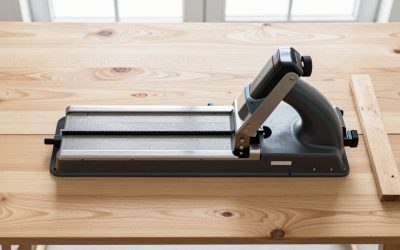
- Router planing sled: A cheaper way to flatten wide slabs that exceed planer width, although it is slow.
- Pre-surfaced lumber: If your projects use common dimensions, surfaced boards from a supplier may be enough, saving the cost of a machine and a dust system.
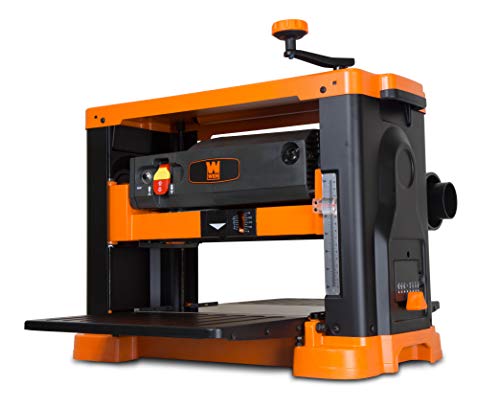
A thickness planer suits you if you buy rough or reclaimed lumber and want every part the same thickness, and the best fit depends mainly on board width and how much you plane: the DeWalt DW735X for frequent 13 in work, the Makita 2012NB for lighter use up to 12 in, the WEN PL1326 for a spiral head at a lower tier, and a stationary combination machine like the Jet JJP-12 for a permanent shop. This guide focuses on the features that decide the choice, because the same handful of names recur across reviewers.
Our top picks



As an Amazon Associate we earn from qualifying purchases at no extra cost to you.
Thickness planers at a glance
| Model | Best for | Key stated specs | Limits |
|---|---|---|---|
| DeWalt DW735X | Frequent planing, wide boards | 13 in width, 15 amp, 20,000 rpm motor, three knives, 96 or 179 cuts per inch, spare knives included | Heavier and noisier than lighter models |
| Makita 2012NB | Light to moderate use | 12 in width, 15 amp, 8,500 rpm, two knives, 83 dB, 61.9 lb, up to 6-3/32 in thickness | Depth of cut narrows to 3/64 in on boards from 9-1/2 in to 12 in wide |
| WEN PL1326 | Spiral head, lower tier | Reported spiral head with 26 HSS inserts, single feed speed | HSS inserts wear faster than carbide |
| Cutech 40800H | Spiral head, carbide, two speeds | Reported 26 carbide inserts, two-speed feed, return rollers | Limited independent coverage |
| Jet JJP-12 | Permanent shop wanting a planer and jointer in one | Maker lists 3 HP, 230 volt single phase, 12 in capacity, jointer table 55 in by 12 in, weight 500 lb | Needs space and 230 volt power; premium tier |
Understand what a thickness planer does
A thickness planer makes the top surface parallel to the bottom. It does not make either surface flat. If you feed a cupped board, the rollers flatten it temporarily and the cutter shaves the high spots, but once the board exits it springs back toward its former shape. The standard workflow therefore starts with a jointer or a sled to flatten one face, then uses the planer to bring the opposite face parallel and the board to final thickness.
For many hobbyists this is the most useful fact in the category. If you already own a jointer, almost any planer works. If you do not, either budget for a jointer later or learn the planer-sled technique, in which a flat carrier board supports the workpiece on shims while the planer cuts its top face.
Benchtop, portable and stationary
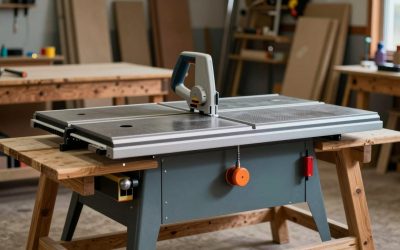
Benchtop and portable planers are the same class: compact, universal-motor machines in the 12 in to 13 in range that sit on a workbench or a stand. They are loud and hungry for power, but they fit most garages. Stationary planers, with induction motors, cast-iron tables and larger capacities, are quieter and handle heavy stock with less strain, yet they weigh far more and often need a 230 volt circuit.
Combination planer-jointers, such as the Jet JJP-12 line, sit between those worlds. The maker lists a 3 HP motor, a 12 in width, and a three-knife cutterhead, with a helical version offered as the JJP-12HH. They give you both operations on one footprint, which is attractive in a small shop that has power for it. The cost is size and weight, and every changeover between jointing and planing takes a few minutes.
Features that matter most
Cutterhead
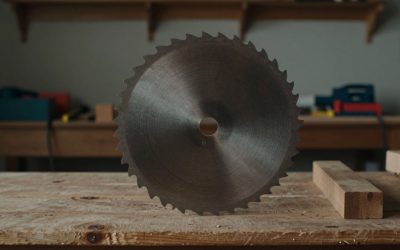
Straight knives, as on the DeWalt DW735X and Makita 2012NB, are easy and relatively cheap to replace. Spiral or helical heads, used on the WEN and Cutech models and the helical Jet version, tend to produce a quieter cut and reduce tear-out on figured wood, according to reviewers. They also let you rotate individual inserts.
Feed speed
Two-speed gearboxes give a rougher fast pass and a smoother finishing pass. The DW735X lists 96 or 179 cuts per inch. Single-speed planers such as the DW734 are simpler and cost less, but you lose the option.
Table support
Longer tables help control snipe. Reviewers note the DW734 offers about 33.5 in of material support with extra-long tables. Folding extension tables on other models serve the same purpose, but they also take up room.
Dust collection
Planers produce a large volume of chips. A model with a fan-assisted chip ejector, as on the DW735X, needs a vacuum or collector connected to a bin for a tidy shop. Check how the dust port fits your hose size before buying.
Depth and thickness limits
Check the maximum thickness the planer accepts and the minimum it can handle without a backer board. The Makita lists up to 6-3/32 in thick material. Short boards and very thin stock can jam, so read the manual for minimum length.
Budget, mid-range and premium tiers
At the budget tier sit the WEN PL1326 and Cutech spiral models. They offer spiral heads at a lower outlay, with trade-offs in feed speed and support. Mid-range includes the DeWalt DW734 and the Makita 2012NB, both valued by home woodworkers who plane occasionally. The premium benchtop tier belongs to the DW735X, and beyond it sit stationary and combination machines like the Jet JJP-12 line, which carry a much higher price and need dedicated floor space.
Match the planer to your work
| Pick this if you… | Choose | Why |
|---|---|---|
| Mill rough lumber weekly | DeWalt DW735X | Two speeds, 13 in capacity, spare knives |
| Plane a few boards a month | Makita 2012NB or DeWalt DW734 | Lighter duty, solid track record |
| Want a quieter spiral cut for figured wood | WEN PL1326 or Cutech 40800H | Spiral inserts |
| Have a permanent shop with 230 volt power | Jet JJP-12 or JJP-12HH | Planer and jointer in one machine |
| Cannot flatten a face yet | Plan for a jointer or sled | The planer does not remove cup |
Alternatives
- Jointer: A jointer creates the flat reference face and an edge square to it. Many buyers pair a 6 in jointer with a 13 in planer for a complete setup.
- Router planing sled: A cheaper way to flatten wide slabs that exceed planer width, although it is slow.
- Pre-surfaced lumber: If your projects use common dimensions, surfaced boards from a supplier may be enough, saving the cost of a machine and a dust system.
Safety and setup
Read the manual before first use. Disconnect power before changing cutters, keep hands away from the feed path, and never plane boards with embedded metal, cracks or loose knots. Stand to the side while feeding, as boards can kick back. Use eye, ear and respiratory protection, since planers generate noise levels in the range of 83 dB to 95 dB according to the figures reviewers and makers publish, as well as fine dust.
A planer needs a stable bench or stand, bolted down if the manual suggests it, and a clear path for long stock. Support boards at the infeed and outfeed with roller stands or tables set to the same height. For electrical questions, such as whether a 15 amp planer can share a circuit with a dust collector, ask a licensed electrician.
Common mistakes buyers make
The first mistake is expecting a planer to flatten warped stock, which it does not. The second is buying on width alone and ignoring the practical limits on depth of cut. Makita, for instance, publishes a stepped limit for the 2012NB: 1/8 in per pass up to 5-7/8 in wide, 1/16 in up to 9-1/2 in, and 3/64 in up to 12 in. That means a wide board needs many light passes, which affects how long a job takes.
The third mistake is leaving dust collection until later. Planers generate a heavy stream of chips, and the fan-assisted ejector on a machine like the DW735X still needs a bin or hose to catch them. The fourth is ignoring noise. Reviewers measure benchtop planers anywhere from the mid-80s to mid-90s dB at the operator, which is loud enough to call for hearing protection every time.
Maintenance in brief
Keep the bed waxed and the rollers clean of pitch so boards feed evenly. Rotate or replace inserts, or change knives, at the first sign of lines or burn marks. Unplug the machine before any adjustment, and store it somewhere dry because rust on the bed leaves marks on the boards. Following the maker’s lubrication schedule extends gear and screw life, and the warranty terms, such as the three years the maker lists for the DW735X, generally assume normal care.
Frequently Asked Questions
What size thickness planer should I buy?
Pick based on your widest typical board. A 12 in machine covers most furniture parts, while 13 in gives a little more headroom for glue-ups. Larger planers, 15 in and up, suit wide panels, but they are stationary machines.
Do I need a jointer as well?
If you start with rough lumber, yes, or an alternative like a planer sled. A planer on its own makes faces parallel, not flat. Buyers who purchase pre-surfaced boards can often skip the jointer.
Straight knives or spiral head?
Reviewers report that spiral heads run quieter and reduce tear-out, while straight knives are cheaper to replace and simpler to sharpen. For mostly softwoods and straight-grained hardwoods, straight knives are fine. For figured maple or cherry, a spiral head is attractive.
How do I avoid snipe?
Support long boards at both ends, keep the board moving, and use a light final pass. Carriage locks help, and feeding sacrificial boards before and after the workpiece can also reduce it.
Can I run a planer on a regular outlet?
The 15 amp benchtop models are designed for standard 120 volt outlets, but they draw a lot at start-up. Use a heavy-gauge cord and avoid sharing the circuit. Combination machines such as the Jet JJP-12 list 230 volt single phase, which most home outlets do not provide, so consult an electrician.
How often should I change the knives?
There is no fixed interval. Swap or rotate cutters when the surface shows lines, burning or fuzz that a light pass will not fix. Dirty or reclaimed wood shortens the interval considerably.



Write Your Review
No reviews yet. Be the first to share your experience!