

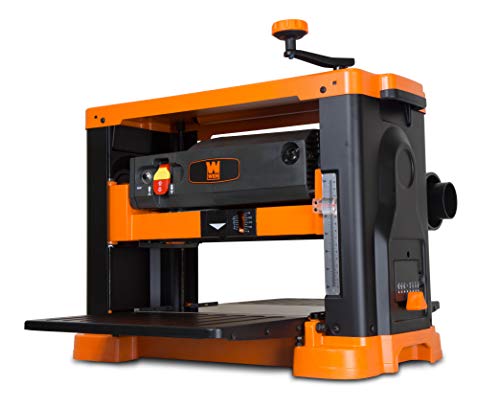
For most home shops the DeWalt DW735X is the benchtop planer to start with, the WEN PL1326 is the pick for buyers who want a spiral cutterhead at a lower tier, the DeWalt DW734 suits people who only plane boards up to about 12.5 in wide, and the Makita 2012NB suits those who want a lighter planer with a quiet motor. Details below separate what the makers state from what reviewers report, because roundup sites in this category are largely affiliate-driven and often repeat each other.
Our top picks



As an Amazon Associate we earn from qualifying purchases at no extra cost to you.
Benchtop planers at a glance
| Model | Best for | Key stated specs | Limits |
|---|---|---|---|
| DeWalt DW735X | All-round home and small-pro shops | 13 in width, 15 amp, 20,000 rpm motor, 10,000 rpm cutter head, three knives, two feed speeds of 96 or 179 cuts per inch, extra knife set included | Loud, as reviewers point out, and the planer is on the heavier side |
| DeWalt DW734 | Boards up to 12.5 in wide | Reported 12.5 in capacity, extra-long tables giving about 33.5 in of support, four-column carriage lock, single speed near 96 cuts per inch | Sources disagree on knife count; one feed speed |
| WEN PL1326 | Spiral head on a tighter budget | Spiral cutterhead reported to carry 26 staggered HSS inserts, single feed speed, reported near 85 dB at the operator versus about 95 dB on the DW735X | HSS inserts, not carbide; one speed |
| Cutech 40800H | Spiral head with two speeds | Reported spiral head with 26 carbide inserts, two-speed feed, board return rollers | Less independent coverage than DeWalt or WEN |
| Makita 2012NB | Lighter, quieter straight-knife planer | 12 in width, 15 amp, 8,500 rpm, two knives, 83 dB listed, net weight listed at 61.9 lb, cuts up to 6-3/32 in thick | Shallow cut for wide boards: 3/64 in from 9-1/2 in to 12 in wide |
How a benchtop planer works and why it matters
A benchtop planer feeds a board through rollers while a rotating cutterhead removes thin layers from the top face. The result is a board of consistent thickness, and the flat result depends on the board starting flat on its underside. A planer does not flatten a twisted board on its own; that task belongs to a jointer or a planer sled. Many beginners buy a planer expecting it to fix cupped stock, then discover that the board follows its original shape through the machine.
That limitation is worth knowing before you spend money. If you buy rough lumber, you will eventually need a flat reference face, which you can produce with a jointer, a router sled, or a sled used with the planer. If you buy lumber that is already surfaced on two sides, a benchtop planer is mainly for dimensioning, removing saw marks from reclaimed boards and matching thickness across parts.
Straight knives versus spiral cutterheads
The big dividing line among benchtop planers is the cutterhead. The DeWalt DW735X uses a three-knife head with an extra set of knives included. Knives are inexpensive to replace and sharpen, but they dull faster in hard or dirty wood, and a nick in a knife can leave a line along the board.
Spiral heads, used on the WEN PL1326 and Cutech models, use small square inserts arranged in a staggered pattern. Reviewers commonly report a quieter cut and less tear-out on figured grain, since each insert slices at an angle. If one insert chips, you rotate or replace it instead of changing a whole knife. The trade-off is that inserts cost more per set than straight knives, and HSS inserts on budget spiral heads wear faster than carbide.
Noise is the second consideration. One reviewer measured roughly 85 dB at the operator position on the WEN against about 95 dB on the DW735X. These are a single outlet’s figures, and noise depends on room acoustics and wood, but the pattern matches general expectations: spiral heads tend to run quieter. Hearing protection is advisable with any planer.
Feed speed, snipe and dust
The DW735X is notable for its two-speed gearbox, 96 or 179 cuts per inch according to the maker. The slower speed gives a smoother finish, while the faster one removes material efficiently on rough boards. Single-speed planers such as the DW734 and the WEN force you to choose one compromise.
Snipe, a slight dip at the start or end of a board, affects nearly every benchtop planer. Reviewers report that the DW735 line uses an automatic carriage lock to reduce it, and the DW734 uses a four-column lock for the same reason. Feeding a sacrificial board before and after your workpiece, supporting long boards at both ends, and avoiding a heavy last pass further limit snipe.
Dust and chips are the other practical issue. The DW735X carries a fan-assisted chip ejection system, and reviewers who own it generally attach a shop vacuum or dust collector to improve results. Planers throw out a large volume of shavings, so a bin or a collector with a high-volume hose is a better match than a small vacuum.
Width and depth of cut
Thirteen inches is the benchmark for benchtop planers, set by the DW735X. If you work with wide panels or glue-ups, a 13 in capacity can save time compared with 12 in machines. If you rarely plane anything wider than a standard 1×10, 12 in is plenty.
Depth of cut per pass is where lighter planers differ. Makita publishes a stepped limit for the 2012NB: up to 1/8 in for boards 5-7/8 in wide or less, 1/16 in between 5-7/8 in and 9-1/2 in, and 3/64 in from 9-1/2 in to 12 in. Light passes protect the motor, but they require more passes on rough stock. Read the manual of the planer you choose for its own limits.
Tiers by budget
Budget tier
The WEN PL1326 and Cutech spiral models fall into this tier. Reviewers describe the WEN as delivering most of the DW735X’s results at a much lower outlay, with a smooth finish and lower noise. Compromises are one feed speed and HSS inserts. Build quality and customer service differ between brands, so read the warranty terms before purchasing.
Mid-range tier
The DeWalt DW734 and the Makita 2012NB sit here. Both have a solid reputation among home woodworkers, with the DW734 offering long tables and the Makita offering lower weight and a quieter motor.
Premium tier
The DW735X is the benchtop reference. It costs more than the DW734 and the budget spiral models, but it brings two speeds, a three-knife head, a spare knife set and a three-year limited warranty according to the maker. For a shop that will plane regularly, that package is why it appears at the top of most lists.
Pick the planer that matches your work
| Pick this if you… | Choose | Why |
|---|---|---|
| Plane often and want the benchmark machine | DeWalt DW735X | Two feed speeds, 13 in width, extra knives, three-year warranty |
| Want a spiral head without a premium spend | WEN PL1326 | Spiral head and lower reported noise |
| Prefer carbide inserts and two speeds | Cutech 40800H | Reported carbide inserts and two-speed feed |
| Rarely plane boards wider than about 12 in | DeWalt DW734 | Long tables and carriage lock |
| Want lower weight and quieter running | Makita 2012NB | Lighter at 61.9 lb with an 83 dB rating |
| Need a flat face first | A jointer or a planer sled | A planer follows the board’s shape |
Alternatives worth considering
- Planer-jointer combination machine: Machines such as the Jet JJP-12 pair a 12 in planer with a jointer, with the maker listing a 3 HP motor and a weight of about 500 lb. They suit permanent shops with 230 volt power, not benchtop buyers.
- Drum sander: Sands boards to thickness with less tear-out risk, although it removes material slowly.
- Buy surfaced lumber: If you rarely need custom thickness, surfaced stock from a lumber yard avoids the investment.
Care and safety notes
Unplug the planer before changing knives or inserts. Keep hands clear of the infeed and outfeed, never feed boards with metal, nails or loose knots, and stand to the side when a board is feeding in case of kickback. Wear eye and hearing protection and a dust mask, since planing produces a lot of fine dust as well as chips.
Maintenance is simple. Clean pitch off the rollers and bed with a solvent recommended in the manual, wax the bed, and rotate or replace inserts as they dull. Dull knives lead to burning, tear-out and strain on the motor.
Frequently Asked Questions
Can a benchtop planer flatten a warped board?
Not by itself. The feed rollers press the board flat as it passes, and it springs back afterward, so the same bow can remain. A jointer or a sled for the planer is used to create one flat face first.
Is a spiral head worth the extra expense?
Reviewers often report a quieter cut and less tear-out in figured wood. The benefit is largest if you plane maple, cherry or curly stock. For straight-grained pine and poplar, a straight-knife head works well and costs less to maintain.
How much wood can I remove per pass?
The maker’s limits vary by machine and board width. Makita, for example, lists 1/8 in at narrow widths and much less at wider widths for the 2012NB. Light passes give better surfaces and put less strain on the motor.
Why does my planer leave snipe?
Snipe occurs when the board is only held by one set of rollers or when the carriage shifts as the board enters or exits. Support long boards at both ends, feed boards end to end, and take a light final pass. Carriage locks, found on the DeWalt models, help reduce it.
Do I need a dust collector?
A planer creates more chips than a typical shop vacuum can handle. A dust collector or a vacuum with a cyclone separator is a practical match. Without one, chips can clog the outlet and hinder performance.
How long do planer knives last?
Life depends on wood species, grit in the lumber and how much you plane. Reclaimed lumber dulls knives quickly. Replace or rotate cutters as soon as you see lines or burning on the board.



Write Your Review
No reviews yet. Be the first to share your experience!