

Key takeaways
- Bolt it down. Mount the jointer to a sturdy bench or a dedicated stand so it does not walk.
- Add infeed and outfeed support. A roller stand or a table at matching height keeps long boards from tipping.
- Square the fence. Check it against the table with a reliable square, and recheck after moving the machine.
- Set the outfeed table. It must be level with the cutting circle. Too low causes snipe, too high causes a taper.
- Take light passes. Shallow cuts reduce strain and tear-out on a light machine.
- Connect dust collection. Jointers make a lot of chips, and a clogged port harms results.
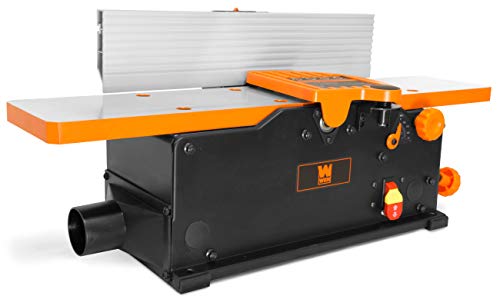
For a small shop, the Cutech 40160H-CT is the benchtop jointer reviewers most often name for a tight space and budget, the Grizzly G0945 is a 6 in alternative with a published table size, the Grizzly G0947 suits buyers who want 8 in capacity at benchtop scale, and a floor-standing model like the Jet JJ-6CSX is the pick if you regularly joint long boards. This guide compares those machines, with the main caveat that benchtop jointers trade bed length and fence stiffness for size.
Our top picks


As an Amazon Associate we earn from qualifying purchases at no extra cost to you.
Benchtop jointers at a glance
| Model | Best for | Key stated specs | Limits |
|---|---|---|---|
| Cutech 40160H-CT | Small shops, short stock | Reported 6 in capacity, spiral cutterhead with double-sided inserts, about 40 lb, aluminum fence | Sources disagree on insert count and motor amperage; light enough to shift in use |
| Grizzly G0945 | 6 in benchtop buyers | Retail listing: 6 in capacity, 6-1/4 in by 30 in table, 10 amp | Short 30 in table |
| Grizzly G0946 | 6 in benchtop alternative | Listed as a 6 in model in the same line | Fewer details found in the sources reviewed |
| Grizzly G0947 | 8 in width at benchtop scale | Retail listing: 8 in width, 8-3/4 in by 34 in table, six-row spiral-type cutterhead | Table still short for its width |
| Jet JJ-6CSX (floor model, for comparison) | Longer boards | Manual lists 1 HP, 7 in by 46 in table, 6-1/16 in by 1/2 in capacity | Needs floor space; not portable |
What you give up with a benchtop jointer
The main trade-off is bed length. A floor-standing jointer such as the Jet JJ-6CSX lists a 46 in table, and the Powermatic 54HH is reported at 66 in. Benchtop jointers shrink that to around 30 in on the Grizzly G0945 and 34 in on the G0947. A short bed means the board can rock on the infeed or outfeed table, so long boards are harder to flatten. For stock up to roughly two or three feet, a benchtop jointer works well; for longer boards, expect to add support stands or consider another approach.
Weight is the second trade-off. The Cutech 40160H-CT is reported at roughly 40 lb, which makes it easy to store but easy to move under load, so reviewers advise bolting it to a bench. Lighter fences are the third. An aluminum fence can flex when you press a heavy board against it, and reviewers suggest checking squareness frequently.
Cutterhead choices
Benchtop jointers have moved toward spiral or helical-style cutterheads. The Cutech uses a spiral head with double-sided inserts per reviewers, though reports of insert count differ, from 12 to 40 depending on the outlet, and motor ratings also vary. Those are reasons to read the maker’s sheet for the unit you buy. Grizzly’s G0947 lists a six-row spiral-type cutterhead.
The practical benefits of a spiral head are less tear-out on figured wood and lower noise. Inserts can be rotated when a corner chips. The downside is the cost of replacement inserts relative to straight knives, and, in some budget models, inserts made from high-speed steel instead of carbide that dull faster.
Setup that makes a small jointer behave
- Bolt it down. Mount the jointer to a sturdy bench or a dedicated stand so it does not walk.
- Add infeed and outfeed support. A roller stand or a table at matching height keeps long boards from tipping.
- Square the fence. Check it against the table with a reliable square, and recheck after moving the machine.
- Set the outfeed table. It must be level with the cutting circle. Too low causes snipe, too high causes a taper.
- Take light passes. Shallow cuts reduce strain and tear-out on a light machine.
- Connect dust collection. Jointers make a lot of chips, and a clogged port harms results.
Budget, mid-range and premium considerations
The Cutech 40160H-CT and the Grizzly 6 in benchtop models fall in the budget tier. The Grizzly G0947 sits in the mid-range because of its extra width. Beyond benchtop scale, the Jet JJ-6CSX and JJ-6CSDX are mid-range floor machines, and the Powermatic 54HH is a premium option, reported at 1 HP with a helical head, a five-year warranty and a weight near 330 lb. The latter is not a benchtop tool.
Think about how much stock you really joint. If you flatten faces on short parts and edge-joint for glue-ups, a benchtop jointer may be all you need. If you buy rough boards of four feet or more, a floor model usually saves frustration.
Pick the benchtop jointer that fits
| Pick this if you… | Choose | Why |
|---|---|---|
| Have very little space and a tight budget | Cutech 40160H-CT | Light, spiral head, 6 in capacity |
| Want published table dimensions at a lower tier | Grizzly G0945 | 6-1/4 in by 30 in table |
| Need more width for wider boards | Grizzly G0947 | 8 in capacity |
| Joint boards over three feet | Jet JJ-6CSX or JJ-6CSDX | 46 in and 56 in tables |
| Want to avoid a jointer entirely | Planer sled | Flattens a face using a thickness planer |
Alternatives
- Planer sled: Holds a board on shims so a thickness planer can flatten the top, a common pairing with a benchtop planer.
- Router sled: Flattens slabs too wide for any jointer.
- Combination planer-jointer: Machines such as the Jet JJP-12 provide both functions, with the maker listing a 3 HP motor, 230 volt power, a 55 in jointer table and a weight of 500 lb. These suit permanent shops.
- Hand planes: Slow but quiet and compact for small projects.
Safety
Keep the guard in place, use push blocks, and never pass hands over the cutterhead. Do not joint boards shorter than the manual allows. Wear eye, ear and dust protection. Unplug before changing inserts or knives. If you need to add a circuit for a larger machine, contact a licensed electrician.
How to read spec sheets and reviews for small jointers
Benchtop jointer listings emphasise cutting width and motor amperage, but several other numbers decide how the machine behaves. Table length comes first, because it sets the longest board you can handle without extra support. Next is fence length and how far it tilts, since a short fence makes it harder to hold a board square. Then comes depth-of-cut adjustment: a smooth lever or knob with a clear scale makes light, repeatable passes far easier than a stiff mechanism.
Treat review claims with some caution. The category is crowded with roundup pages that copy each other, and the Cutech disagreement over insert counts and motor ratings shows how a single detail can drift between outlets. Where possible, cross-check a claim against the maker’s manual, which normally lists table size, cutting capacity and cutterhead speed. The Jet JJ-6CSX manual, for example, lists a 7 in by 46 in table and a 4,800 rpm cutterhead, and the long-bed JJ-6CSDX lists a 6,000 rpm cutterhead.
Pairing a small jointer with the rest of the shop
A benchtop jointer rarely works alone. The usual sequence is face-joint one side, edge-joint an adjacent side, plane the opposite face to thickness, and rip to width on a table saw. If you already own a benchtop thickness planer, a small jointer rounds out the process for modest-size projects such as boxes, small tables and cutting boards. If you do not, think about whether a planer sled would meet the need before spending on a second machine.
Plan the footprint as well. Benchtop jointers produce a stream of chips from the side, so leave room for a hose and a collection bin. Stand the machine at a height where you can push a board with your whole body, not just your arms, and keep the floor clear of offcuts. A rubber mat helps with both comfort and footing.
Finally, keep expectations realistic. Reviewers who like these machines describe them as capable for short stock and a good way into the craft, and those who struggle usually try long boards on short beds. Matching the machine to the work is the single most useful step in this category.
Frequently Asked Questions
Is a benchtop jointer accurate enough?
For short stock, many hobbyists get good results after careful setup. Accuracy depends on flat tables, a square fence and a properly set outfeed table. Light machines need to be anchored to avoid movement.
What is the longest board I can joint on a benchtop machine?
There is no fixed rule. Table lengths of around 30 to 34 in suit boards up to a couple of feet comfortably. Longer boards need outfeed support and practice, and a longer-bed machine is easier.
Why do reviewers disagree on specs for the Cutech?
Different outlets list different insert counts and motor ratings, probably because of model variants and repeated copying. Read the maker’s sheet for your unit.
Should I choose 6 in or 8 in?
Six inches suits most face and edge work. Eight inches helps with wider boards but still has a short table on the Grizzly benchtop model. If you rarely face-joint wide boards, 6 in is enough.
Do I still need a thickness planer?
Yes, for boards that must be an even thickness. The jointer flattens one face and an edge, and the planer then makes the opposite face parallel.
How do I stop snipe on a jointer?
Set the outfeed table level with the knives or inserts, keep even pressure through the pass and keep the board moving. Re-set the table if you see a dip at one end.


Write Your Review
No reviews yet. Be the first to share your experience!