

For a table saw, a true dust collector in the one to two horsepower class is the usual answer for a permanent shop, while a shop vacuum fitted with a cyclone separator is the practical choice for a small garage or a jobsite saw. Festool-style extractors are excellent for sanders and track saws but are generally not matched to a table saw’s airflow needs. This guide explains the choice by shop size, lists the machines reviewers mention most, and covers the hookup details that decide whether a collector works on your saw.
Our top picks


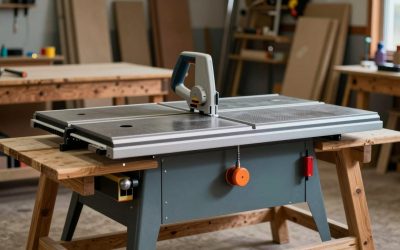
 SKIL 15 Amp 10-Inch Jobsite Table Saw
- Ensures fence stays parallel to blade for fast…
- Legs quickly fold in to provide portability and…
- Available micro-adjustment of blade so that it is…
As an Amazon Associate we earn from qualifying purchases at no extra cost to you.
Why Table Saws Are Hard to Collect From
A table saw throws dust in two places: a plume that rises above the table and a heap that falls into the cabinet below. Capturing both takes airflow at the cabinet port and, ideally, at a blade-guard pickup above the table. One guide notes that dust collectors move high volume at low pressure, usually through four-inch ducting, which is why they suit large chip-makers such as table saws, planers and jointers. Shop vacuums do the reverse: high suction through a small hose, which suits sanders and routers.
At a Glance: Collectors and Separators Compared
| Option | Type | Key stated specs | Best for | Limits |
|---|---|---|---|---|
| Oneida Dust Deputy | Cyclone separator for a vacuum | The maker and reviewers cite roughly 99 to 99.9 percent separation before the vacuum filter | Small shops on a budget | Still limited by the vacuum’s small hose |
| DeWalt separator with 6 gallon tank | Cyclone separator and tank | Family Handyman cites 99.5 percent efficiency and inlet sizes of 1-7/8 and 2-1/2 inches | Contractors with an existing vacuum | Needs a separate shop vacuum |
| Ridgid 16 gallon wet/dry vacuum | Shop vacuum | Listed with a pleated cartridge, upgradeable to HEPA | Cleanup and cabinet-port capture | Filtration is the weak point per reviewers |
| Shop Fox W1826 | Wall-mount 1 HP collector | Listed with a 2.5-micron bag and about 85 dB | Compact garage shops | Dust clings to the bag; hard to empty |
| Powertec wall-mount | 1 HP collector | Listed at 560 CFM, 4-inch inlet, 1-micron cartridge, dual voltage | Small shops with one stationary tool at a time | Loud; bag installation is fiddly |
| WEN DC1300 | Hobby collector | One guide lists 1,300 CFM and dual inlets | Hobbyists | Check the filter grade on the data sheet |
| Grizzly 2 HP canister | Canister collector | Listed at 1,700 CFM, 4-inch inlets for up to 3 lines, 1-micron canister | Shops with several machines | Needs a 240V circuit |
| JET JCDC-1.5 and DC-1100VX | 1 to 1.5 HP collectors | The DC-1100VX is listed at 1,100 CFM, 1.5 HP, 2-micron filtration and a 6-inch inlet | Larger shops | Premium tier; needs floor space |
Specifications come from the makers and roundup reviewers, and they vary between versions. Read the current data sheet for the voltage, filter rating and hose size before ordering.
Shop Vacuum Plus Cyclone: The Budget Route
For a one-person garage shop, a quality shop vacuum with an Oneida Dust Deputy on top is the setup most guides call the smart-money option. The cyclone spins most of the chips and dust into a bucket, so the vacuum’s filter stays clean and suction does not fade. One roundup describes it as the best budget upgrade. The limits are physical: a 2.5-inch hose and the vacuum’s modest airflow can handle a cabinet port but will not clear the cloud above a blade as well as a four-inch system.
The VacMaster 5 gallon is listed at 102 CFM and about 15 pounds, a reminder that portable vacuums are designed for pressure, not volume. If you go this route, plug the cabinet’s gaps, keep the hose short and empty the bucket before it fills.
Dedicated Collectors: One Horsepower to Two
A single-stage collector with a four-inch hose is better matched to a cabinet saw’s dust port. The Powertec and Shop Fox wall-mount models take little floor space, which suits a garage. The WEN DC1300 is a common hobbyist pick. A canister model such as the Grizzly 2 HP, listed with a larger filter area and multiple four-inch connections, suits a shop where a planer and a jointer share the same machine.
The JET range sits at the premium end. The DC-1100VX is listed with a six-inch inlet, and the JCDC-1.5 is recommended in one roundup for larger shops running several stationary machines. Bigger inlets matter when you run long ducting, because every bend and metre of hose costs airflow.
Why Festool-Style Extractors Are the Wrong Tool Here
The Festool CT 15 won an editor’s choice at one site, with HEPA certification, and it is an excellent match for sanders, routers and track saws. A reviewer cautions against running a table saw or planer on the CT Midi. It is listed at around 130 CFM with a 1.25-inch hose that will not fit a four-inch port without an adapter, and it does not move enough air. If fine-dust health is your main worry, a HEPA extractor for sanding plus a collector for the saw is the common two-machine answer.
Fit and Hookup Notes
- Port size: Most cabinet saws use a four-inch port; contractor saws often have a smaller opening or none. Check your manual and the collector’s inlet.
- Hose length: Keep flexible hose short and smooth-walled. Long, ribbed hose steals airflow.
- Voltage: Larger canister models need a 240V circuit. Have a qualified electrician install any new circuit rather than improvising.
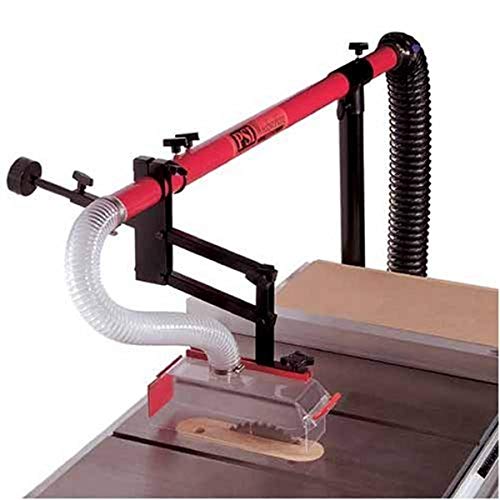
- Blade guard pickup: An overhead guard with a dust port catches the plume that cabinet extraction misses.
- Noise: Collector motors are loud. Wear hearing protection, and note that the Shop Fox is listed near 85 dB.
- Filter care: Clean or tap out cartridges regularly. A clogged filter looks like a weak motor.
Cartridge, Bag or Canister Filters
Filter style affects both air quality and upkeep. Bag filters are the cheapest, but fine dust passes through a coarse bag and the bag clings to dust, as reviewers note for the Shop Fox. Cartridge and canister filters, such as the one-micron units listed for the Powertec and Grizzly, have more surface area and catch finer particles. They also need regular cleaning, either by tapping or brushing. A canister with a built-in cleaning brush, as listed on the Grizzly, saves effort.
Pick X If …
| If you … | Pick |
|---|---|
| Have a small garage and a tight budget | Shop vacuum plus Dust Deputy or DeWalt separator |
| Want a compact collector for one saw | Powertec or Shop Fox wall-mount |
| Want a hobbyist all-rounder | WEN DC1300 class |
| Run several machines with ducting | Grizzly 2 HP canister or JET JCDC-1.5 |
| Mostly sand and use track saws | A HEPA extractor such as the Festool CT 15 |
Budget Tiers
At the budget tier, a vacuum with a cyclone is the sensible start. In the mid-range, a one-horsepower wall-mount or hobbyist collector with a four-inch inlet handles a single saw. At the premium tier, 1.5 to 2 horsepower collectors with fine filtration and larger inlets support ducting to multiple machines, and add the need for a dedicated circuit.
Setting Up for Better Capture
Even a strong collector underperforms when the saw leaks air in the wrong places. Seal the gaps around the motor opening and the back of the cabinet, and close any open slots at the base so that air is pulled through the blade area rather than around it. Many saws ship with a small round port that is smaller than the four-inch hose; a tapered adapter helps, but the narrowest point still limits airflow, so some owners enlarge the factory port within the maker’s guidance. Place the hose so it does not kink as the blade tilts, and leave enough slack for the saw’s full travel.
For mixed-use shops, a blast gate at each machine lets one collector serve several tools without losing suction at the one you are using. Smooth metal or rigid plastic ducting loses less airflow than flexible hose, so keep the flexible section only for the last stretch to the machine.
Alternatives
- Air filtration unit: Hangs from the ceiling and cleans fine airborne dust that escapes capture.
- Dust-collecting blade guard: Improves capture above the table for any setup.
- Respirator: A well-fitted mask rated for fine dust is a sensible backup. Consult the product’s instructions, and talk to a doctor if you have breathing concerns.
Frequently Asked Questions
Can a shop vacuum handle a table saw?
It can capture the cabinet heap when paired with a cyclone, but its small hose limits airflow above the table. Many woodworkers use a vacuum for the saw only when space or budget rules out a collector.
How much airflow does a table saw need?
Makers and guides vary, and your saw’s manual is the best reference. In general, a collector with a four-inch inlet and several hundred CFM or more is the typical match for a cabinet saw.
Is a cyclone separator worth adding?
Reviewers say it keeps the vacuum filter clean and maintains suction, which cuts running costs. It adds a bucket to empty and a little bulk to move around.
Do I need a HEPA filter?
Fine wood dust is a respiratory concern, so a fine filter helps. If you have health concerns, speak to a doctor and follow your tool and filter manuals.
Can I use my collector with a jobsite saw?
Often yes, through an adapter, but jobsite saws capture dust poorly because the base is open. Expect partial results and keep a respirator handy.
Do I need a new electrical circuit?
Larger collectors may need 240V. Ask a licensed electrician to assess your panel and install any circuit, and follow the maker’s wiring requirements.



Write Your Review
No reviews yet. Be the first to share your experience!