

Key takeaways
- Budget: corded saws from value brands cost the least, and you can sometimes find a bare-tool compact saw. Expect heavier bodies, less refined guides and a shorter warranty.
- Mid-range: the corded DEWALT DWM120K and bare-tool cordless saws if you already own batteries.
- Premium: cordless deep-cut saws with a battery and charger kit. Most of the cost is the battery platform, so the total is lower if you already own it.
For most people cutting pipe, conduit, angle iron and strut away from a bench, a cordless deep-cut portable band saw such as the Milwaukee M18 FUEL Deep Cut (2729-20) or the DEWALT DCS374B is the practical choice, the corded DEWALT DWM120K suits a shop that wants unlimited runtime and variable speed, and the Milwaukee M12 FUEL Compact (2529-20) suits tight spaces and one-handed work on small stock. Which one fits depends mostly on two things: how thick the material is and which battery platform you already own.
Our top picks
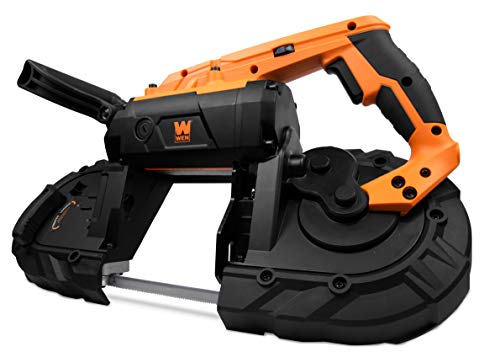
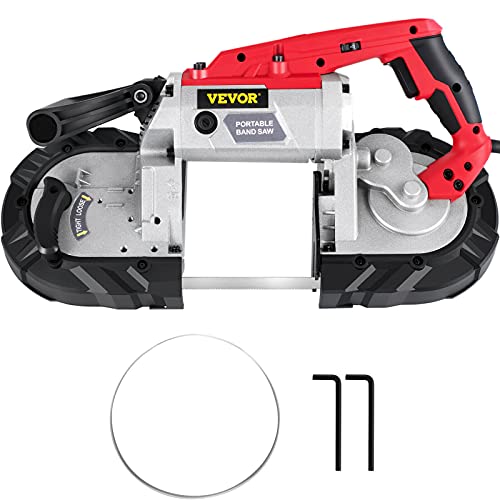
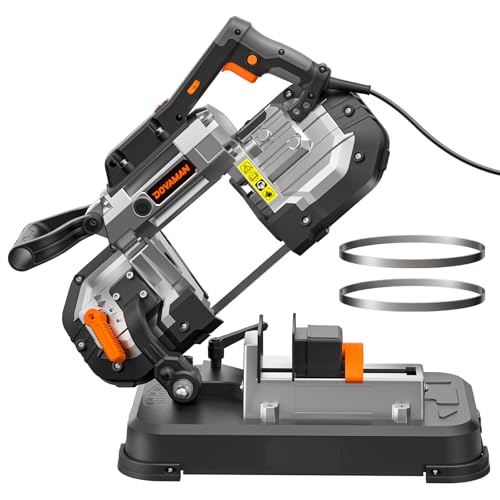

As an Amazon Associate we earn from qualifying purchases at no extra cost to you.
What a portable band saw does well
A portable band saw is a hand-held saw with a continuous blade that runs around two wheels. The blade cuts in one direction, so the saw produces a cleaner, cooler and quieter cut in metal than an abrasive chop saw, and with far fewer sparks. It is the standard tool for cutting threaded rod, tubing, conduit, angle, channel and strut on jobsites, and for rough-cutting stock in a home shop. Hand-held saws are not a replacement for a stationary saw when you need repeatable square cuts in large stock, but they go where the work is.
At a glance
| Model | Power | Stated capacity | Speed | Notes |
|---|---|---|---|---|
| Milwaukee M18 FUEL Deep Cut 2729-20 | M18 battery, brushless | 5 in by 5 in in one pass, per the maker | About 550 SFPM per a roundup | Constant Power Technology, tool-free shoe, LED light, hang hook; battery and charger sold separately |
| Milwaukee M18 FUEL 2929-20 (newer) | M18 battery | 5 in by 5 in per one outlet | Not confirmed | Described as the newest deep-cut model; includes a blade-stopping brake per a roundup |
| DEWALT DCS374B | 20V MAX XR battery, brushless | Up to 5 in by 4-3/4 in rectangular, 4 in round | 490 sfpm, variable dial | 44-7/8 in blade, tool-free blade change, LED light, hang hook, 3-year limited warranty |
| DEWALT DWM120K | Corded, 10 amp | 5 in by 4-3/4 in rectangular, 5 in round per retailers | 100 to 350 FPM per most listings | About 15 lb, kit case, LED sight light, replaceable brushes |
| Milwaukee M12 FUEL Compact 2529-20 | M12 battery, brushless | 2-1/2 in by 2-1/2 in | Up to 570 SFPM | About 6 lb, one-handed design, 30-9/16 in blade, 5-year warranty per retailers |
The Milwaukee and DEWALT specifications come from the makers’ product pages, with the corded DEWALT and M12 details taken from retailer listings that sometimes conflict. Roundup sites that repeat claims such as runtime per charge are often affiliate-driven, so treat those numbers as claims, not benchmarks.
The picks
Milwaukee M18 FUEL Deep Cut (2729-20): best cordless all-rounder
Most 2026 roundups name a Milwaukee deep-cut saw as their top cordless pick. The maker lists a 5 in by 5 in capacity in a single pass, a POWERSTATE brushless motor, Constant Power Technology to hold speed under load, an all-metal direct drive that shares most parts with its corded saw, a tool-free adjustable shoe, a dual-actuation trigger, an LED light and a hang hook. An adjustable shoe lets it cut material larger than 5 inches. One roundup says the older 2729-20 is a cheaper choice than the newer 2929-20 and uses the same M18 batteries. Because it is sold as a bare tool in some listings, the battery and charger may need to be bought separately.
DEWALT DCS374B: best for a 20V MAX owner
The maker lists a capacity of up to 5 in by 4-3/4 in rectangular stock and 4 in round, a 490 sfpm variable-speed dial, a 44-7/8 in blade, a tool-free blade change lever and an LED light with a short delay. It comes with a 3-year limited warranty, a 1-year free service period and a 90-day satisfaction guarantee. The battery and charger are sold separately. Roundups position it as the usual cordless rival to the Milwaukee.
DEWALT DWM120K: best corded and variable speed
Retailer listings describe a 10 amp saw with 100 to 350 FPM variable speed, a 5 in by 4-3/4 in rectangular capacity, a weight around 15 lb, a steel shroud with rubber bumpers, blade tracking adjustment, dual-bearing blade guides and externally replaceable brushes. Slower speeds suit stainless and thicker walls; faster speeds suit aluminum, conduit and mild steel. A corded saw means no battery cost or runtime limit, but you need an outlet and an extension cord rated for the amperage.
Milwaukee M12 FUEL Compact (2529-20): best for tight spaces
At about 6 lb, this saw is designed for one-handed use and overhead or in-the-wall work. It has a 2-1/2 in by 2-1/2 in capacity, up to 570 SFPM, a variable-speed trigger, a rafter hook and a work light, and it uses M12 batteries. It cuts small tubing, conduit, threaded rod and strut well, but it is not made for 4 in or 5 in stock.
Budget tiers
- Budget: corded saws from value brands cost the least, and you can sometimes find a bare-tool compact saw. Expect heavier bodies, less refined guides and a shorter warranty.
- Mid-range: the corded DEWALT DWM120K and bare-tool cordless saws if you already own batteries.
- Premium: cordless deep-cut saws with a battery and charger kit. Most of the cost is the battery platform, so the total is lower if you already own it.
What to look for
- Capacity: compare the throat depth and the maximum height, not only the headline number. A 5 in by 5 in saw cuts a 4 in pipe with room to spare, while a compact saw does not.
- Speed control: a variable dial or trigger lets you slow the blade for stainless or thick stock. Constant-power electronics keep the speed steady under load.
- Weight and balance: a 13 to 15 lb saw is tiring overhead. Look at handle placement and the hang hook.
- Blade changes: tool-free blade release saves time. The DEWALT lists one.
- Battery platform: if you already own Milwaukee M18 or DEWALT 20V MAX batteries, the bare tool is the better deal.
- Warranty: compare terms on the maker’s page; they vary from 3 years to 5 years.
Blades, cutting fluid and technique
Choose the blade for the wall thickness. A rule of thumb printed on many blade packages is to keep at least two or three teeth in the work at all times: use finer pitches such as 14 to 18 teeth per inch for thin wall tube and conduit, and coarser pitches for solid bar. Use cutting wax or oil on steel, and let the blade do the work. Do not force the saw, because overfeeding dulls the blade and can break it. Secure the work in a vise or clamp before cutting.
Safety notes
Wear safety glasses, hearing protection and gloves suited to handling sharp swarf. Clamp the work so the saw does not drag it. Keep the cord or battery away from the blade path, remove the battery before changing blades, and let hot chips cool before handling. Do not cut materials the manual excludes. For work on live electrical conduit, always have the circuit de-energized and consult a licensed electrician.
Pick X if…
| If you… | Pick |
|---|---|
| Own M18 batteries and cut pipe, strut or angle often | Milwaukee M18 FUEL Deep Cut |
| Own DEWALT 20V MAX batteries | DEWALT DCS374B |
| Work in a shop with an outlet and want variable speed | DEWALT DWM120K |
| Do overhead or in-wall electrical and plumbing work | Milwaukee M12 FUEL Compact |
| Need repeatable square cuts in 6 in or larger stock | A stationary horizontal band saw instead |
Alternatives
- Stationary horizontal band saw: for shop work, a 7 in by 12 in horizontal saw such as the WEN 39707 (maker lists a 7 in round capacity at 90 degrees and four blade speeds) or the long-running JET J-3410 gives square, repeatable cuts. They weigh around 320 to 360 lb, so they stay in the shop.
- Reciprocating saw: cheaper and handy for demolition, but the cut is rougher.
- Cold-cut or abrasive chop saw: faster in some stock but noisier and sparkier.
- Compact cordless metal-cutting saw: small saws around the 2-1/2 in class suit trades that work in confined spaces.
Frequently Asked Questions
Is a cordless portable band saw strong enough for metal?
Yes, for common jobsite stock. Makers list 5 in by 5 in capacity on brushless deep-cut models, and reviewers report that cordless saws cut pipe, strut and bar well. For constant production cutting, a corded or stationary saw runs without a battery limit.
What size capacity do I need?
Match the capacity to the largest stock you cut, with a small margin. A 5 in class saw handles pipe and structural shapes up to about 4 in. A 2-1/2 in compact saw is enough for conduit, tubing and rod.
Can I cut stainless steel with a portable band saw?
Yes, with a suitable bimetal blade, a slow blade speed and cutting lubricant. Variable speed helps, so a saw with a speed dial or trigger is more flexible. Check the blade maker’s guidance for the grade.
Do I need to buy batteries separately?
Often yes. Bare tools such as the DEWALT DCS374B and Milwaukee 2729-20 are sold without a battery or charger. Kits include them. If you already own the platform, the bare tool costs less overall.
How do I stop blades from breaking?
Clamp the work, choose a tooth pitch with at least two or three teeth in the cut, use cutting wax or oil, and avoid forcing the saw. Replace a dull blade rather than pushing harder.
Is a portable band saw safer than an abrasive saw?
It produces fewer sparks and less noise, but it still has a sharp moving blade. Wear eye and hearing protection, clamp the work, and follow the manual.





Write Your Review
No reviews yet. Be the first to share your experience!