

Key takeaways
- Ripping is the cut that asks the most from a table saw blade. The teeth run with the grain.
Ripping is the cut that asks the most from a table saw blade. The teeth run with the grain, they have to clear long ribbons of waste from the gullets, and the motor feels every extra bit of drag. A 10 inch blade with a high tooth count looks tidy on paper yet bogs down in thick hardwood, while a low-count blade can tear out the edge of a board you meant to glue up. The keyword here is specific: you want a 10 inch rip blade, which usually means fewer teeth, flat or alternating tooth shapes and a wide gullet.
This guide is for hobbyists with a contractor or jobsite saw, cabinet saw owners who rip a lot of solid lumber, and anyone tired of burn marks on cherry and maple. The picks cover glue-line blades that leave an edge ready for a joint, general-purpose 24-tooth options for framing lumber, and thin-kerf designs for saws with modest motors. Prices swing between budget and premium, so tiers replace figures. Specs come from the listed titles, so double-check the arbor and kerf details on each listing before buying a replacement in 2026.
Quick Picks
Our top picks


As an Amazon Associate we earn from qualifying purchases at no extra cost to you.
| Product | Best for | Key spec from the title |
|---|---|---|
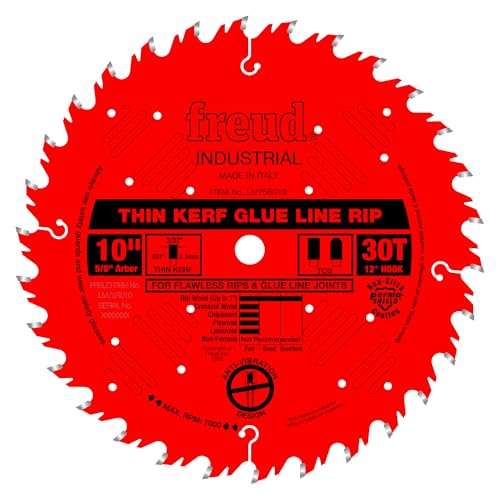
| Freud LM75R010 | Clean, glue-ready rips in hardwood | 10″ thin kerf glue line ripping blade, carbide |
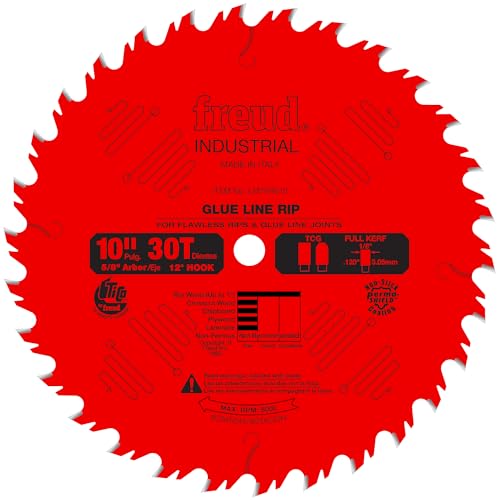
| Freud Industrial Glue Line Ripping Blade (30T) | Premium edge quality on a full-power saw | 30 teeth, TCG, Tico Hi-Density carbide |
| DEWALT DWA11024 | Mixed jobsite ripping and general cuts | 24 tooth general purpose, ultra sharp carbide |
| CMT 250.024.10 ITK Xtreme | Fast, accurate ripping with an ATB grind | 24 teeth ATB, 5/8-inch bore |
| CRAFTSMAN CMAS21024 | Framing lumber and rough ripping | 24T framing/ripping carbide |
| FOXBC 10-Inch Flat Tooth | Budget thin-kerf ripping | 24-tooth, flat tooth, 5/8-inch arbor |
| BOSCH DCB1024 Daredevil | Quick rips in construction lumber | 24 tooth, table and miter saw blade |
How to Choose
Tooth count and tooth shape for ripping
For ripping, 24 teeth is the common starting point on a 10 inch blade, and the titles in this guide cluster around that number. Fewer teeth means bigger gullets, so sawdust leaves the cut instead of packing in and burning the board. A 30-tooth blade, like the Freud glue-line model, trades a little speed for a smoother edge. Flat-top and triple-chip grinds shear fibers cleanly along the grain, while alternate top bevel designs lean toward cleaner crosscuts. Choose by the cuts you make most: a blade labeled for ripping beats an all-purpose 40 or 60 tooth blade every time when you are slicing along the grain.
Kerf width and your saw’s motor
Thin kerf blades remove less wood, so a smaller motor or a portable saw works less hard. That makes them popular on jobsite saws. The trade-off is a slightly thinner plate that can flex if the fence is poorly aligned or the stock pinches. Full kerf blades feel steadier on a cabinet saw with plenty of power. Check that the riving knife or splitter on your saw suits the blade thickness, since a mismatched knife can bind in the cut. When a title mentions thin kerf, confirm the exact kerf figure on the listing and compare it with the thickness of your saw’s knife.
Arbor size and compatibility
Almost every 10 inch table saw uses a 5/8 inch arbor, and several titles here state it directly. Confirm it on your saw before ordering, because a few specialty or older machines use a different bore. Also look at the maximum speed marked on the blade and make sure it matches your saw’s spin speed. Never run a blade on a saw that it is not designed for, always unplug the saw before changing it, and follow the manual’s guidance on blade guards and riving knives.
Carbide quality and where budget blades cut corners
The carbide tips are what you are paying for. Premium blades use dense, fine-grained carbide that holds an edge across more board feet and survives resharpening. Budget blades often use thinner tips, less precise plate grinding and less effective vibration control. They still cut fine on construction lumber, but they dull sooner, leave rougher edges on hardwood and may wobble slightly at speed. Ignore claims about anti-stick coatings unless the listing explains the finish, and remember that a sharp blade at a reasonable price beats a dull premium blade you never get around to cleaning.
The 7 Best Options
Freud LM75R010
This is a 10 inch industrial thin kerf glue line ripping blade with carbide teeth, and the name tells you what it was built for: edges clean enough to glue straight off the saw. It suits woodworkers who rip hardwood boards for panels and tabletops and want to skip a trip to the jointer. The thin-kerf profile also suits saws with moderate motors. It is also worth considering for shops that dislike sanding edges, since cleaner rips mean fewer passes with a plane or sander later.
- Strength: the glue-line design aims at smooth ripped edges that need little cleanup.
- Strength: thin kerf puts less load on the motor than a full-kerf blade of the same diameter.
- Trade-off: it sits in the premium tier, so it is a significant spend for occasional use.
Skip it if you mostly cut rough construction lumber.
Freud Industrial Glue Line Ripping Blade, 30 Teeth
The title lists 30 teeth, a TCG grind and a Tico Hi-Density carbide ripping blend for maximum performance. That combination points toward woodworkers who value finish quality over raw speed, particularly on dense hardwoods where burning is a worry. It fits a stable, powerful saw where a full-width plate can run steady.
- Strength: 30 teeth with a TCG grind offer a smoother cut than a bare 24-tooth design.
- Strength: the Tico Hi-Density carbide named in the title targets long edge life.
- Trade-off: more teeth mean more chips to clear, so it may feed slower than a 24-tooth blade.
Skip it if your saw has a modest motor and you rip thick stock all day.
DEWALT DWA11024
This 10 inch, 24 tooth general purpose blade comes with ultra sharp carbide, according to the title. It works for the builder who rips and crosscuts framing lumber and plywood from one blade without changing it between cuts. The DEWALT name is familiar on jobsites, which makes replacement easy. Because it is a general-purpose design, it also suits shops with only one saw blade budget, where a single dependable blade has to handle whatever the weekend project throws at it.
- Strength: 24 teeth clear sawdust well for typical rips in softwood.
- Strength: general-purpose design avoids swapping blades during mixed work.
- Trade-off: it is a generalist, so hardwood edges may need sanding or jointing before gluing.
Skip it if furniture-grade glue joints are the goal.
CMT 250.024.10 ITK Xtreme Ripping Blade
The ITK Xtreme is a 10-inch, 24-tooth ripping blade with an ATB grind and a 5/8-inch bore, per the title. It suits woodworkers who want a purpose-built ripping blade for cabinet and furniture work without moving to the very top tier. The 24-tooth layout favors smooth feed through thick stock. It also suits anyone who already owns a crosscut blade and wants a second blade dedicated to ripping, so each one can stay sharp for its own job.
- Strength: the 5/8-inch bore fits standard 10 inch table saw arbors.
- Strength: a dedicated ripping blade focuses on feed speed and clean cuts along the grain.
- Trade-off: an ATB grind is tuned partly for cleaner crosscuts, so some users prefer a flat-top rip grind.
Skip it if you want a flat-top glue-line grind.
CRAFTSMAN CMAS21024
The CRAFTSMAN is a 10 inch, 24T framing and ripping carbide blade for miter and table saws. It fits the homeowner who builds decks, shelving and shop projects out of dimensional lumber and wants a low-cost replacement blade. The framing focus suggests it is built for speed rather than a polished edge. Because the same blade fits both saws, it also makes sense for small garages where one spare blade has to cover the miter saw and the table saw alike.
- Strength: framing and ripping design suits softwood and construction lumber.
- Strength: it fits both table saws and miter saws, so one blade can cover two tools.
- Trade-off: expect rougher edges on hardwood than a glue-line design produces.
Skip it if you build fine furniture and need glue-ready edges.
FOXBC 10-Inch Flat Tooth Ripping Blade
This budget blade is a 10-inch, 24-tooth flat tooth design with a thin kerf and a 5/8-inch arbor, built for wood cutting. It fits hobbyists with a small saw and tight spending limits who mostly rip softwood and plywood. The flat tooth profile matches the way rip blades are designed to shear along the grain. It also makes a fair backup blade to keep near the saw for dirty or nail-prone lumber, so the better blades stay protected for finish work.
- Strength: flat tooth and 24-tooth layout suit rip work.
- Strength: the thin kerf is easier on lower-powered saws.
- Trade-off: budget carbide may dull sooner under heavy use.
Skip it if you cut dense hardwoods every day and want maximum edge life.
BOSCH DCB1024 Daredevil
The Daredevil is a 10 in., 24 tooth blade sold for both table and miter saws and described as fast ripping in the title. It suits contractors and weekend builders who want quick cuts through lumber and are happy to replace the blade when it wears. The blue finish makes it easy to spot in a bin. Because it is sold for both saw types, it also appeals to anyone replacing a dull stock blade in a hurry before a weekend project.
- Strength: 24 teeth deliver fast feed through softwood.
- Strength: fits both table and miter saws.
- Trade-off: a construction-oriented blade is not tuned for the smoothest hardwood edges.
Skip it if cabinet-grade finish is your priority.
Which One Fits Your Situation
You build furniture and glue boards edge to edge
The Freud Industrial Glue Line Ripping Blade with 30 teeth is the natural fit. Its TCG grind and dense carbide aim at the cleanest edges in this guide.
You own a jobsite saw with a modest motor
The Freud LM75R010 uses a thin kerf and a glue-line design, so it gives a good balance of finish and motor friendliness. If the budget is tight, the FOXBC thin-kerf blade is the practical alternative.
You frame, build decks and cut dimensional lumber
The CRAFTSMAN CMAS21024 or the BOSCH DCB1024 will do the job, and either one is easy to replace as it dulls. The DEWALT DWA11024 is a good pick if you also crosscut during the same session.
You rip thick cabinet stock and want precision
The CMT 250.024.10 ITK Xtreme brings a 24-tooth ripping layout and a standard 5/8-inch bore. It sits between the budget and glue-line tiers.
Common Mistakes
- Using a 60-tooth crosscut blade for ripping, which clogs, burns and strains the motor.
- Skipping the arbor check and assuming every 10 inch blade fits every saw.
- Forgetting that a thin-kerf plate needs a riving knife that matches its thickness.
- Judging a blade only by price instead of by tooth shape and carbide quality.
- Leaving pitch on the teeth; a dirty blade cuts hot and burns hardwood even when it is sharp.
Related guides
- Table Saw Push Sticks And Featherboards
- Table Saw Blades For Ripping Hardwood
- Jobsite Table Saws For Contractors
Frequently Asked Questions
How many teeth should a 10 inch rip blade have?
Twenty-four is the common choice for dedicated ripping, and some glue-line blades use 30. Fewer teeth clear sawdust faster, while more teeth give a smoother edge at the cost of feed speed.
Is a thin kerf blade worse than a full kerf blade?
Not necessarily. Thin kerf blades reduce motor load, which helps portable saws. Full kerf blades can feel more stable on heavy cabinet saws, so match the blade to the machine.
Can one blade handle ripping and crosscutting?
A general-purpose 24-tooth blade can do both reasonably well on construction lumber. For furniture work, a dedicated rip blade and a separate crosscut blade will give better edges.
How often should a rip blade be sharpened?
Sharpen it when cuts need more feed force, burn marks appear, or the sound of the cut changes. Cleaning pitch buildup first often restores performance, and premium carbide can usually be resharpened more than once.
More from Amazon
Programs that pair well with the guide above. Offers and eligibility are set by Amazon and may change.
A free business account with business pricing and bulk-buying tools for work, shop or home office.
Create a business accountFree shipping on eligible items, Prime Video and more. Eligible new members can start with a free trial.
Start a Prime free trialAudiobooks and podcasts to listen to on the go. Eligible new members can start with a free trial.
Try Audible freeAd-free music streaming. Eligible new subscribers can start with a free trial.
Try Music Unlimited freeAs an Amazon Associate we earn from qualifying purchases.

Write Your Review
No reviews yet. Be the first to share your experience!