

Key takeaways
- Bench space: A heavy benchtop machine needs a solid bench. If the base is not bolted or clamped down, light models walk during use.
- Height of work: Check the maximum drum height against your thickest stock. Thick blanks can exceed the working height of a smaller unit.
- Voltage: Standard household supply is fine for most benchtop models. Floor models with larger motors can need dedicated circuits; ask a licensed electrician if you are unsure.
- Sleeve supply: Many machines ship with only 80 grit. Buy 120 and 180 grit sleeves in your drum sizes at the outset.
- Safety: Keep fingers clear of the pinch point between drum and table, use eye and hearing protection, and follow the manufacturer’s manual for guards and insert rings.
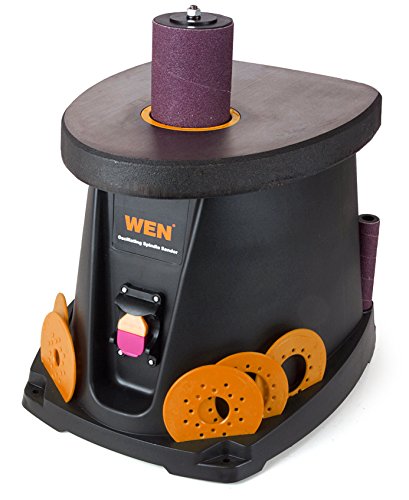
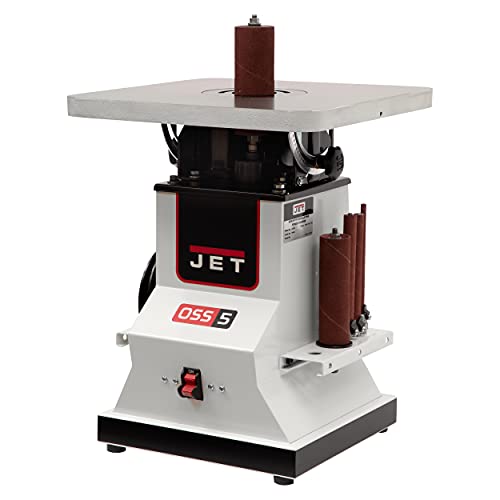
A floor-standing or heavy benchtop oscillating spindle sander with a cast-iron table, such as the JET JBOS-5, suits a shop that smooths curves every week, while a lighter benchtop unit from WEN or Triton suits an occasional maker, and a handheld spindle attachment suits someone with almost no bench space. The rest of this guide explains how those groups differ, which stated specs matter, and where each design falls short.
Our top picks

As an Amazon Associate we earn from qualifying purchases at no extra cost to you.
Why an oscillating spindle sander is worth buying
A spindle sander spins a rubber drum wrapped in an abrasive sleeve. On an oscillating model, the drum also moves up and down while it turns. That vertical stroke spreads wear across the whole sleeve, which keeps heat down and stops burn marks on hardwood edges. It also leaves a more even surface than a fixed drum. The tool is aimed at inside curves, scrolled edges, rounded corners, cutouts for chair seats, and template-sanded parts that would be slow to finish by hand.
It is a specialist tool. It does not flatten boards and it does not replace a random orbital sander. What it does well is remove saw marks left by a band saw or scroll saw, bringing a curved edge right up to a pencil line, and doing so with repeatable results.
What to compare before you buy
Motor and stroke
Makers list motor strength either in horsepower or in amps. Reviewers who compared the field report that the half-horsepower machines handle dense hardwood better and bog down less on long passes, while the smaller motors suit softwood, plywood and thin stock. Stroke length is the vertical travel of the spindle. The JET JBOS-5 is listed with a one-inch stroke, the Rikon 50-300 with a 15/16-inch stroke at 29 strokes per minute, and the WEN 6510T family with a 5/8-inch stroke at 58 oscillations per minute. A longer stroke uses more of each sleeve, but a faster stroke can leave a finer scratch pattern.
Spindle sizes
The sleeves and drums are what let you fit a tight radius. Most benchtop models include a range from half an inch up to two inches, and some, like the WEN 6510T and the VEVOR model discussed by reviewers, add a three-inch drum. The smallest drum sets the tightest inside curve you can sand, so check the radii on your usual projects before choosing.
Table size, tilt and insert rings
A large table supports wide panels and keeps edges square. Cast iron adds weight that absorbs vibration. A tilting table, listed by the maker at zero to forty-five degrees on the JET JBOS-5, lets you sand bevels and chamfers. Table inserts, or rings, fit closely around each drum so thin pieces do not catch in the gap. Make sure the ring set matches the drums included.
Dust collection
Spindle sanding creates fine dust close to your face. Models with a dust port help, but reviewers note that several budget machines include the port without the hose adapter, and that a shop vacuum hose may not fit without an extra fitting. Plan on a dust extractor or shop vacuum, and wear a dust mask or respirator that suits fine wood dust.
At a glance: models reviewers cover
| Model | Best for | Key stated specs | Limits |
|---|---|---|---|
| JET JBOS-5 | Frequent shop use | Half horsepower, one-inch stroke, 14-1/2 by 14-1/2 inch cast-iron table that tilts zero to 45 degrees, five spindle sizes up to two inches | Heavy at roughly 82 pounds, premium tier |
| Rikon 50-300 | Cast-iron stability at mid-range | Half horsepower, 15/16-inch stroke, tilting cast-iron table, five spindle diameters | Heavy, documentation lists inconsistent weights |
| Grizzly G0739 | Value benchtop with many accessories | Half horsepower, drums and sleeves included, onboard storage as reported by reviewers | Smaller table, can move unless bolted down, dust port fit issues reported |
| Grizzly G0538 | Compact benchtop | One-third horsepower, fixed 1,725 rpm, cast-iron table with miter slot per reviewers | Less power than half-horsepower rivals, no speed control |
| WEN 6510T | Budget benchtop | Half horsepower, 5/8-inch stroke at 58 oscillations per minute, six sleeve sizes up to three inches, table about 20 by 15 inches | No dust extractor included, no tilt listed |
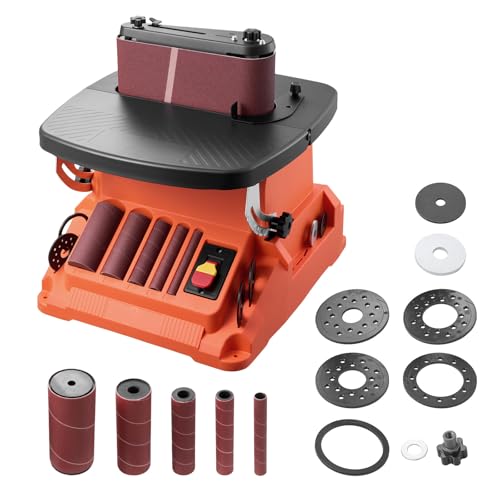
| WEN 6524 and RIDGID EB4424 | Combination spindle and belt sanding | Four-by-24-inch belt plus oscillating spindle, tilting tables | Compromise in each function, sleeves often 80 grit only |
| Triton TSPS450 | Mid-weight shop use | 450 watts, 58 oscillations per minute, cast-iron table about 11.5 by 14.5 inches | No tilt listed, voltage listings vary by source |
| WEN HA5932 and Triton TSPSP650 | Portable spindle tools that clamp to a bench or work by hand | Variable speed, four sleeve sizes, light weight | No workpiece support, 80 grit only, needs external dust collection |
Specifications differ between roundups, and several of them are affiliate-style lists, so treat these figures as the maker-listed values reviewers repeat and confirm them against the manual for the exact model number you buy.
Choosing by budget tier
Budget tier
WEN, VEVOR and Woodskil machines sit here. They are light enough to move, often include five or six sleeve sizes, and are enough for plywood, pine and craft projects. Trade-offs reported across reviews include lighter tables, more vibration, mostly coarse sleeves in the box and a dust port that needs an adapter. If you buy one, plan to add finer sleeves and a clamp or bolt-down plan so it does not walk across the bench.
Mid-range tier
Grizzly, Rikon and Triton cast-iron models fill the middle. The extra mass quiets the machine and the tables are flatter. A cast-iron top also resists the dents that aluminum picks up when you drop a workpiece. Reviewers describe this tier as the best fit for hobbyists who make furniture parts, guitar bodies, or toy components every month.
Premium tier
The JET JBOS-5 is the usual name here. A large tilting table, a long stroke and a half-horsepower motor are the reasons, and the penalty is weight and bench footprint. Floor-standing machines such as the Grizzly G1071Z, described by one roundup as one horsepower with variable speed, belong to a smaller group of buyers who run a spindle sander in a production routine.
Fit, size and bench notes
- Bench space: A heavy benchtop machine needs a solid bench. If the base is not bolted or clamped down, light models walk during use.
- Height of work: Check the maximum drum height against your thickest stock. Thick blanks can exceed the working height of a smaller unit.
- Voltage: Standard household supply is fine for most benchtop models. Floor models with larger motors can need dedicated circuits; ask a licensed electrician if you are unsure.
- Sleeve supply: Many machines ship with only 80 grit. Buy 120 and 180 grit sleeves in your drum sizes at the outset.
- Safety: Keep fingers clear of the pinch point between drum and table, use eye and hearing protection, and follow the manufacturer’s manual for guards and insert rings.
Pick X if you need this
| Pick | If you need |
|---|---|
| JET JBOS-5 | A large tilting table, a long stroke and a machine that stays put for weekly use |
| Rikon 50-300 | Cast-iron stability without stepping to the top of the price range |
| Grizzly G0739 | Lots of included accessories at a value tier |
| WEN 6510T | A larger table on a budget, accepting extra dust-collection purchases |
| Combination belt and spindle unit | One machine for flat edges and curves in a small garage shop |
| Handheld spindle attachment | Occasional curved edges and almost no storage space |
Alternatives to consider
Drum sander attachment for a drill press
A sanding drum chucked into a drill press does a basic version of the same job, though it does not oscillate and can burn wood at higher speeds. It costs little and uses equipment you may already own.
Edge sander or belt-and-disc combination
If most of your work is flat or gently curved edges, a belt-and-disc sander covers more ground. It struggles with tight inside curves, which is exactly where a spindle sander earns its place.
Hand tools
Spokeshaves, rasps and sanding blocks wrapped around dowels still shape curves, at a slower pace and with a bigger demand on skill. They suit someone with a handful of curved parts per year.
Care and use tips
Match the drum diameter to the curve, because a drum larger than the radius flattens the arc. Keep the workpiece moving against the rotation direction, take light passes, and replace worn sleeves instead of leaning harder. Clean resin-loaded sleeves with a crepe rubber stick when the maker allows it. Disconnect power before changing sleeves, drums or insert rings.
Frequently Asked Questions
Is an oscillating spindle sander better than a fixed spindle?
Oscillation moves the drum up and down while it spins, so the whole sleeve works and heat is spread out. Reviewers generally find this gives a cleaner edge and longer sleeve life. A fixed drum can still work on small jobs but tends to wear one band of the sleeve.
Can I use a spindle sander for flat surfaces?
It is built for edges and curves, not for flattening. Use a random orbital sander, a planer or a wide-belt service for flat faces. Pushing a wide board across a drum will leave an uneven finish.
What grit should I start with?
Many machines come with 80 grit sleeves, which is useful for removing saw marks fast. Follow with 120 and then 150 or 180 grit for a surface ready to finish. Going one step at a time avoids deep scratches that show up under stain.
How much dust collection do I need?
Fine wood dust is a health concern, so connect a dust extractor or shop vacuum to the port and wear a suitable mask. Check that the hose adapter matches the port size, because reviewers report mismatches on several models. If you have breathing concerns, talk to a doctor about respiratory protection.
Do I need a tilting table?
A tilting table lets you sand bevels and chamfers, as on the JET JBOS-5 with its stated zero to 45 degree range. If you only sand square edges, a fixed table is fine. Tilt is mostly useful for furniture, boxes and jigs with angled edges.
Is a combination belt and spindle sander a good compromise?
It saves space and money when you need both functions occasionally. Reviewers point out that each function is a little less capable than a dedicated machine. If you sand curves every week, a dedicated spindle unit is the smoother path.


Write Your Review
No reviews yet. Be the first to share your experience!