

Key takeaways
- Hardwood, tile, and concrete floors: choose a small mini car or crawler with soft rubber tires. Avoid high-speed models unless the room is cleared.
- Short grass: use at least 1/18 scale, with tires large enough to keep the chassis from dragging. A 1/10 truck is more reliable on uneven lawns.
- Loose gravel: select a 1/10 truck with sealed bearings, a protected gear cover, and tires with pronounced tread. Brushless power can throw stones into the body and suspension.
- Sand: use a vehicle advertised as water-resistant, but remember that water resistance does not make it sandproof. Fine grit can enter bearings, motors, and differentials.
- Rock trails: use a crawler, not a speed truck. Low gearing, high-clearance axles, and flexible tires matter more than horsepower.
- Racing surfaces: use a buggy or touring car with adjustable suspension. These are fast and precise but are poorly suited to tall grass, curbs, and rough playgrounds.
The best RC cars for beginners are usually a durable 1/10-scale basher for outdoor driving, a slower 1/18- or 1/24-scale crawler for tight spaces, and a simple 1/28- or 1/32-scale car for indoor floors; the right choice depends more on your surface, maintenance tolerance, and replacement-parts access than on top speed.
Our top picks


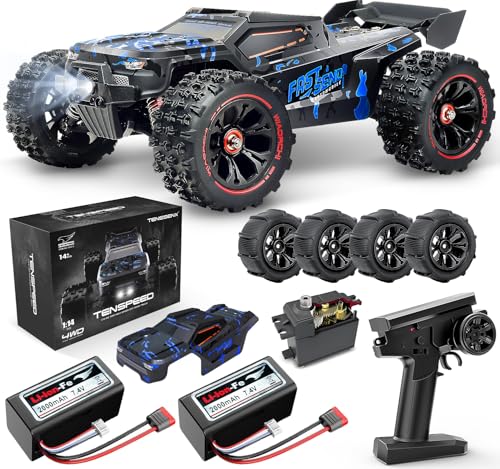
As an Amazon Associate we earn from qualifying purchases at no extra cost to you. Ratings are shown as listed on Amazon.
Quick picks by driver and surface
| Situation | Best type | Useful target specification | Why it fits |
|---|---|---|---|
| Young beginner on a driveway | 1/10-scale 2WD brushed truck | 25–35 mph, 2,000–3,000 mAh battery, 30–45 minutes per charge | Stable, repairable, and fast enough without being difficult to control |
| Indoor apartment or small room | 1/28- to 1/32-scale mini car | 8–15 mph, 500–800 mAh battery, 10–20 minutes per charge | Quiet, inexpensive to run, and less likely to damage furniture |
| Rock, gravel, and garden trails | 1/18- or 1/24-scale crawler | 1–3 mph, 750–2,000 mAh battery, 30–60 minutes per charge | Low gearing and soft tires prioritize control over speed |
| Teen or adult wanting jumps | 1/10-scale 4WD basher | 35–50 mph, oil-filled shocks, metal-geared differentials | Four-wheel drive and stronger suspension handle loose surfaces and landings |
| Experienced driver seeking racing feel | 1/10-scale 2WD buggy or touring car | 20–40 mph, adjustable suspension, LiPo-ready electronics | Sharper handling, but less forgiving of poor surfaces and impacts |
Best RC cars for beginners
Traxxas Slash 2WD
The Traxxas Slash 2WD is one of the safest all-round recommendations for a first outdoor RC car. Its short-course truck body protects much of the chassis from dirt, the brushed motor is easier to manage than a high-output brushless system, and replacement tires, bodies, suspension arms, and gears are widely available. The standard 1/10-scale platform is roughly 22 inches long and typically weighs about 5–6 pounds with a battery.
Choose it for packed dirt, asphalt, grass, and smooth gravel. It is not a good first choice for a small living room: its size, turning radius, and speed make collisions likely. A typical NiMH battery provides approximately 15–25 minutes of driving, while a 2,000–3,000 mAh pack and conservative throttle use can extend practical sessions. General-market prices are commonly around $200–$350 depending on the included battery and charger.
Traxxas Rustler 2WD
The Rustler 2WD is a better match than the Slash if the main surface is a driveway or short lawn and the driver wants a more responsive stadium-truck layout. It is lighter and often feels quicker than a similarly powered short-course truck, but its exposed wheels and narrower body offer less protection from side impacts. It is a sensible option for older children, teenagers, and adults who can learn throttle control.
ARRMA GROM models
ARRMA’s small GROM vehicles, including the Granite GROM and Typhon GROM, suit drivers who want a compact basher without committing to a full-size 1/10-scale vehicle. At approximately 1/18 scale, they fit in smaller spaces and are less expensive to repair after a minor crash. The Granite GROM favors rougher ground with larger tires; the Typhon GROM favors smoother dirt and pavement with a buggy-style body.
Small scale does not mean indestructible. Their short wheelbase can make them flip on high-grip surfaces, and miniature drivetrain parts can wear faster when driven through thick grass. Expect roughly 15–25 minutes per charge, depending on the battery and driving style.
Best RC cars for kids
For children, the best RC car is one with a speed-limiting mode, a covered drivetrain, proportional steering and throttle, and a battery that can be removed without handling loose wires. A slow toy-grade car may be easy to use, but many have sealed batteries, limited steering control, and no practical supply of replacement parts. A hobby-grade brushed model costs more initially but can remain usable after a broken suspension arm or worn tire is replaced.
For ages roughly 8–12
Start with a 1/18- or 1/16-scale brushed truck, preferably with a training mode that reduces maximum speed to about 10–15 mph. Use a paved court, short grass, or compact dirt rather than rocks or deep sand. Buy a second battery only after the child can steer consistently; extra runtime is less useful than learning to stop before hitting a curb.
For younger children
A low-speed 1/28- or 1/32-scale car is generally easier to supervise indoors, provided the room has hard flooring and few fragile objects. These cars are not intended for outdoor grass, and their small tires can become trapped by carpet fibers. Avoid judging suitability by speed alone: a small car moving quickly across a table can still cause damage or disappear under furniture.
Best RC crawlers for adults and beginners
Axial SCX24
The Axial SCX24 is a strong choice when the goal is careful driving rather than racing. Its 1/24-scale chassis is about 8 inches long, and its low-speed drivetrain, portal-axle design on many versions, and articulated suspension let it climb over roots, stones, and indoor obstacle courses. Runtime commonly falls in the 30–60 minute range, though crawling slowly places different demands on the battery than high-speed driving.
It works indoors, on garden soil, and over small rocks, but it is too slow for large lawns and too light for tall grass. The first parts likely to need attention are steering links, driveshafts, axle gears, and tires. These are inexpensive compared with replacing a complete vehicle, and the platform has a broad aftermarket parts ecosystem.
Traxxas TRX-4M
The Traxxas TRX-4M is another capable small crawler, offered in 1/18 scale. It is slightly larger than the SCX24 and has enough ground clearance for a wider range of garden obstacles. Its proportional controls and smooth low-speed response make it approachable for adults who want a technical, quiet RC hobby. It is also a better fit than a high-speed truck for a basement, workshop, or small backyard.
Expect approximately 30–60 minutes of runtime depending on the battery capacity and terrain. The main ownership costs are replacement tires, steering components, driveshafts, and occasional gears rather than fuel or frequent electronic repairs. General-market pricing is often about $150–$250 before optional upgrades.
When a fast 4WD basher makes sense
A 1/10-scale 4WD truck or buggy is appropriate for an adult or experienced teenager who has a large open area, accepts more maintenance, and wants jumps or loose-surface driving. Models such as the ARRMA Granite 4×4 and Traxxas Rustler 4X4 offer much stronger acceleration and better traction than a 2WD beginner truck. Brushless versions can exceed 40 mph on suitable batteries, so they require a broad, obstacle-free driving area and a willingness to inspect the vehicle after every hard session.
The trade-off is cost. A brushless setup may require a LiPo battery, a compatible balance charger, and safety storage, bringing a realistic initial budget to roughly $400–$700. Tires, suspension arms, driveshafts, and differential gears are consumable parts when the car is repeatedly jumped or driven into curbs. For many new drivers, a brushed 2WD vehicle is the better value because it teaches control before adding speed and drivetrain complexity.
How to match an RC car to the surface
- Hardwood, tile, and concrete floors: choose a small mini car or crawler with soft rubber tires. Avoid high-speed models unless the room is cleared.
- Short grass: use at least 1/18 scale, with tires large enough to keep the chassis from dragging. A 1/10 truck is more reliable on uneven lawns.
- Loose gravel: select a 1/10 truck with sealed bearings, a protected gear cover, and tires with pronounced tread. Brushless power can throw stones into the body and suspension.
- Sand: use a vehicle advertised as water-resistant, but remember that water resistance does not make it sandproof. Fine grit can enter bearings, motors, and differentials.
- Rock trails: use a crawler, not a speed truck. Low gearing, high-clearance axles, and flexible tires matter more than horsepower.
- Racing surfaces: use a buggy or touring car with adjustable suspension. These are fast and precise but are poorly suited to tall grass, curbs, and rough playgrounds.
Battery life, running cost, and replacement parts
Runtime depends on current draw, temperature, terrain, and how often the throttle is held wide open. A simple estimate is:
Approximate runtime = battery capacity in amp-hours ÷ average current draw in amps × 60.
For example, a 2.0 Ah battery used by a vehicle averaging 8 amps gives 2.0 ÷ 8 × 60 = 15 minutes. Real-world runtime is usually lower or higher because average current changes constantly. Two batteries can provide a longer session, but allow the motor and battery to cool before another run.
Before buying, search the manufacturer’s parts diagrams for suspension arms, steering links, driveshafts, gears, wheels, tires, and body clips. A vehicle with a lower purchase price can become expensive if these parts are unavailable. In 2026, established ranges from Traxxas, ARRMA, Axial, Tamiya, Losi, and Team Associated generally offer better long-term parts support than anonymous models with changing names and no diagrams.
Durability and maintenance that actually matter
- Brush sand and grass from the chassis immediately; packed debris increases motor temperature and binds suspension.
- Do not charge a LiPo battery unattended or with the wrong charger. Store it in a fire-resistant battery bag or suitable storage container according to the battery maker’s instructions.
- After wet driving, remove the battery, dry the chassis, and inspect bearings. “Water-resistant” electronics still need cleaning and drying.
- Check wheel nuts, driveshafts, and suspension screws after the first few runs. Loose hardware is a common cause of failures misdiagnosed as broken parts.
- Replace bent suspension arms instead of forcing them straight repeatedly; distorted plastic changes wheel alignment and accelerates tire wear.
Final buying decision
Choose the Traxxas Slash 2WD or Rustler 2WD for a dependable first outdoor vehicle, an ARRMA GROM for compact bashing, the Axial SCX24 or Traxxas TRX-4M for slow indoor and garden crawling, and a 1/10-scale 4WD brushless model only when the driver has open space and accepts higher running costs. The best RC cars are not necessarily the fastest ones: they are the models whose scale, tires, controls, battery system, and parts supply match where and how often they will be driven.



Write Your Review
No reviews yet. Be the first to share your experience!