

Key takeaways
- Do not steam the same milk twice; reheating leaves baked-on residue and produces poor texture.
- Do not use abrasive pads on polished surfaces, since scratches retain residue and make the finish dull.
- Check the spout after a drop. A small dent can create a split stream that makes clean latte-art lines difficult.
- Rinse the steam wand before placing it into the pitcher, and wipe it immediately afterward.
- Keep acidic cleaners away from decorative coatings unless the manufacturer specifically permits them.
The best stainless steel milk pitchers for frothing are the 12-ounce Motta Europa for precise single drinks, the 12-ounce Fellow Monty for compact home use, and the 20-ounce Rhino Coffee Gear ProMilk for making two drinks without repeatedly refilling.
Our top picks


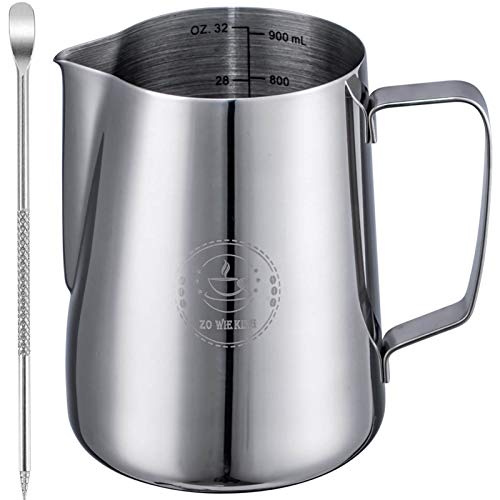
As an Amazon Associate we earn from qualifying purchases at no extra cost to you. Ratings are shown as listed on Amazon.
Best stainless steel milk pitchers at a glance
Pitcher capacity matters more than many buyers expect. A pitcher should contain enough milk to create a smooth vortex while leaving room for expansion, but an oversized jug makes small portions harder to control. For one 6- to 8-ounce drink, a 12-ounce pitcher is usually the easiest size. Choose 20 ounces if you regularly steam two drinks together or use a larger commercial-style steam wand.
| Pitcher | Nominal capacity | Useful fill range | Steel and weight | Spout and markings | Best suited to |
|---|---|---|---|---|---|
| Motta Europa | 12 oz / 350 ml | 6–8 oz / 180–240 ml | Stainless steel; approximately 220 g | Fine, pointed spout; no internal marks | Latte art and single drinks |
| Fellow Monty | 11.8 oz / 350 ml | 6–8 oz / 180–240 ml | 304 stainless steel; approximately 250 g | Sharp spout; no internal marks | Compact kitchens and controlled pouring |
| Rhino Coffee Gear ProMilk | 12 oz / 360 ml | 6–8 oz / 180–240 ml | Stainless steel; approximately 190–220 g | Precision spout; usually unmarked | Everyday home steaming |
| Rhino Coffee Gear ProMilk | 20 oz / 600 ml | 10–14 oz / 300–420 ml | Stainless steel; approximately 300 g | Precision spout; usually unmarked | Two small lattes or one large drink |
| Espro Toroid | 12 oz / 355 ml | 6–8 oz / 180–240 ml | Stainless steel; approximately 230–260 g | Designed for controlled pouring; no standard volume marks | Beginners who want a forgiving shape |
| Generic marked 12 oz pitcher | 12 oz / 350 ml | 6–8 oz / 180–240 ml | Often 0.5–0.8 mm stainless steel; roughly 180–250 g | Medium spout; internal graduations vary | Budget buyers who value measured portions |
Published weights can vary slightly by production run, handle design, and whether the manufacturer includes the lid or packaging. The useful fill range is more important than the maximum capacity: filling to the brim leaves little room for milk expansion and increases spill risk.
Head-to-head: what separates a good pitcher from a merely usable one?
Capacity and shape
The Motta Europa and Fellow Monty are strong single-drink choices because their 350 ml capacity keeps a modest milk dose close to the steam tip. The Rhino 20-ounce model is more versatile for multiple drinks, but it is less efficient for a single 4-ounce milk portion. A large base can make the milk look calm while the lower layer is already becoming overheated.
For a simple sizing check, use the planned milk volume plus roughly 25% expansion room. For 7 ounces of milk, 7 × 1.25 equals 8.75 ounces, so a 12-ounce pitcher gives useful headroom. For two 7-ounce portions, the same calculation gives 17.5 ounces, making a 20-ounce pitcher the practical choice.
Steel thickness and heat response
Thin stainless steel responds quickly. That is helpful when learning to stop steaming at the right moment, because the outside of the pitcher becomes noticeably warmer soon after the milk heats. It also means the pitcher can move from cool to too hot quickly if the steam wand is powerful.
Thicker walls feel more substantial and can make the temperature rise slightly less abrupt, but wall thickness is not a substitute for technique. A well-formed 304 stainless pitcher is normally preferable to an unusually thick jug with a blunt spout. Stainless steel also avoids the coating wear and flavor retention associated with damaged nonstick interiors.
Spout precision
A narrow, symmetrical spout helps separate a thin stream from a heavier pour. That matters for latte art: begin high to mix the foam into the espresso, then lower the pitcher and slow the pour to place the pattern. The Motta Europa and Fellow Monty are particularly attractive when controlled line work is the priority.
A wide or uneven spout is not unusable, but it tends to release milk in a blob when the pitcher angle changes. Check the tip for a clean centerline and smooth metal. Small dents near the lip can permanently change the pour, even when the rest of the pitcher remains serviceable.
Handle comfort and control
Handles should provide enough clearance for two or three fingers without forcing the wrist into an awkward angle. A large fixed handle is comfortable for repeated steaming but takes more drawer space. Handleless or loop-style designs are compact and give a direct grip around the body, although they transmit heat more quickly and may feel less secure with wet hands.
The Fellow Monty uses a compact profile that suits crowded counters. The Motta Europa offers a more traditional barista-style grip. For frequent use, choose the handle that lets you tilt the pitcher with the smallest wrist movement; this is more valuable than a decorative finish.
Measurement marks: useful convenience or false precision?
Internal marks are helpful when you want repeatable portions, especially when switching between dairy and plant-based milk. They also reduce waste: if a recipe needs 180 ml, you can pour close to that amount before steaming rather than estimating from the outside.
Marks do not account for expansion, foam texture, or the milk left behind in the pitcher. They may also fade if printed rather than etched. A pitcher with no graduations can be just as repeatable if you use a kitchen scale or fill to a consistent visual level. If markings are important, prefer etched or deeply formed graduations over surface ink.
Decision matrix: which pitcher fits your routine?
| Your situation | Recommended type | Why | Trade-off |
|---|---|---|---|
| One latte most days | 12 oz / 350–360 ml | Better control over a small milk volume | Cannot comfortably steam two drinks at once |
| Learning latte art | 12 oz with a narrow spout | Small changes in angle produce predictable flow | Less forgiving if overfilled |
| Two drinks several times a week | 20 oz / 600 ml | Enough headroom for a combined batch | Awkward for a single small cappuccino |
| Limited counter or drawer space | Compact 12 oz, handleless or small-handle design | Stores easily beside a machine | Can feel hotter and less secure in the hand |
| Lowest reasonable cost | Plain 12 oz stainless pitcher | Fewer cosmetic features and usually a lower market price | Spout consistency and markings vary more |
| Heavy daily use | 304 stainless, sturdy handle, smooth welds | Better resistance to dents, staining, and repeated washing | Often costs more and weighs more |
Heat response and steaming control
A pitcher should make temperature changes easy to notice without becoming dangerously hot immediately. Hold the body near its lower half rather than pressing fingers against the base. Steam until the milk develops a fine, glossy texture and stop before it smells cooked or the pitcher becomes too hot to touch briefly. The exact stopping point varies with milk type and steam pressure, so a thermometer can be useful while learning.
Do not leave milk sitting in the pitcher after steaming. Residue dries into the seam around the spout and handle, where it is harder to remove and can interfere with the next pour. Rinse promptly with warm water, wash with mild dish soap, and leave the pitcher open to air-dry.
Cleaning, wear, and ownership costs
Stainless steel pitchers are inexpensive to maintain, but several habits shorten their useful life:
- Do not steam the same milk twice; reheating leaves baked-on residue and produces poor texture.
- Do not use abrasive pads on polished surfaces, since scratches retain residue and make the finish dull.
- Check the spout after a drop. A small dent can create a split stream that makes clean latte-art lines difficult.
- Rinse the steam wand before placing it into the pitcher, and wipe it immediately afterward.
- Keep acidic cleaners away from decorative coatings unless the manufacturer specifically permits them.
For occasional home use, a plain stainless pitcher in the general market range of about $10–$25 is usually sufficient. More refined branded models commonly fall around $25–$45, while larger or specially shaped pitchers can cost more. The extra money is most worthwhile when it buys a better spout, a comfortable handle, or consistent steel construction—not merely a colored exterior.
Final recommendations
Choose the Motta Europa 12 oz when pour precision and traditional latte-art control are your priorities. Choose the Fellow Monty when you want a compact, polished pitcher for one drink at a time. Choose the Rhino Coffee Gear ProMilk 20 oz when capacity and repeated two-drink preparation matter more than small-batch finesse. The Espro Toroid is a sensible alternative for beginners who prefer a shape intended to encourage consistent milk movement.
Whatever the brand, prioritize a 12-ounce size for single drinks, a clean narrow spout, comfortable finger clearance, uncoated stainless steel, and markings that will not disappear after washing. Those details have a larger effect on daily use than appearance alone.

Write Your Review
No reviews yet. Be the first to share your experience!