

Key takeaways
- Choose Wi-Fi if you weigh yourself regularly, share the scale with family, or want readings uploaded without carrying a phone. It normally requires a 2.4 GHz network and a manufacturer account.
- Choose Bluetooth if you want fewer connected services, use the scale occasionally, or keep the device in a room with unreliable Wi-Fi. Your phone usually needs to be nearby, and the app may need to be opened before or after weighing.
- Use a separate health platform carefully. Apple Health, Google Health Connect, Fitbit, Garmin Connect, and other services may receive weight data, but compatibility differs by scale and operating system. Confirm whether synchronization is one-way or two-way.
Best Smart Body Composition Scales for Home
The best smart body composition scales for most homes are the Withings Body Smart for balanced Wi-Fi features, the Garmin Index S2 for Garmin users, and the Eufy Smart Scale P2 Pro for a lower-cost, high-metric option.
These scales all estimate more than body weight, but their extra readings are not interchangeable with clinical measurements. Body-fat percentage, muscle mass, water percentage, visceral-fat indicators, and metabolic-age scores are calculated from bioelectrical impedance and can change with hydration, food, exercise, skin contact, and time of day. Use them to follow trends under consistent conditions rather than treating one reading as a diagnosis.
Our top picks

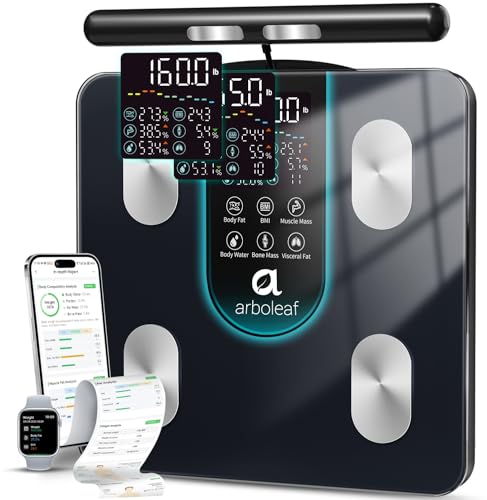


As an Amazon Associate we earn from qualifying purchases at no extra cost to you. Ratings are shown as listed on Amazon.
Quick comparison of the leading choices
| Scale | Weight limit | Connection | Users | Power and size | Best fit |
|---|---|---|---|---|---|
| Withings Body Smart | 200 kg / 440 lb | 2.4 GHz Wi-Fi and Bluetooth | Up to 8 | 4 AAA batteries; about 325 x 325 x 25 mm | Automatic syncing and a polished health dashboard |
| Garmin Index S2 | 181.4 kg / 400 lb | Wi-Fi and Bluetooth | Up to 16 | 4 AAA batteries; about 320 x 310 x 28 mm | People already using Garmin Connect |
| Eufy Smart Scale P2 Pro | 180 kg / 396 lb | Wi-Fi and Bluetooth | Up to 16 | 4 AAA batteries; about 325 x 325 x 26 mm | Many metrics at a generally lower market price |
| Bluetooth-only smart scale | Typically 180–180 kg / 397–400 lb | Bluetooth only | Usually 8–24 | Often 3–4 AAA batteries; roughly 280–300 mm square | Small spaces and occasional manual syncing |
Dimensions and user limits can vary slightly by regional version, so check the manufacturer’s specification page before buying. The table’s Bluetooth-only category is a type rather than a single model; it is included because it remains a sensible choice when automatic cloud syncing is not important.
Best overall: Withings Body Smart
Withings Body Smart is the strongest all-round choice when several people want automatic readings without opening an app every time. It measures weight, BMI, body-fat percentage, water percentage, muscle mass, bone mass, and related composition indicators. It can also provide heart-rate readings while standing, although that feature should not replace a medical monitor or professional assessment.
Its main advantage is the combination of Wi-Fi syncing, a clear on-scale display, and support for multiple profiles. Wi-Fi means a reading can upload after the weigh-in even when your phone is in another room. That is useful for daily or weekly tracking, but it also means you should review account permissions and connected services during setup.
Choose it over a cheaper Bluetooth scale if convenience matters more than minimizing cost. General market pricing is usually in the mid-range for smart scales, with occasional discounts. The drawback is that some advanced trend and wellness features may be tied to the manufacturer’s subscription ecosystem, depending on region and current software policy.
Best for Garmin households: Garmin Index S2
The Garmin Index S2 makes the most sense for someone who already uses a Garmin watch, cycling computer, or Garmin Connect. Weight and composition readings can sit alongside activity and exercise data in the same account, reducing the need to maintain separate apps.
It supports weight, BMI, body-fat percentage, skeletal-muscle mass, bone mass, body water, and weight trends. The scale’s color display is useful for quick feedback, while Wi-Fi handles background uploads. Its 400-pound limit is high enough for many households, but it is lower than the Withings Body Smart’s 440-pound rating.
The important buying question is ecosystem fit. If you do not use Garmin Connect, the Index S2’s extra cost may buy little beyond features available from less expensive scales. It is also a relatively large object for a compact bathroom, so measure the clear floor area before ordering.
Best value for many metrics: Eufy Smart Scale P2 Pro
The Eufy Smart Scale P2 Pro is a practical pick when you want a broad list of estimated metrics and automatic Wi-Fi uploads without moving into the highest price tier. It tracks weight and common body-composition estimates through the EufyLife app, with Bluetooth available during setup or when Wi-Fi is not being used.
Its 396-pound capacity, large glass platform, and multi-user support suit a family. The trade-off is not the number of metrics but how useful they are. More labels do not automatically mean more accurate information: readings such as protein percentage, body age, or subcutaneous fat are model-derived estimates. Use the app’s trend graphs, not individual decimal places, when comparing weeks.
Before buying, check whether the current app and account settings match your privacy preferences. Cloud-connected scales can offer better convenience, but they may collect profile information, measurements, device identifiers, and usage data.
Wi-Fi versus Bluetooth: which connection should you choose?
- Choose Wi-Fi if you weigh yourself regularly, share the scale with family, or want readings uploaded without carrying a phone. It normally requires a 2.4 GHz network and a manufacturer account.
- Choose Bluetooth if you want fewer connected services, use the scale occasionally, or keep the device in a room with unreliable Wi-Fi. Your phone usually needs to be nearby, and the app may need to be opened before or after weighing.
- Use a separate health platform carefully. Apple Health, Google Health Connect, Fitbit, Garmin Connect, and other services may receive weight data, but compatibility differs by scale and operating system. Confirm whether synchronization is one-way or two-way.
A Bluetooth-only scale can be the better privacy choice because it does not need continuous internet access. It is not automatically private, however: the phone app may still create an online account or upload data unless you decline optional services.
Decision matrix by household and buying priority
| Your situation | Best direction | Why |
|---|---|---|
| Lowest sensible cost | Bluetooth-only scale | Usually avoids the premium for Wi-Fi and still records weight trends. |
| Daily tracking with no phone nearby | Withings Body Smart or Garmin Index S2 | Wi-Fi uploads readings automatically after setup. |
| Existing Garmin household | Garmin Index S2 | Measurements can remain within Garmin Connect. |
| Many family members | Garmin Index S2 or Eufy P2 Pro | Both advertise support for up to 16 user profiles. |
| Higher weight capacity needed | Withings Body Smart | Its stated 440-pound limit exceeds the 396–400-pound limits of the other listed options. |
| Minimal data sharing | Bluetooth-only model | It can limit internet dependence, provided the companion app permits local use. |
How to get more consistent readings
- Place the scale on a hard, level floor. Carpet can affect both stability and the electrical measurement path.
- Install the batteries and complete profile setup before comparing readings. Enter the correct height, age range, and sex setting where the app requests them; incorrect profile information can distort estimates.
- Weigh under similar conditions, such as after waking and using the bathroom, before eating or exercising.
- Stand barefoot with both feet fully on the electrodes, remain still, and wait for the display to finish.
- Review weekly or monthly trends rather than reacting to a single change. Hydration and a salty meal can move weight and impedance readings without representing a comparable change in body tissue.
As a simple ownership calculation, weighing four times per week produces about 208 readings per year. If a scale costs $40 and lasts four years, the hardware cost is roughly $0.05 per use before batteries. A $100 Wi-Fi model used at the same frequency costs about $0.12 per use. The more expensive scale is worth it only if automatic syncing, better profiles, or ecosystem integration will actually change your routine.
Privacy and durability details buyers often miss
Check whether the app offers account deletion, data export, two-factor authentication, guest weighing, profile editing, and control over connected health platforms. Turn off optional marketing permissions and disconnect integrations you do not use. If several people share the scale, confirm that profile recognition does not expose one person’s measurements on another person’s phone.
The glass weighing surface is usually easy to wipe, but it can become slippery when wet. Clean it with a lightly damp cloth and dry it; do not flood the seams or submerge the scale. The first parts likely to cause trouble are depleted batteries, dirty or damp electrodes, unstable flooring, and app pairing—not the load cells themselves. Avoid dropping the unit, placing it against a radiator, or exceeding its stated capacity.
Do not use a body-composition mode if the manufacturer warns against it for implanted electronic medical devices, pregnancy, or other specific conditions. When a measurement affects treatment, nutrition, or a health concern, ask a qualified professional rather than relying on a consumer scale.


Write Your Review
No reviews yet. Be the first to share your experience!