

Key takeaways
- Top-knob adjustment: Simple and inexpensive, but the knob must be loosened or tightened each time. It can also change accidentally during use.
- Bottom dial: Keeps the setting away from the hand and often offers finer control. It may be awkward to adjust while the mill is full of food.
- External collar or ring: The most convenient for frequent cooks because it can be changed quickly without disassembling the mill.
- Preset electric adjustment: Convenient for one-handed use, though the lowest and highest settings may be less distinct than the controls suggest.
The best salt and pepper mill sets match the grinder material, adjustment system, refill design, capacity, and base stability to how you cook—not simply how attractive the pair looks.
Best salt and pepper mill sets by kitchen situation
| Kitchen situation | Best choice | Specifications to target | Typical market range |
|---|---|---|---|
| Frequent cooking for a family | Large manual mills | 6–8 in. height, 35–60 g pepper capacity, 5–7 grind settings | $35–$100 per set |
| Small counter or apartment kitchen | Compact manual set | 4–5 in. height, 20–35 g capacity, footprint under 2.5 in. | $20–$60 per set |
| Limited hand strength or one-hand cooking | Battery-powered electric mills | One-button operation, 4–8 AA or AAA batteries, 3–6 grind levels | $30–$90 per set |
| High humidity or frequent table use | Ceramic salt mechanism with sealed body | Corrosion-resistant grinder, silicone or plastic plug, wide refill opening | $25–$80 per set |
| Maximum pepper output | High-capacity steel pepper mill | 60–90 g capacity, hardened steel burrs, external adjustment dial | $50–$130 per set |
Ceramic versus steel grinders
For a two-piece set, the most practical arrangement is often a ceramic grinder for salt and a steel grinder for pepper. The two ingredients behave differently, so one grinder material does not have to serve both jobs.
Our top picks

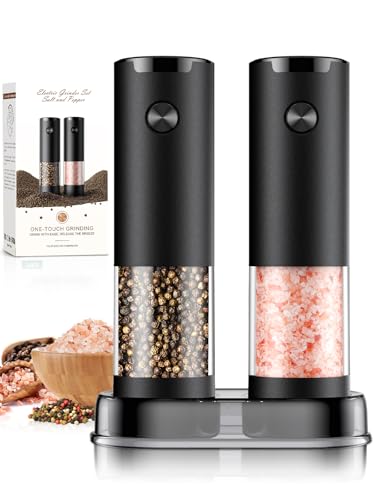

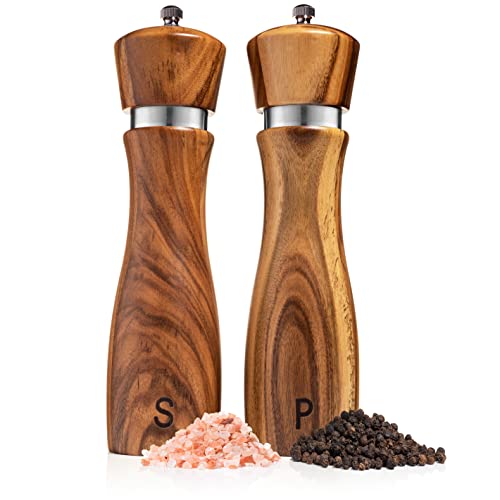
As an Amazon Associate we earn from qualifying purchases at no extra cost to you. Ratings are shown as listed on Amazon.
Ceramic grinders for salt
Ceramic mechanisms resist corrosion from salt and moisture. That makes them the safer long-term choice for sea salt, kosher salt, and damp kitchen environments. Ceramic is also nonreactive and does not impart a metallic taste.
The limitation is strength. A poorly made ceramic mechanism can chip if filled with oversized crystals or struck against a hard surface. Ceramic grinders also vary widely in sharpness and consistency; a low-cost mechanism may produce powder mixed with large pieces rather than a clean, even grind.
Steel grinders for pepper
Hardened steel burrs are generally effective at cracking and grinding peppercorns. They tend to provide a sharper, more repeatable grind than basic ceramic mechanisms, particularly when the mill has a properly aligned shaft and burr assembly.
Steel is less suitable for salt. Salt attracts moisture and can accelerate corrosion, especially in carbon-steel parts. Stainless steel improves resistance but is not a guarantee against buildup or wear. Check the manufacturer’s labeling: a grinder described only as “metal” is not necessarily suitable for salt.
For pepper, look for a burr mechanism rather than a simple blade. Burrs crush the peppercorns between shaped surfaces, while blades chop them inconsistently and can create excessive dust.
Grind-size adjustment is more important than the number of settings
A mill may advertise six or more settings, but the useful question is whether the adjustment changes the distance between the grinding surfaces without making the handle loose or difficult to turn. A good mechanism should move from fine enough for sauces to coarse enough for steak or finishing vegetables.
- Top-knob adjustment: Simple and inexpensive, but the knob must be loosened or tightened each time. It can also change accidentally during use.
- Bottom dial: Keeps the setting away from the hand and often offers finer control. It may be awkward to adjust while the mill is full of food.
- External collar or ring: The most convenient for frequent cooks because it can be changed quickly without disassembling the mill.
- Preset electric adjustment: Convenient for one-handed use, though the lowest and highest settings may be less distinct than the controls suggest.
Test the adjustment by turning it through its full range while empty. If the mechanism grinds or binds at one end, or if the setting changes when the handle is operated, choose another design.
Refilling: the overlooked difference between good and frustrating mills
Refill openings should be wide enough that peppercorns can be poured directly from a jar without a funnel. An opening of approximately 1.25 inches is comfortable; openings closer to 0.75 inch are slower and more prone to spills.
A removable top provides fast access but creates a loose part that can be misplaced. A threaded plug or hinged door stays attached, but its seal should fit tightly enough to keep humidity out. Avoid filling a mill completely. Leaving about 0.5 inch of headroom reduces pressure on the shaft and makes the top easier to replace.
Transparent bodies make the remaining contents visible, but light can gradually affect some spices, and clear plastic shows fingerprints. Opaque wood or stainless steel hides the fill level but often looks better on the table. A small viewing window is a useful compromise.
Capacity, size, and the cost of frequent refills
Capacity should reflect consumption rather than maximum volume. A large mill is convenient for a busy household, but peppercorns can lose aroma over time, particularly when stored beside a hot stove.
| Mill height | Approximate pepper capacity | Best use | Approximate countertop footprint |
|---|---|---|---|
| 4–5 in. | 20–35 g | Occasional cooking or small kitchens | 1.75–2.5 in. diameter |
| 6–8 in. | 35–60 g | Daily home cooking | 2.25–3 in. diameter |
| 9–12 in. | 60–100 g | Large households or table presentation | 2.5–3.5 in. diameter |
As a practical example, if a household uses 1 gram of pepper per day, a 40-gram mill lasts about 40 days. A 90-gram mill lasts roughly three months, but the extra capacity is useful only if the pepper remains fresh and the larger body is comfortable to hold.
When one-handed operation is worth choosing
Electric mills are the best option when you season while stirring, hold a pan with one hand, or find a twisting motion uncomfortable. Look for a large top button that can be pressed with the palm or index finger. A narrow side button is harder to use while cooking.
Battery models add weight, usually placing the center of gravity high in the mill. A model that feels balanced when empty may become top-heavy when filled. Check whether the battery compartment is separated from the food chamber and whether the grinder can stand upright without being held.
Some electric sets include a light beneath the grinder. It can help show how much seasoning is being dispensed, but it should not outweigh more important features such as a reliable switch, quiet motor, and a removable mechanism for cleaning.
Countertop stability and everyday handling
A stable base prevents a mill from falling when it is set down with one hand. Favor a flat base at least as wide as the body, with rubber or silicone feet. A narrow, rounded bottom may look elegant but is more likely to tip when the mill is bumped.
For wooden mills, a sealed finish helps protect against cooking humidity, but wood should still be kept away from direct steam. Stainless steel and acrylic bodies are easier to wipe clean. Avoid a deeply textured exterior if the mill will be used near greasy stovetop surfaces.
Ownership details that affect durability
- Do not put a manual mill in the dishwasher unless the instructions specifically allow it. Heat and detergent can damage finishes, adhesives, bearings, and seals.
- Wipe the exterior with a slightly damp cloth, then dry it. Do not rinse the grinder mechanism under a tap.
- Empty old salt before changing salt types. Moist residue can harden around the burrs.
- Use dry, appropriately sized peppercorns. Very large, oily, flavored, or damp peppercorns can clog some mechanisms.
- Do not fill a pepper mill with salt unless its mechanism is explicitly designed for salt.
- Expect the grinding surfaces and adjustment threads to wear before the outer body. A replaceable mechanism or serviceable design is more valuable than decorative hardware.
For most kitchens, choose a 6–8-inch set with a ceramic salt grinder, hardened-steel pepper grinder, external grind adjustment, a refill opening of at least 1.25 inches, and a broad non-slip base. Choose a smaller manual set when counter space matters, or an electric set when one-handed seasoning is the deciding requirement. Those specifications are a more dependable guide to the best salt and pepper mill sets than matching colors, oversized capacity, or a long list of nominal grind settings.


Write Your Review
No reviews yet. Be the first to share your experience!