

Key takeaways
- 40–60 pounds: light technique work, children or smaller adults, and occasional use. Expect more swing.
- 70–100 pounds: the most versatile range for adult home boxing.
- 100–150 pounds: frequent training, powerful punchers, kickboxing, and reduced swinging.
- Over 150 pounds: specialized use; verify the complete mounting system and building structure first.
The best heavy bags for home boxing workouts are the ones whose weight, diameter, filling, and mounting method suit your available space and training style—not simply the heaviest bag you can buy.
For most home users, a 70- to 100-pound hanging bag with a compact 12- to 14-inch diameter is the best balance of stability, punch feedback, and manageable installation. Beginners in apartments may be better served by a freestanding bag, while advanced punchers, kickboxers, and frequent users generally benefit from a heavier 100- to 150-pound bag mounted to a properly reinforced structure.
Our top picks


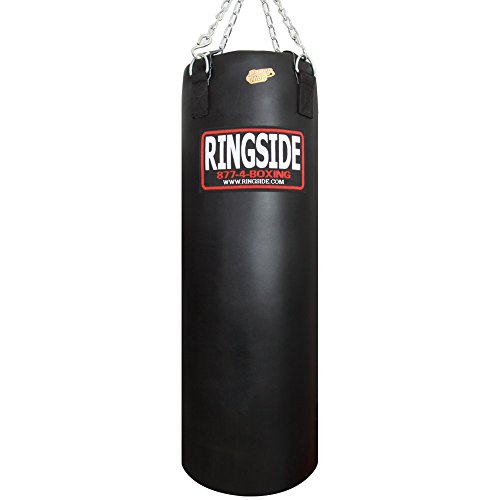

As an Amazon Associate we earn from qualifying purchases at no extra cost to you. Ratings are shown as listed on Amazon.
Quick picks by home-training situation
| Situation | Best bag type | Useful specification | Why it fits |
|---|---|---|---|
| Beginner with limited space | Compact hanging bag or freestanding bag | 50–70 lb; 10–13 in diameter | Requires less structural support and gives forgiving punch feedback |
| Apartment or rental home | Water-filled freestanding bag | Base approximately 20–30 gal; 200–300 lb when filled | Avoids drilling into joists, although vibration and floor clearance still matter |
| Regular boxing, three or more sessions weekly | Dense hanging heavy bag | 80–100 lb; 12–14 in diameter | Resists swinging and tolerates repeated combinations |
| Heavy puncher or kickboxer | Long, heavily filled hanging bag | 100–150 lb; 14–16 in diameter; 48–72 in length | Provides more mass and enough striking surface for punches, kicks, and knees |
| Mixed household use | Medium-density synthetic-leather bag | 70–100 lb; layered textile filling | Offers useful feedback without becoming excessively hard for lighter users |
Best heavy bags by use case
Best all-around hanging bag: 70- to 100-pound layered-fill bag
A conventional cylindrical bag in this range is the safest recommendation for a dedicated home boxing area. Look for a synthetic-leather or heavy-duty vinyl shell, reinforced top straps, a steel chain or swivel, and layered textile filling rather than a hard, compressed core. A 12-inch bag is space-efficient; a 14-inch bag feels more substantial and is less likely to twist under combinations.
This category suits adults learning basic footwork, straight punches, hooks, and body shots. It is also more practical than a 150-pound bag if several people of different sizes will train. Expect a general market price of roughly $100 to $250 for the bag and basic hanging hardware, with stronger brackets and professional installation costing extra.
Best for low-noise installation: water-filled freestanding bag
Freestanding models, including products such as the Century BOB XL and Century Wavemaster lines, are useful when ceiling joists cannot be modified. Their bases are filled with water or sand, and the striking column returns to position after impact. Water is easier to add and remove; sand creates a heavier, less mobile base but is more cumbersome to empty.
The trade-off is movement. A freestanding bag can rotate or slide during hard combinations, and the base transmits vibration into the floor. Place it on a dense rubber training mat, keep it away from walls, and leave enough room to circle it. These bags are often more expensive than basic hanging bags, commonly about $180 to $400 depending on height, base capacity, and target shape.
Best for a small room: compact 50- to 70-pound bag
A short bag with a 10- to 12-inch diameter can work in a garage, spare room, or basement where a full-length bag would interfere with furniture. Everlast Powercore products and comparable compact bags are examples of the space-saving format, although the exact model specifications vary.
Compact bags are not only shorter; they also tend to have less mass and a smaller target. That makes them useful for accuracy drills and short boxing combinations, but less suitable for full-power kicks or aggressive lateral movement. If your ceiling is low, calculate the lowest point of the bag, chain, and swivel before ordering. You need clearance above the bag as well as space below it for footwork.
Best for kickboxing and Muay Thai: long heavy bag
A long bag measuring about 48 to 72 inches gives you usable surfaces for head, body, thigh, and low-kick drills. Choose 100 to 150 pounds if the mounting structure can safely support it and the room permits a generous training radius. Outslayer and Ringside both sell long and heavy bag formats, but compare the actual dimensions and hardware included with the particular model.
Long bags usually swing more slowly than short, light bags, but they exert greater load on the anchor when they move. They also need more vertical clearance. A 6-foot bag plus chains may require a ceiling height near 9 feet to hang at a practical level without the bottom touching the floor.
How to choose the right weight
A common starting point is a bag weighing about half the user’s body weight, with a lower limit near 50 pounds for most adult boxing practice. This is only a guideline. A skilled 150-pound boxer may prefer a 100-pound bag, while a beginner may find that same bag too rigid and intimidating.
- 40–60 pounds: light technique work, children or smaller adults, and occasional use. Expect more swing.
- 70–100 pounds: the most versatile range for adult home boxing.
- 100–150 pounds: frequent training, powerful punchers, kickboxing, and reduced swinging.
- Over 150 pounds: specialized use; verify the complete mounting system and building structure first.
Weight affects movement, not just impact. A lighter bag forces you to manage its swing and can sharpen timing, but it may be frustrating for full-power combinations. A heavier bag gives a stable target, though it can return more force through your wrists and elbows if you strike with poor alignment. Pain, numbness, or persistent joint symptoms are reasons to stop and consult a qualified healthcare professional.
Filling and shell materials matter more than marketing labels
Layered textile filling
Shredded fabric and compressed textile layers are common in quality home bags. They produce a relatively even surface and can be adjusted by redistributing the contents. Over time, the filling may settle, creating a hard lower section or soft spot near the top. Periodic kneading and rotation can reduce unevenness, but a badly compacted bag may eventually need professional refilling.
Water-filled bags
Water creates a responsive, somewhat forgiving target and makes freestanding bases convenient to transport when empty. Temperature changes, leaks, and the large filled base are practical concerns. Never move a full base across a delicate floor without checking its weight capacity and using appropriate equipment.
Foam and air-core designs
Foam-covered bags can feel consistent and are often quieter than densely packed textile bags. Air-core targets are light and portable but are better for speed and accuracy than maximum-power work. A soft surface does not automatically mean low impact on your joints; technique and hand protection still matter.
Hanging requirements: the part buyers underestimate
A 100-pound bag can impose substantially more than 100 pounds of dynamic force on its anchor as it swings. Attach a heavy bag to a structural ceiling joist, a properly installed wall bracket, or a purpose-built frame—not drywall, a decorative beam, or an unverified ceiling hook.
Before installation, identify the joist or studs, check the bracket’s stated load rating, and use a swivel designed for heavy-bag movement. Four-point straps can reduce chain noise, while a spring between the swivel and bag can soften vibration. However, springs also allow more movement and are not a substitute for structural support.
As a practical clearance check, leave at least 24 inches from the bag to the nearest wall and enough open area for a full step in every training direction. If the bag is 14 inches in diameter, a 24-inch gap from its outer surface means the anchor must be roughly 31 inches from the wall. That calculation prevents the common mistake of measuring from the center point rather than the bag’s edge.
Ownership costs and maintenance
The bag is only part of the budget. Allow roughly $25–$80 for a swivel, chains, straps, or a ceiling plate, plus $30–$100 for a quality rubber mat. Hand wraps and gloves are consumables: wraps stretch and absorb sweat, while glove padding and lining eventually compress or develop odor. A typical home user should expect to replace wraps regularly and inspect gloves and hardware every few months.
- Wipe the shell after each session with a lightly damp cloth, then dry it fully.
- Do not soak textile-filled bags or use harsh solvents that can weaken vinyl or synthetic leather.
- Inspect stitching, D-rings, chains, carabiners, swivels, and ceiling bolts at least monthly.
- Rotate a hanging bag periodically if one striking zone is receiving most of the impact.
- Keep water-filled bases away from freezing conditions and check for slow leaks.
- Use boxing gloves and hand wraps rather than bare knuckles, especially on dense bags.
Bottom line
Choose a 70- to 100-pound hanging bag if you want the best general-purpose home boxing option and have a verified structural anchor. Choose a freestanding water-filled model when drilling or ceiling access is the limiting factor. Pick a 100- to 150-pound long bag for regular kickboxing or powerful combinations, and choose a compact 50- to 70-pound bag when room size and installation constraints matter more than maximum stability. The right heavy bag is the one that fits your structure, clearance, training frequency, and technique—not the one with the largest number on its label.

Write Your Review
No reviews yet. Be the first to share your experience!