

Key takeaways
- Window closures: Zippers collect grit and can fail before the main fabric. Brush them clean and never force a jammed slider.
- Hub joints: Dirt and dried mud can make folding difficult. Wipe the frame before packing and inspect for bent rods.
- Fabric coatings: Folding a wet blind is the fastest route to mildew and odor. Dry it completely at home, preferably out of direct sunlight.
- Stakes and tie-downs: Lightweight stakes are easy to bend or lose. Carry spares and use every tie-down point during strong wind.
- Carry bags: The bag often develops tears at the zipper or handle first. Do not overstuff it; fold the blind loosely enough that the hubs are not under constant strain.
Best Ground Blinds for Comfortable Concealment
The best ground blinds for most hunters are a hub-style blind with enough room to draw or shoulder a weapon comfortably, silent-adjusting shooting windows, and a rain-resistant shell; the right model then depends on whether you prioritize fast setup, maximum interior space, visibility, or packability.
Quick picks by hunting situation
| Hunting situation | Best blind type or pick | Why it fits | Trade-off |
|---|---|---|---|
| Solo bowhunter who relocates often | Compact one- or two-person hub blind | Usually sets up in about 60 seconds and weighs roughly 12–18 lb | Limited elbow room and fewer usable windows |
| Two hunters or a hunter with a child | Two- or three-person hub blind | More room for movement, gear, and a second shooting position | Typically 18–30 lb and more conspicuous in transport |
| Long sits in wind, rain, or snow | Heavy-duty hub blind with a full skirt | Better fabric, stronger hubs, and more effective ground-level weather protection | Slower to carry and often more expensive |
| Archery hunting with several approach routes | Wide-visibility or 360-degree-window blind | Improves side and rear visibility while keeping the hunter concealed | More window management is required, and the interior may be brighter |
| Budget-conscious occasional hunter | Basic two-person hub blind | Useful capacity without premium window systems | More noise, lighter fabric, and fewer refinement features |
What separates the best ground blinds from merely usable ones?
Setup time is more than the advertised number
Most modern hub blinds can be opened in roughly one to three minutes by one person. That figure usually describes the frame only. Real setup also includes choosing a level location, staking the corners, brushing in the exterior, arranging a chair, and opening the correct windows. A realistic field-ready time is often five to ten minutes.
Our top picks


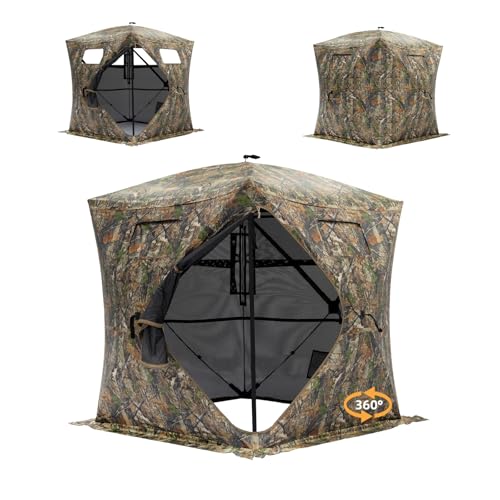
As an Amazon Associate we earn from qualifying purchases at no extra cost to you. Ratings are shown as listed on Amazon.
Hub frames are generally the best choice for mobile hunters because the roof and wall hubs deploy as one assembly. Spring steel pop-up blinds can be lighter, but they may offer less interior structure and can be awkward to fold. Permanent or semi-permanent tower-style concealment provides comfort but does not suit a hunt that requires frequent relocation.
Look for oversized hubs that are easy to grip with gloves, webbing loops rather than thin elastic pull cords, and a carry bag that does not require perfect folding. A blind that deploys quickly but takes 20 frustrating minutes to repack is not truly convenient.
Interior room determines whether you can shoot naturally
Manufacturers often describe a blind as “two-person” or “three-person,” but that capacity can mean three upright occupants sitting shoulder to shoulder. For bowhunting, count on one fewer occupant than the label suggests. A practical two-person hunting blind should provide at least 60 inches of interior width, while a three-person model is more comfortable around 70–80 inches wide.
Check the blind’s height as well as its floor dimensions. A low roof can interfere with a compound bow at full draw, especially when the hunter is seated on a tall chair. A roof height around 70 inches gives most seated archers more margin, but the window sill and roof angle matter just as much. Rifle hunters generally need less vertical clearance, yet a cramped blind still makes it harder to turn quietly and maintain a stable shooting position.
Before buying, measure your chair, weapon, and largest item of clothing. A useful minimum allowance is approximately 12 inches of open floor beside the chair for a bow, pack, or shooting sticks. If two people will hunt together, test whether both can reach their intended windows without crossing arms or bumping the frame.
Shooting-window design affects concealment and safety
The most versatile blinds combine several window styles rather than using one large opening. Full-length horizontal windows work well for rifles and crossbows. Smaller vertical openings are often easier for archers because they reveal less movement. A lower mesh window can provide visibility while keeping the weapon below the main sightline.
Silent window adjustment is essential. Zippers can be quiet when operated slowly, but hook-and-loop closures are usually faster and can be noisy in cold, dry conditions. Some premium designs use adjustable fabric panels, rigid window covers, or shoot-through mesh. Shoot-through mesh can be convenient, but confirm that the manufacturer approves it for your weapon and ammunition; do not assume every mesh is safe for broadheads or rifle fire.
For bowhunting, choose a window that opens wide enough for the limbs and cams without forcing the bow against fabric. For rifle hunting, prioritize a stable lower edge that can support the fore-end without pushing the barrel into the wall. Never allow a muzzle to contact blind fabric, and follow the weapon manufacturer’s guidance on shooting through any material.
Weather resistance and camouflage: what matters in the field
Water resistance is not just a fabric rating. Seams, zippers, roof geometry, and the bottom skirt determine whether a blind stays comfortable during a full-day sit. A roof with a pronounced peak sheds water better than a nearly flat top. A sewn-in skirt helps block drafts and splashing mud, while removable stakes let you tension the walls in wind.
Most hunting blinds use polyester fabric with a water-repellent finish. That finish can weaken after repeated folding, abrasion, and exposure to dirt. A blind that is merely water-resistant may be adequate for short hunts, but hunters who sit through sustained rain should look for taped or well-sealed seams, a heavier roof panel, and a removable rain cover if offered.
Camouflage should match the dominant background at the hunting site, not simply the animal being pursued. A dark timber pattern can disappear in shaded woods but look conspicuous in open grass. A more neutral bark-and-leaf pattern is versatile across seasons. Snow-specific covers are useful in regions with consistent snowfall; a thin white sheet loosely draped over a dark blind is less secure and can flap in wind.
Regardless of pattern, break up the blind’s outline. Add local vegetation only where it will not block windows or create noise. Do not permanently attach wet branches or leaves to the fabric, because trapped moisture promotes mildew.
Head-to-head: compact versus oversized hub blinds
| Characteristic | Compact one- or two-person hub | Large two- or three-person hub |
|---|---|---|
| Typical packed weight | 12–18 lb | 18–30 lb |
| Typical interior width | 48–60 in | 65–80 in |
| Typical setup time | 1–3 minutes for frame; 5–8 minutes field-ready | 2–4 minutes for frame; 6–12 minutes field-ready |
| Best use | Run-and-gun scouting, solo archery, tight cover | Long sits, shared hunts, extra gear, rifle or crossbow setups |
| Main weakness | Restricted movement and storage | More visible, heavier, and harder to conceal |
The compact blind wins when position matters more than comfort. It is easier to carry into a new location and can fit between trees or along a field edge. The larger blind is preferable when you will remain in one location for several hours, need to move quietly, or want room for a second person. Bigger is not automatically better: excess interior space can increase movement, light leakage, and the amount of fabric exposed to wind.
Ownership realities: what wears out first
- Window closures: Zippers collect grit and can fail before the main fabric. Brush them clean and never force a jammed slider.
- Hub joints: Dirt and dried mud can make folding difficult. Wipe the frame before packing and inspect for bent rods.
- Fabric coatings: Folding a wet blind is the fastest route to mildew and odor. Dry it completely at home, preferably out of direct sunlight.
- Stakes and tie-downs: Lightweight stakes are easy to bend or lose. Carry spares and use every tie-down point during strong wind.
- Carry bags: The bag often develops tears at the zipper or handle first. Do not overstuff it; fold the blind loosely enough that the hubs are not under constant strain.
Expect consumables such as replacement stakes, guy lines, and occasional zipper lubricant to be part of ownership. Avoid spraying silicone or oil onto fabric unless the manufacturer permits it, because some products can damage water-repellent coatings or attract grit.
A simple cost-per-use calculation
Suppose a $180 blind is used 12 times per season for four seasons. That is 48 outings, or $3.75 per use before replacement parts. A $300 heavy-duty blind used 30 times per season for four seasons costs $2.50 per use. The more expensive option can therefore be the better value for a frequent hunter, while an occasional hunter may sensibly choose the lighter, less expensive design.
For most buyers, the best ground blind is a two-person hub model with at least 60 inches of usable width, quiet adjustable windows, a sewn-in skirt, and fabric substantial enough for the local weather. Choose a compact version for mobility, a larger version for comfort, and a visibility-focused design when archery shot opportunities can come from several directions.



Write Your Review
No reviews yet. Be the first to share your experience!