

Key takeaways
- Find the best woodworking radial arm saws for crosscuts, miters, rips and dadoes. Compare five genuine radial arm saws, specs, safety checks and tips.
A radial arm saw hangs a circular blade and motor from an overhead arm above a fixed table. You pull the cutting head toward you for a crosscut, swing the arm for a miter, tilt the head for a bevel, and rotate the head for a rip. That range made the radial arm saw the centre of many wood shops for decades, and it still earns its floor space for wide crosscuts, repeated cuts with a stop, and dado work.

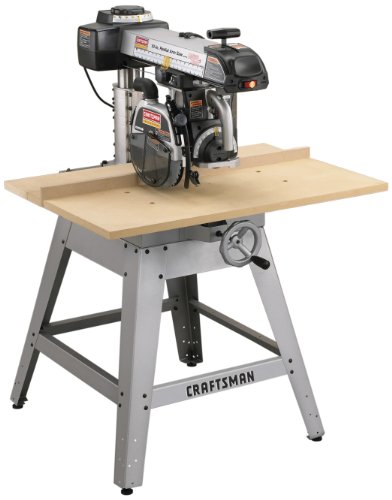
Be honest about the market before you shop. True radial arm saws are mostly vintage or industrial machines now, and sliding compound miter saws took over most crosscutting work. Most buyers will shop the used market and check the guard and alignment in person. The five saws below are all genuine radial arm saws, not sliding miter saws dressed up under a different name.
As an Amazon Associate, I earn from qualifying purchases.
How to Choose a Radial Arm Saw
Start with the work you will do. For boards up to 12 inches wide, a 10-inch saw is enough. For wide panels or door parts, look for a 12-inch or 14-inch saw with a longer crosscut and a large table, which supports long stock and makes repeated cuts with a fence stop more consistent.
Check the blade size and the motor together. A 10-inch saw with a 1.5 horsepower motor handles most home-shop crosscuts and dadoes. A 12-inch or 14-inch industrial saw with a 3 horsepower motor cuts thicker stock with less strain, but it may need a 240-volt circuit, so check your shop wiring first. Use a blade made for a radial arm saw, with a negative or low hook angle, since an aggressive positive hook angle can climb toward you during a crosscut.
Check the arm, the carriage, and the guard. The arm should swing smoothly and lock firmly at 0 and 45 degrees, and the carriage should slide without side play or binding. The upper hood and lower blade guard must be present and complete, and the head should return to the rear of the arm when you let go. For ripping, the saw needs anti-kickback fingers on both sides of the blade. Older Craftsman saws were part of a large guard recall, so match the model number to the recall information, and never buy a saw with a missing guard, a damaged cord, or a switch that sticks.
Think about weight and support. A home-shop radial arm saw weighs roughly 80 to 200 pounds, while an industrial model can weigh 550 to 750 pounds, so plan for help moving it and a permanent spot in the shop. Before you buy a used saw, find its manual by model number and ask the seller to run the saw so you can listen for bearing noise.
Comparison Table
| Saw | Blade | Crosscut | Weight | Best for |
|---|---|---|---|---|
| Dayton 49G998 | 10 and 12 inch | 16.5 inches | 378 pounds | General shop work |
| General International 14-Inch | 14 inch | 25 inches | 550 pounds | Industrial crosscuts |
| Craftsman 9-22010 Professional | 10 inch | 14 inches | 78.9 pounds | Home shops |
| Delta RS830 | 10 inch | 16 inches | 181 pounds | First radial arm saw |
| Delta 33-400 | 14 inch | 29 inches | 749 pounds | Large industrial work |
Dayton 49G998 Radial Arm Saw
The Dayton 49G998 is a 1 horsepower radial arm saw that works with both 10-inch and 12-inch blades. Its motor runs at 3,400 RPM, and the saw handles crosscuts up to 16.5 inches, or 11.75 inches at 45 degrees. Rip capacity reaches 31.5 inches. The saw comes with a floor stand and an oversized work table, a blade guard, and an automatic blade brake.
- Specs:
- Blade size: 10 and 12 inches
- Motor: 1 horsepower, 115 volts
- Motor speed: 3,400 RPM
- Crosscut capacity: 16.5 inches
- Rip capacity: 31.5 inches
-
Weight: 378 pounds
General International 14-Inch Radial Arm Saw
The General International 14-inch radial arm saw is an industrial machine built around a heavy cast iron and steel frame. At about 550 pounds it stays put, damps vibration, and suits a shop that cuts wide stock day after day. The 14-inch carbide-tipped blade cuts to a depth of 4.625 inches at 90 degrees and 3.125 inches at 45 degrees, with a maximum crosscut of 25 inches. A magnetic switch keeps the saw from restarting on its own after a power cut, and overload protection guards the motor.
- Specs:
- Blade size: 14 inches
- Arbor diameter: 1 inch
- Maximum depth of cut at 90 degrees: 4.625 inches
- Maximum crosscut: 25 inches
- Motor speed: 3,450 RPM
-
Weight: 550 pounds
Craftsman 9-22010 Professional Radial Arm Saw
The Craftsman 9-22010 Professional is a 10-inch radial arm saw made for home shops, and it is the lightest saw in this guide at 78.9 pounds. Craftsman no longer makes radial arm saws, so you will mostly find this model used. Its Laser Trac system marks the cut line on the work, which helps you line up crosscuts without guessing where the blade will land. The saw crosscuts boards up to 14 inches wide and handles miters and bevels to 45 degrees. Before buying, check that the blade guard is complete and covers the blade fully, and match the model against the guard recall information.
- Specs:
- Blade size: 10 inches
- Crosscut capacity: 14 inches
- Miter capacity: 45 degrees
- Bevel capacity: 45 degrees
- Features: Laser Trac guide, feed rate monitor, blade brake
-
Weight: 78.9 pounds
Delta RS830 Radial Arm Saw

The Delta RS830 is a 10-inch professional radial arm saw with a 16-inch crosscut capacity, and it is a sensible first radial arm saw for a home shop. Its 1.5 horsepower motor runs on 120 or 240 volts and is shipped wired for 120 volts, so most home shops can run it without rewiring. Depth of cut reaches 2.75 inches at 90 degrees and 2.5 inches at a 45-degree bevel. The saw includes a steel stand, a cast iron track, an extra-large table, a saw blade, and wrenches, and a dual-threaded shaft lets you attach a range of accessories.
- Specs:
- Blade size: 10 inches
- Motor: 1.5 horsepower, 120 or 240 volts
- Motor speed: 3,450 RPM
- Maximum crosscut: 16 inches
- Depth of cut at 90 degrees: 2.75 inches
-
Weight: 181 pounds
Delta 33-400 Radial Arm Saw

The Delta 33-400 is a large industrial radial arm saw with a turret arm design that sets it apart from the smaller saws in this guide. The arm rotates a full 360 degrees above the work table, which gives you more freedom to set up miters and other cuts around a large workpiece. Crosscut capacity reaches 29 inches and rip capacity reaches 41 inches, so this saw handles wide panels and long boards that would overwhelm a home-shop saw. Its 3 horsepower motor drives a 14-inch blade, and an electro-mechanical blade brake stops the blade after a cut.
- Specs:
- Blade size: 14 inches
- Motor: 3 horsepower
- Maximum crosscut: 29 inches
- Maximum rip: 41 inches
- Table size: 44 by 36.5 inches
-
Weight: 749 pounds
Which Radial Arm Saw Should You Pick
For most home shops, the Delta RS830 is the best starting point: a full-size 10-inch saw with a 16-inch crosscut, a 1.5 horsepower motor on a standard home circuit, and a complete guard and brake setup. Pick the Craftsman 9-22010 for the lightest saw here, or the Dayton 49G998 for a heavier general-shop saw that accepts 10-inch and 12-inch blades. For industrial work, pick the General International 14-inch saw for wide crosscuts in thick stock, or the Delta 33-400 for its 360-degree turret arm, 29-inch crosscut, and 41-inch rip. If a radial arm saw is more machine than your shop needs, a sliding compound miter saw is the honest alternative for crosscuts and miters, but it cannot rip.
Frequently Asked Questions
Are radial arm saws still made?
Yes, but only by a small number of industrial makers now. Most familiar home-shop brands stopped making them years ago, so most buyers shop the used market or buy an industrial model.
What is a radial arm saw best used for?
It is best used for wide crosscuts, repeated cuts with a fence stop, miters, bevels, and dadoes. It can also rip by rotating the head, but ripping needs extra care, a complete guard, and anti-kickback fingers.
What blade should I use on a radial arm saw?
Use a blade made for a radial arm saw, with a negative or low hook angle, in the size and arbor your saw calls for. The blade must be rated for at least the speed your saw runs at.
Is a radial arm saw better than a sliding miter saw?
It depends on the work. A radial arm saw cuts wider stock, rips, and handles dadoes, and it stays set up as a station in the shop. A sliding miter saw is lighter, smaller, and easier to move, and it covers most crosscutting and miter work.
Conclusion
A radial arm saw is still a capable woodworking machine, but it is a machine you buy with your eyes open. The best woodworking radial arm saws in this guide cover the full range, from the light Craftsman home-shop saw to the heavy Delta 33-400 industrial saw. Match the saw to your shop, inspect any used saw in person, and check the guard.
More from Amazon
Programs that pair well with the guide above. Offers and eligibility are set by Amazon and may change.
A free business account with business pricing and bulk-buying tools for work, shop or home office.
Create a business accountFree shipping on eligible items, Prime Video and more. Eligible new members can start with a free trial.
Start a Prime free trialAudiobooks and podcasts to listen to on the go. Eligible new members can start with a free trial.
Try Audible freeAd-free music streaming. Eligible new subscribers can start with a free trial.
Try Music Unlimited freeAs an Amazon Associate we earn from qualifying purchases.

Write Your Review
No reviews yet. Be the first to share your experience!