

Key takeaways
- Compare the best pin nailers for woodworking, from pneumatic micro-pinners to cordless models, and find the right 23-gauge tool for trim and cabinets.
A pin nailer is the quiet specialist of the woodworking shop. A 23-gauge pin nailer drives headless pins so fine that the hole they leave behind is nearly invisible, which makes it the right tool for holding small moldings, delicate trim, veneer, and glued joints while the glue sets.

A pin nailer is not a replacement for a heavier nailer: a 23-gauge pin has almost no holding power on its own, so it works as a clamp that holds parts in place while glue cures. The five models below cover both sides of the market, with three pneumatic pinners for the bench and two cordless pinners for work away from a compressor.
As an Amazon Associate, I earn from qualifying purchases.
How to Choose a Pin Nailer for Woodworking
Start with the power source. Pneumatic pin nailers are lighter, simpler, and usually less expensive, but they need a compressor and a hose. If your work stays at the bench, pneumatic is the practical choice. Cordless pin nailers run on a battery platform, so they are the better pick where a hose is a nuisance. If you already own Milwaukee or Makita batteries, a bare-tool cordless pinner slots straight into your kit.
Next, check the pin length range. Most 23-gauge pinners drive pins from 5/8 inch to 1-3/8 inches, which covers thin trim, small moldings, picture frames, and veneer. A few models stretch to 2-inch pins, and that extra length matters when you need to pin through thicker trim into hardwood.
Look for a tool-free depth adjustment. Pin depth is fussy: a pin driven too deep can blow through thin stock, while a pin left proud has to be set by hand. A depth dial lets you tune the setting for each species without touching the compressor regulator. A tool-free jam release is just as useful, since thin pins can bend and jam.
Weight and nose design matter too. A pinner lives in your hand for long stretches of detail work, so a light tool matters. A narrow nose reaches into tight corners where a wide body cannot fit. A dry-fire lockout is worth having: it stops the tool from firing when the magazine runs empty, which protects the driver blade and the workpiece.
Comparison Table
| Model | Power | Pin Length | Magazine | Best For |
|---|---|---|---|---|
| DEWALT DWFP2350K | Pneumatic | 5/8 to 2 in. | 130 pins | Long pins in hardwood |
| Bostitch BTFP2350K | Pneumatic | 5/8 to 2 in. | 130 pins | Everyday shop pinning |
| Porter-Cable PIN138 | Pneumatic | 5/8 to 1-3/8 in. | 100 pins | First pin nailer |
| Milwaukee M12 2540-20 | 12V cordless | 5/8 to 1-3/8 in. | 110 pins | Cordless trim work |
| Makita XTP02Z | 18V cordless | 5/8 to 1-3/8 in. | 120 pins | Makita battery owners |
DEWALT DWFP2350K 23-Gauge Pin Nailer
The DEWALT DWFP2350K is the pinner to buy if you need the longest reach in this class. It drives 23-gauge pins up to 2 inches long, which is rare for a micro-pinner, and it sinks those long pins cleanly into dense hardwoods such as oak without bending them.
It was the first 23-gauge pin nailer with a tool-free jam release. When a thin pin bends in the nose, you unlatch the cover and clear it without hunting for a wrench. A tool-free depth adjustment dial lets you fine-tune pin depth for soft pine one minute and hard maple the next. The kit includes a carrying case.
- Specs:
- 23-gauge pneumatic pin nailer
- Drives pins from 5/8 inch to 2 inches
- Tool-free jam release
- Tool-free depth adjustment
- Sequential firing mode
-
Includes carrying case
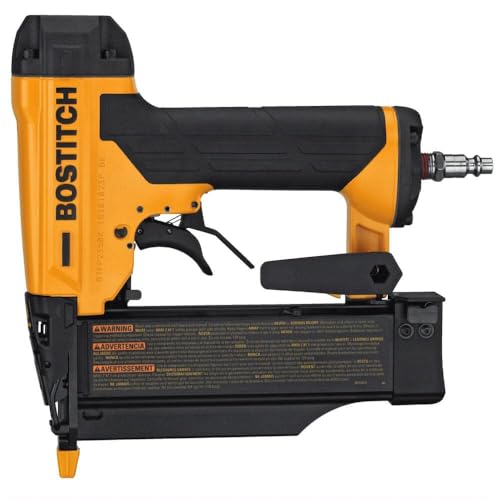
Bostitch BTFP2350K 23-Gauge Pin Nailer
The Bostitch BTFP2350K is the workhorse of this group. It shares the same 2-inch pin capacity as the DEWALT above, since both brands sit under the same parent company, but the Bostitch has its own character: a rear exhaust that blows air away from the workpiece, and a 7-year limited warranty that is generous for a shop tool.
Like its sibling, it drives 23-gauge pins from 5/8 inch to 2 inches, with a tool-free depth adjustment dial and a tool-free jam clearance system. It runs at 70 to 120 PSI, which any small shop compressor can supply.
- Specs:
- 23-gauge pneumatic pin nailer
- Drives pins from 5/8 inch to 2 inches
- Tool-free depth adjustment dial
- Tool-free jam clearance
- Rear exhaust directs air away from work
- Operating pressure 70 to 120 PSI
-
7-year limited warranty
Porter-Cable PIN138 23-Gauge Pin Nailer
The Porter-Cable PIN138 is the simplest and most approachable pinner in this guide, and the best starting point if you have never owned one. It drives 23-gauge pins from 5/8 inch to 1-3/8 inches, which covers the vast majority of pinning jobs: small trim, moldings, crafts, and picture frames.
What makes it a good first pinner is that it arrives ready to work. The kit includes 2,000 pins, a wrench, and a carrying case, so you can put it to use the moment it comes out of the box. The narrow nose reaches into tight spots. The trade-off is pin length: at 1-3/8 inches maximum, it cannot reach as deep as the DEWALT or the Bostitch.
- Specs:
- 23-gauge pneumatic pin nailer
- Drives pins from 5/8 inch to 1-3/8 inches
- Magazine capacity 100 pins
- Includes 2,000 pins, wrench, and carrying case
-
Narrow nose for tight corners
Milwaukee M12 2540-20 23-Gauge Pin Nailer

The Milwaukee M12 2540-20 is the cordless pinner for woodworkers who already live on the M12 platform. It runs on a 12-volt M12 battery, so there is no compressor and no hose to drag around the shop or the job site. It is sold as a bare tool, with no battery or charger included.
Inside, a nitrogen air spring mechanism drives pins to a consistent depth in both hard and soft woods while leaving small, clean holes. Milwaukee describes it as the most compact cordless pin nailer in its class, and the slim body reaches into tight spaces where a hose-fed tool would get in the way. It drives 23-gauge pins from 5/8 inch to 1-3/8 inches, with a magazine that holds 110 pins.
- Specs:
- 23-gauge cordless pin nailer
- Runs on Milwaukee M12 12-volt batteries
- Drives pins from 5/8 inch to 1-3/8 inches
- Magazine capacity 110 pins
- Nitrogen air spring mechanism
-
Bare tool only, battery and charger sold separately
Makita XTP02Z 18V LXT Pin Nailer
The Makita XTP02Z is the cordless pinner for the 18-volt LXT platform, and the most feature-rich cordless model in this guide. It drives six different lengths of 23-gauge pins, from 5/8 inch to 1-3/8 inches, with a magazine capacity of 120 pins, the largest of the two cordless picks here.
An anti-dry-fire mechanism stops the tool from firing when the magazine is empty, protecting the driver and the workpiece. A built-in LED light illuminates the work area, which helps when pinning inside cabinets or in dim corners. It is sold as a bare tool, so you will need an 18-volt LXT battery and charger if you do not already own them.
- Specs:
- 23-gauge cordless pin nailer
- Runs on Makita 18V LXT batteries
- Drives pins from 5/8 inch to 1-3/8 inches
- Magazine capacity 120 pins
- Anti-dry-fire mechanism
- Built-in LED work light
- Includes two no-mar tips, belt hook, and safety glasses
-
Bare tool only, battery and charger sold separately
Which Pin Nailer Should You Pick
If you want the most capable pneumatic pinner, buy the DEWALT DWFP2350K. Its 2-inch pin capacity handles the widest range of jobs. If you want the same long-pin capability with a longer warranty and a rear exhaust, buy the Bostitch BTFP2350K. If this is your first pin nailer, buy the Porter-Cable PIN138: it covers the standard pin range and arrives with pins and a case. If you want to cut the hose, match the cordless pinner to the batteries you already own: Milwaukee M12 owners should buy the M12 2540-20, while Makita 18-volt LXT owners should buy the XTP02Z.
FAQ
What is a 23-gauge pin nailer used for in woodworking?
A 23-gauge pin nailer drives thin, headless pins that leave nearly invisible holes. Woodworkers use it to hold small trim, moldings, veneer, and glued joints in place while the glue sets.
Can a pin nailer replace a brad nailer?
No. A 23-gauge pin has very little holding power on its own, so it works as a temporary clamp while glue cures rather than as a structural fastener. A brad nailer drives thicker 18-gauge nails with real holding strength for trim and casing.
Do I need a compressor for a pin nailer?
Pneumatic pin nailers need a compressor and a hose, and any small shop compressor that supplies 70 to 120 PSI will run one. Cordless pin nailers run on a battery platform instead, so they need no compressor at all.
What size pins should I buy for a 23-gauge pin nailer?
Most 23-gauge pinners accept pins from 5/8 inch to 1-3/8 inches, and a few models take pins up to 2 inches. As a rule, the pin should be long enough to pass through the trim and bite into the wood behind it, but short enough not to poke through the back of the piece.
Conclusion
A 23-gauge pin nailer earns its place in a woodworking shop by doing one job better than any other tool: holding delicate parts exactly where you want them while the glue does the real work. Pneumatic models such as the DEWALT, Bostitch, and Porter-Cable picks above are ready for the bench. Cordless models from Milwaukee and Makita free you from the hose when the work moves away from the compressor.
More from Amazon
Programs that pair well with the guide above. Offers and eligibility are set by Amazon and may change.
A free business account with business pricing and bulk-buying tools for work, shop or home office.
Create a business accountFree shipping on eligible items, Prime Video and more. Eligible new members can start with a free trial.
Start a Prime free trialAudiobooks and podcasts to listen to on the go. Eligible new members can start with a free trial.
Try Audible freeAd-free music streaming. Eligible new subscribers can start with a free trial.
Try Music Unlimited freeAs an Amazon Associate we earn from qualifying purchases.
Write Your Review
No reviews yet. Be the first to share your experience!