

Key takeaways
- Find the best woodworking borescopes for wall cavities, machinery, and joints — five inspection cameras with screens, phone links, and steerable probes.
A borescope earns its place in a woodshop the first time it saves a wall, a cabinet, or a machine from being opened up on a guess. A small camera on a slim cable slips through a drilled hole or a gap behind a panel and shows what is really going on inside. You can check for a blocked dust port, a loose wire inside a wall, or a dropped screw inside a table saw cabinet without taking half the shop apart.


The best woodworking borescopes balance three things: a probe slim enough for the holes you already drill, a cable long enough to reach the far side of a cavity, and a screen clear enough to show detail in the dark. The five picks below cover the main shapes of the tool, from a phone-connected scope to a steerable model.
As an Amazon Associate, I earn from qualifying purchases.
How to Choose a Woodworking Borescope
Start with probe diameter. A probe around 5.5 mm slips through a small drilled hole and into narrow gaps between studs and inside mortises. A probe around 8 mm still fits most inspection holes and usually carries a brighter light, but it needs a larger entry hole. Measure the smallest opening you can use before you order.
Cable length matters just as much. A 5-foot cable suits a cabinet or machine housing, while a 16.5-foot cable reaches across a room or deep into a ceiling cavity. Semi-rigid cable holds its shape as you push it forward.
Next, decide how you want to see the image. A borescope with its own screen works the moment you switch it on, with no phone or app in the way, which is handy when your hands are dusty. A phone-connected scope uses the phone you already carry as its screen, which keeps the tool small and light. The trade-off is that you need a compatible phone, the right adapter, and the maker’s app installed first.
Lens layout changes what you can see. A single forward lens looks straight ahead, which suits most wall checks. A dual-lens probe adds a side lens, so you can look along the inside face of a wall without pulling the probe out. An articulating probe goes further: its tip bends under your control, so you can look around a corner.
Light and waterproofing finish the shortlist. Adjustable LEDs matter because a bright light washes out a close surface, while a dim light leaves a deep cavity in shadow. An IP67-rated probe resists dust and brief immersion. On a screen model, check battery life too: several hours per charge covers a full afternoon.
Comparison Table
| Borescope | Screen | Probe | Cable | Best For |
|---|---|---|---|---|
| Teslong Two-Way Articulating | 4.5-inch IPS | 8.5 mm, articulating | 5 ft | Steering around corners |
| Teslong NTS500 Dual Lens | 5-inch IPS | 5.5 mm, dual lens | 9.8 ft | Slim access and long reach |
| DEPSTECH DS500 Dual Lens | 5-inch IPS | 7.9 mm, dual lens | 16.5 ft | Long wall and duct runs |
| DEPSTECH NTC55 2K | Phone screen | 7 mm, dual lens | 16.5 ft | Pocketable phone inspections |
| DEPSTECH DS380 Dual Lens | 4.3-inch LCD | 5.5 mm, dual lens | 16.5 ft | Compact standalone viewing |
Our Picks
Teslong Two-Way Articulating Borescope
The Teslong Two-Way Articulating Borescope is the pick for jobs where the camera needs to look around a corner rather than straight ahead. Its tip bends in two directions, so you can peer behind a stud or check the far side of a joint without enlarging the entry hole. The dedicated 4.5-inch IPS screen keeps the tool self-contained: switch it on, feed the probe in, and steer with the control on the handle.
- Specs:
- Screen: 4.5-inch IPS LCD
- Probe diameter: 8.5 mm
- Cable length: 5 ft, semi-rigid
- Articulation: two-way, steerable tip
- Image capture: 1080p
- Waterproof rating: IP67, probe only
- Lighting: adjustable LED lights
- Storage: microSD card support
Teslong NTS500 Dual Lens Borescope
The Teslong NTS500 Dual Lens Borescope pairs a slim probe with a large screen, making it the most versatile standalone scope in this guide. Its 5.5 mm dual-lens probe passes through narrow gaps that stop wider probes, and a button switches between the forward lens and the side lens. The 5-inch IPS screen is large enough to show fine detail, such as a crack in a glue line.
- Specs:
- Screen: 5-inch IPS LCD, 720p display
- Probe diameter: 5.5 mm, 0.21 inch
- Lenses: dual lens, front and side view
- Cable length: 9.8 ft, semi-rigid
- Image capture: 1920 x 1080 photos
- Waterproof rating: IP67, probe only
- Battery: 3500 mAh rechargeable
- Storage: 32 GB microSD card included
- Included: hard carrying case
DEPSTECH DS500 Dual Lens Inspection Camera
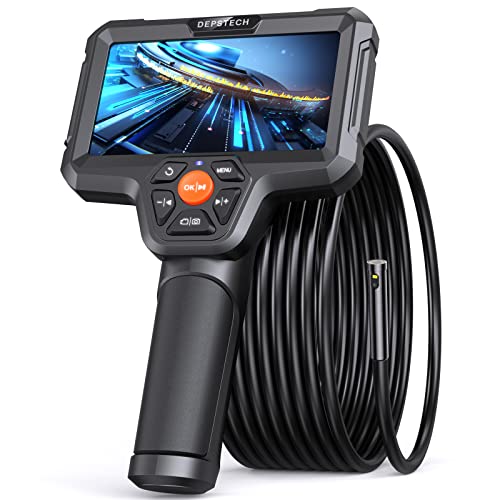
The DEPSTECH DS500 Dual Lens Inspection Camera is built for long runs. Its 16.5-foot semi-rigid cable crosses a room, follows a dust collection duct, or reaches the far end of a ceiling cavity, and the dual-lens probe switches between a forward view and a side view at the press of a button. The 5-inch IPS screen shows a 1080p image.
- Specs:
- Screen: 5-inch IPS LCD
- Probe diameter: 7.9 mm
- Lenses: dual lens, front and side view
- Cable length: 16.5 ft, 5 m, semi-rigid
- Video capture: 1080p
- Waterproof rating: IP67, probe only
- Battery: 5000 mAh, up to 7 hours
- Storage: 32 GB TF card included
- Included: hook, magnet, hard case, USB-C charging
DEPSTECH NTC55 2K Endoscope Camera
The DEPSTECH NTC55 2K Endoscope Camera is the pocket pick in this guide. It has no screen of its own: it plugs into a phone and uses the phone as its display through the DEPSTECHCAM app. That keeps the tool small enough to carry in a tool bag pocket. The 2K sensor records at 2560 x 1440, the sharpest image in this guide, and the dual lenses give front and side views without repositioning the probe.
- Specs:
- Screen: phone display via DEPSTECHCAM app
- Probe diameter: 7 mm
- Lenses: dual lens, front and side view
- Cable length: 16.5 ft, 5 m, semi-rigid
- Video capture: 2K, 2560 x 1440
- Viewing angle: 80 degrees
- Waterproof rating: IP67, probe and cable
- Connectivity: USB-C and Lightning adapters included
- Included: hook and magnet attachments
DEPSTECH DS380 Dual Lens Borescope

The DEPSTECH DS380 Dual Lens Borescope is the compact standalone option. Its 4.3-inch LCD screen is smaller than the 5-inch screens above, but the whole unit is lighter and easier to hold one-handed. The 5.5 mm dual-lens probe is the slimmest standalone probe in this guide, so it fits through the smallest entry holes, and the side lens helps you inspect the inner face of a wall without withdrawing the probe.
- Specs:
- Screen: 4.3-inch LCD
- Probe diameter: 5.5 mm, 0.21 inch
- Lenses: dual lens, front and side view
- Cable length: 16.5 ft, semi-rigid
- Video capture: 1080p
- Waterproof rating: IP67, probe and cable
- Lighting: 7 adjustable LEDs
- Storage: 32 GB TF card included
- Included: hook, magnet, hard case
Which Woodworking Borescope Should You Pick
Choose the Teslong Two-Way Articulating Borescope if you need to steer the camera around corners inside cabinets and machine housings. Choose the Teslong NTS500 for the best mix of a slim probe, a large screen, and a replaceable probe. Choose the DEPSTECH DS500 if your inspections run long and far, since its 16.5-foot cable and seven-hour battery cover the biggest jobs in this guide.
Choose the DEPSTECH NTC55 if you want the smallest tool and the sharpest image, and you are happy using your phone as the screen. Choose the DEPSTECH DS380 for a standalone screen in the smallest, lightest package. Whichever model you pick, drill a small test hole first, feed the cable slowly, and keep the lens clean.
Frequently Asked Questions
What size hole does a woodworking borescope need?
It depends on the probe. A 5.5 mm probe fits through a hole drilled with a small bit, while a 7.9 mm or 8.5 mm probe needs a larger hole. Drill a test hole in scrap first to confirm the fit before drilling into a finished panel.
Can a borescope see inside a wall without cutting it open?
Yes, in many cases. A small hole, often hidden behind a switch plate or a vent, is enough to feed the probe into the cavity. Once inside, a dual-lens or articulating probe can look along the studs, check insulation, and trace wires. If the cavity is blocked, you may need a second hole further along the run.
Is a phone borescope or a screen borescope better for the shop?
A screen borescope works on its own, with no phone or app, which suits dusty hands and quick checks. A phone borescope is smaller, lighter, and usually sharper, and it makes saving and sharing photos easy. Pick the screen model for independence, and the phone model for portability.
How do I keep a borescope lens clean in a dusty shop?
Wipe the lens with a soft, lint-free cloth before each use, and keep the protective cap on the probe when the tool is stored. Avoid touching the lens with bare fingers, and never force the probe through a tight hole that could scratch it.
Conclusion
A borescope turns guesswork into a look inside. For most woodshops, the Teslong NTS500 is the strongest all-round choice, with its slim dual-lens probe and large screen, while the articulating Teslong suits tight corners and the DEPSTECH DS500 suits long runs. If you prefer a pocket tool, the DEPSTECH NTC55 delivers the sharpest image through your phone, and the DS380 keeps things simple with a compact standalone screen.
More from Amazon
Programs that pair well with the guide above. Offers and eligibility are set by Amazon and may change.
A free business account with business pricing and bulk-buying tools for work, shop or home office.
Create a business accountFree shipping on eligible items, Prime Video and more. Eligible new members can start with a free trial.
Start a Prime free trialAudiobooks and podcasts to listen to on the go. Eligible new members can start with a free trial.
Try Audible freeAd-free music streaming. Eligible new subscribers can start with a free trial.
Try Music Unlimited freeAs an Amazon Associate we earn from qualifying purchases.
Write Your Review
No reviews yet. Be the first to share your experience!