

Key takeaways
- Compare five bench planes for woodworking, from No. 4 smoothers to No. 5 jack planes and a low-angle jack, with sizes, blades and bodies explained.
A good bench plane turns rough, machine-marked boards into flat, smooth surfaces ready for glue, joinery, or finish. Unlike a block plane, which is a short, one-handed tool, a bench plane has a rear tote handle and a front knob, so both hands guide the cut. That two-handed grip, plus a longer sole, is what makes it the right tool for smoothing tabletops, flattening panels, and truing long edges. Bench planes follow the old Stanley numbering system: a No. 4 is a smoother, a No. 5 is a jack plane, and a No. 7 or No. 8 is a jointer plane. Most woodworkers start with a No. 4 smoother and a No. 5 jack.
As an Amazon Associate, I earn from qualifying purchases.
How to Choose a Bench Plane
Start with size, because sole length decides what the plane does well. A short sole follows the board and smooths local high spots, which is ideal for a final surface. A long sole bridges dips and hollows, so it flattens a board instead of following its curves. For boxes, cutting boards, and small furniture, a No. 4 smoother covers most of the work. For rough lumber and wide panels, a No. 5 jack earns its place first.
Look next at the blade, often called the iron. Wider blades cover more wood per pass, and thicker blades resist chatter, the vibration that leaves a rippled surface. A 2-inch blade is standard on No. 4 and No. 5 planes and suits most furniture work. High-carbon steel sharpens easily, while A2 tool steel holds an edge longer but takes more effort to sharpen.
The body and frog decide how solid the plane feels in use. A cast iron body gives the weight that keeps the plane moving through a cut without extra downward force. Ductile iron is tougher than plain gray cast iron and resists cracking if the plane is knocked off the bench. The frog is the angled seat that holds the blade, and a fully machined frog that mates tightly with the body reduces chatter. Check the adjustment controls too. A depth wheel sets how far the blade projects below the sole, and a lateral lever centers the blade so it cuts evenly. A Norris-style adjuster combines both movements in one control. Finally, expect some setup: flatten the blade back, hone the edge, and check the sole before the first project.
Comparison Table
| Plane | Type | Sole Length | Blade Width | Body |
|---|---|---|---|---|
| Stanley Sweetheart No. 4 | Smoothing plane | 10-5/8 inches | 2 inches | Ductile iron |
| Stanley 12-404 No. 4 | Smoothing plane | 9-3/4 inches | 2 inches | Cast iron |
| Amazon Basics No. 4 | Smoothing plane | 9-3/4 inches | 2 inches | Cast iron |
| WoodRiver No. 5 V3 | Jack plane | 13-7/8 inches | 2 inches | Ductile iron |
| Stanley No. 62 Low-Angle Jack | Low-angle jack plane | 15.8 inches | 2 inches | Ductile iron |
Stanley Sweetheart No. 4 Smoothing Bench Plane

The Stanley Sweetheart No. 4 is the premium version of the classic smoother. Its one-piece base and frog remove a common source of chatter, because the blade seat and the body are a single casting rather than two parts bolted together. The thick A2 steel blade holds an edge well on hardwoods, and the Norris-type adjuster gives fine control over depth and lateral position. An adjustable throat plate lets you tighten the mouth for fine shavings on figured grain.
- Specs:
- Model: 12-136
- Type: No. 4 smoothing bench plane
- Sole length: 10-5/8 inches
- Blade: 2 inches wide, A2 steel, 1/8 inch thick, 25-degree bevel
- Body: Ductile iron, one-piece base and frog
- Adjustment: Norris-type adjuster with lateral locking, adjustable throat plate
- Handles: Cherry wood knob and tote
Stanley 12-404 No. 4 Adjustable Bench Plane

The Stanley 12-404 is the familiar, widely available No. 4 that many shops buy first. It is a straightforward smoothing plane with a gray cast iron base, precision-ground sides and bottom, and a 2-inch cutter that handles general smoothing and trimming. Depth and lateral adjustment are manual and easy to learn. The hardened, tempered high-carbon chrome steel cutter sharpens readily, and the frog holds the cutter at a 45-degree angle, the standard bedding angle for a bench plane.
- Specs:
- Model: 12-404
- Type: No. 4 smoothing bench plane
- Sole length: 9-3/4 inches
- Blade: 2-inch cutter, hardened and tempered high-carbon chrome steel
- Body: Gray cast iron, precision-ground sides and bottom
- Bedding angle: 45 degrees
- Adjustment: Depth adjustment knob and lateral alignment lever
- Cap: Quick-release lever cap for easy cutter removal
Amazon Basics No. 4 Adjustable Bench Plane

The Amazon Basics No. 4 is the entry point into bench planes, and it covers the same basic job as the classic No. 4 smoother. It has a cast iron body, a 2-inch steel blade, and wooden handles, with an adjustable gear that sets the cutting depth. This is a sensible choice for a beginner who wants to learn sharpening, setup, and planing technique without committing to a premium tool first.
- Specs:
- Model: DS-WPAMZ002
- Type: No. 4 smoothing bench plane
- Blade: 2-inch steel blade
- Body: Cast iron
- Handles: Wooden knob and tote
- Adjustment: Adjustable gear for cutting depth
- Use: Smoothing and trimming for woodworking and carpentry projects
WoodRiver No. 5 Bench Plane V3
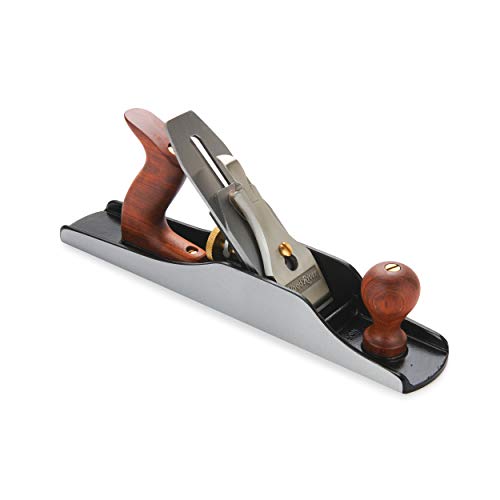
The WoodRiver No. 5 V3 is a jack plane built on the Bedrock pattern, the classic design known for a rigid frog and smooth adjustment. At 13-7/8 inches long, it is long enough to flatten boards and true up glued panels. The heavy ductile iron castings give it momentum through a cut, and the fully machined frog mates tightly with the body to limit chatter. The 2-inch high-carbon steel blade is easy to sharpen and suits both rough stock removal and finer smoothing passes.
- Specs:
- Model: 150875W
- Type: No. 5 jack bench plane, V3
- Sole length: 13-7/8 inches
- Blade: 2-inch high-carbon steel blade
- Body: Stress-relieved ductile iron castings, Bedrock-pattern frog
- Sole and sides: Machined flat and square
- Handles: Bubinga knob and tote
Stanley No. 62 Low-Angle Jack Plane
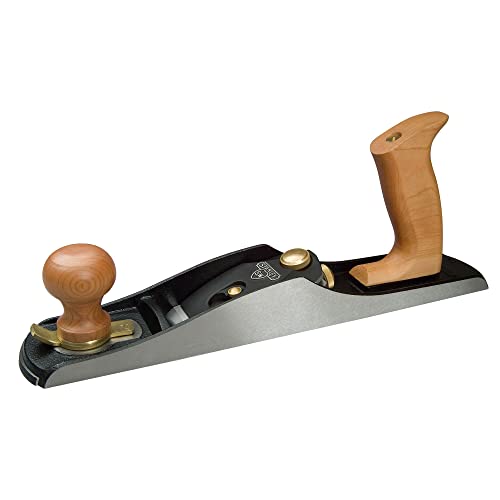
The Stanley No. 62 is a low-angle jack plane from the Sweetheart line, and it fills a different role from the standard No. 5 jack. Its blade sits bevel-up on a 12-degree bed, which gives a low effective cutting angle that suits end grain, shooting boards, and figured wood. The extra-thick A2 steel blade, at 3/16 inch thick, resists chatter and holds an edge through long sessions on hard material. At 15.8 inches long, this plane also works as a short jointer on smaller boards, truing edges that a No. 4 would follow rather than flatten.
- Specs:
- Model: 1-12-137
- Type: No. 62 low-angle jack plane
- Length: 15.8 inches
- Blade: 2 inches wide, A2 steel, 3/16 inch thick, 25-degree bevel, bevel-up
- Bed angle: 12 degrees
- Body: Ductile iron, one-piece base and frog
- Adjustment: Norris-type adjuster, adjustable throat plate
- Handles: Cherry wood knob and tote
Which Bench Plane Should You Pick
If you buy one bench plane, make it a No. 4 smoother. It handles final surfaces, small panels, and edge trimming, and it is the easiest size to learn on. The Amazon Basics No. 4 is the lowest-commitment way to start, while the Stanley 12-404 adds a familiar brand and a proven pattern. The Stanley Sweetheart No. 4 is the step up for woodworkers who smooth often and want thicker steel and finer adjustment.
If you flatten rough lumber or glue up wide panels, add a jack plane next. The WoodRiver No. 5 V3 is a capable all-round jack, with a Bedrock-pattern frog and enough length to flatten boards. The Stanley No. 62 low-angle jack is the better choice for end grain and figured wood, since its bevel-up blade and low bed angle handle those cuts with less tear-out.
FAQ
What size bench plane should a beginner buy first?
A No. 4 smoothing plane is the usual first buy. Its 9- to 10-inch sole suits small panels, boxes, and furniture parts, and it teaches sharpening and depth adjustment without the weight of a longer plane.
What is the difference between a No. 4 and a No. 5 bench plane?
A No. 4 is a smoothing plane with a short sole for final passes and local high spots. A No. 5 is a jack plane with a longer sole, about 14 inches, for flattening boards and removing stock.
Do bench planes need sharpening before first use?
Yes, in most cases. Even a well-made new plane benefits from flattening the back of the blade, honing the cutting edge, and checking the sole. A sharp blade is the single biggest factor in how well any bench plane cuts.
Can one bench plane handle both smoothing and flattening?
A No. 5 jack comes closest, since it can take heavier cuts for flattening and finer cuts for smoothing. Even so, a dedicated No. 4 smoother gives a finer final surface, so most shops eventually own both sizes.
Conclusion
The best bench plane for woodworking is the one that matches the work you do most. A No. 4 smoother is the right start for final surfaces, a No. 5 jack is the right tool for flattening rough stock, and a low-angle jack like the No. 62 adds a useful option for end grain and figured wood. Pick the size first, then weigh blade steel and body construction.
More from Amazon
Programs that pair well with the guide above. Offers and eligibility are set by Amazon and may change.
A free business account with business pricing and bulk-buying tools for work, shop or home office.
Create a business accountFree shipping on eligible items, Prime Video and more. Eligible new members can start with a free trial.
Start a Prime free trialAudiobooks and podcasts to listen to on the go. Eligible new members can start with a free trial.
Try Audible freeAd-free music streaming. Eligible new subscribers can start with a free trial.
Try Music Unlimited freeAs an Amazon Associate we earn from qualifying purchases.




Write Your Review
No reviews yet. Be the first to share your experience!