

Key takeaways
- Compare the best block planes for end grain, edge trimming, and joinery cleanup, from low-angle classics to Japanese kanna and budget picks.
A block plane is the small tool that fixes small problems. A door that sticks, a dovetail pin that stands proud, a chamfer that needs one more pass, an end-grain edge that tears under a bigger plane — these are jobs for a tool you hold in one hand and steer with your thumb.
This guide covers five block planes for different shop problems: a classic low-angle plane for end grain, a heavier low-angle plane for fine joinery, a pocket-size plane for apron carry, a Japanese pull-stroke plane for chamfers, and a budget plane for rough jobs.
As an Amazon Associate, I earn from qualifying purchases.
How to Choose a Block Plane
Start with the bed angle. A low-angle block plane beds the iron at about 12 to 13.5 degrees, bevel up, giving an effective cutting angle near 37 degrees with a standard 25-degree bevel. That low angle slices end grain cleanly and handles figured wood with less tear-out. A standard-angle plane beds the iron near 20 to 21 degrees, giving an effective angle near 45 degrees, which suits general trimming and cross-grain work. If you mostly trim end grain and fit joints, go low angle.
Next, check the mouth. An adjustable mouth lets you close the gap ahead of the blade for fine shavings on tricky grain, and open it for heavier cuts in softwood. Fixed-mouth planes are simpler and cheaper, but they give you no way to tighten the cut when tear-out appears.
Size matters. A 6 to 7 inch plane gives enough sole to register on an edge and still fits one hand. A 5-1/2 inch plane rides in an apron pocket. Look at the iron too: a thicker iron, around 1/8 inch, resists chatter and holds an edge longer than a thin stamped blade.
Comparison Table
| Product | Bed Angle | Length | Best For |
|---|---|---|---|
| Stanley Sweetheart No. 60-1/2 | 13.5 degrees | 6 inches | End grain and general trimming |
| WoodRiver Low Angle Block Plane | 12 degrees | 7 inches | Fine joinery and end grain |
| Stanley No. 102 Block Plane | 12 degrees | 5-1/2 inches | Pocket carry and small trims |
| KAKURI Japanese Hand Plane 42mm | Pull-stroke kanna | 5.9 inches | Chamfers and smoothing |
| Buck Bros 3-1/2 in. Block Plane | 21 degrees | 3-1/2 inches | Rough jobs and spot fixes |
Block Plane Picks
Stanley Sweetheart No. 60-1/2 Low Angle Block Plane

The Stanley Sweetheart No. 60-1/2 is the classic low-angle block plane, and the pick for a woodworker who wants one plane that does the most common jobs well. The iron beds at 13.5 degrees, bevel up, so it slices end grain without the crushing and tear-out a steeper plane leaves behind. The mouth adjusts, so you can close it down for fine shavings on a dovetail pin or open it for a heavier cut on softwood.
The iron is a thick A2 blade, about 1/8 inch thick, which resists chatter and holds an edge through a long trimming session.
One honest note: this is a premium-priced plane in its class, and it still needs a first honing before it cuts its best. Buy it when you want a low-angle plane you will keep for decades, not when you need a beater for the job site.
- Specs:
- Bed angle: 13.5 degrees, low angle
- Length: 6 inches
- Cutter width: 1-3/8 inches
- Iron: A2 steel, about 1/8 inch thick
- Mouth: Adjustable
- Body: Ductile iron
WoodRiver Low Angle Block Plane With Adjustable Mouth
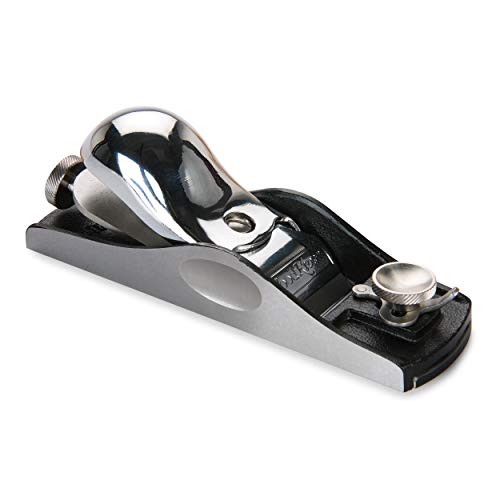
The WoodRiver Low Angle Block Plane is the pick for fine joinery work, where the plane has to trim a tenon cheek or a mitered corner without tearing the fibers. The iron beds at 12 degrees, the lowest angle in this guide, and the adjustable mouth closes tight for whisper-thin shavings on figured wood.
The body is ductile iron, 7 inches long and 2 inches wide, giving a longer sole than the Stanley 60-1/2 and a steadier register on long edges. The blade is 1-5/8 inches wide and 0.125 inches thick, high-carbon tool steel ground to a 25-degree bevel.
One honest note: at about 2 pounds it is the heaviest plane here, so it tires the hand faster on overhead or all-day trimming.
- Specs:
- Bed angle: 12 degrees, low angle
- Length: 7 inches
- Width: 2 inches
- Blade: 1-5/8 inches wide, 0.125 inch thick, 25-degree bevel
- Mouth: Adjustable
- Lever cap: Knuckle style
- Body: Ductile iron
Stanley No. 102 Block Plane

The Stanley No. 102 is the pick for the apron pocket. At 5-1/2 inches long it is the smallest full-featured metal block plane in this guide, and it disappears into a tool apron until a plug needs trimming or a shim needs shaping. The iron beds low, bevel up, at 12 degrees, so it handles end grain far better than its size suggests.
The iron is A2 steel, 1-3/16 inches wide and 1/8 inch thick, with a stainless-steel depth adjuster that moves in fine steps.
One honest note: the small size limits the sole, so it will not register square on a long edge the way a 6 or 7 inch plane does.
- Specs:
- Bed angle: 12 degrees, low angle
- Length: 5-1/2 inches
- Blade: 1-3/16 inches wide, 1/8 inch thick, A2 steel
- Mouth: Fixed
- Adjuster: Stainless-steel depth adjuster
- Body: Cast iron
KAKURI Japanese Hand Plane 42mm

The KAKURI 42mm is the pick for woodworkers who want to try a Japanese kanna. Unlike the Western planes in this guide, it is a pull-stroke plane: you draw it toward you, and the wooden body rides on the work with the blade set by light taps. The 42mm blade suits chamfering, smoothing small surfaces, and trimming edges where a metal plane feels clumsy.
The body is eco oak, made in Japan, and the blade is Japanese high-carbon steel, which takes a very keen edge. At 5.9 inches long and 2.1 inches wide it sits comfortably in one hand, and at about 10 ounces it is the lightest plane here by a wide margin.
One honest note: this is a different skill from pushing a Western plane, and the blade needs a flat stone and a steady hand to set up. Buy it when you want a chamfer and smoothing tool that feels like a different craft, not when you need a plane that works straight out of the box.
- Specs:
- Type: Japanese kanna, pull-stroke
- Blade width: 42mm
- Dimensions: 5.9 x 2.1 x 1.6 inches
- Body: Eco oak
- Blade: Japanese high-carbon steel
- Model: P-150
- Made in: Japan
Buck Bros 3-1/2 in. Block Plane

The Buck Bros 3-1/2 inch block plane is the pick for rough jobs. Trimming a shingle, shaping a shim, easing a painted edge, or cutting a plug flush on a job site — these are jobs where a good plane risks a nicked iron or a chipped sole, and a small budget plane earns its keep. At 3-1/2 inches long it fits in a pocket and weighs almost nothing, and the simple depth adjuster sets the cut without fuss.
The body is cast iron with a standard 21-degree bed, which suits general trimming and cross-grain work.
One honest note: the thin iron and simple adjuster mean it chatters on hard end grain and will not hold a fine setting through a long session. Buy it as a beater and a detail plane, and do not expect it to replace a low-angle plane for joinery.
- Specs:
- Bed angle: 21 degrees, standard angle
- Length: 3-1/2 inches
- Body: Cast iron
- Adjuster: Depth adjustment knob
- Type: Compact one-hand block plane
Which Block Plane Should You Pick
If you want one block plane for most shop work, buy the Stanley Sweetheart 60-1/2. Its low angle, adjustable mouth, and thick A2 iron cover end grain, edge trimming, and joinery cleanup in one tool. If you carry a plane in your apron all day, the Stanley No. 102 is the pocket pick. If you want to learn the pull-stroke kanna, the KAKURI 42mm is a low-cost way in.
Frequently Asked Questions
What is a low-angle block plane good for?
A low-angle block plane beds the iron near 12 to 13.5 degrees, giving a low effective cutting angle that slices end grain cleanly and reduces tear-out on figured wood. It is the best choice for trimming dovetails, tenons, and mitered corners flush.
Do I need an adjustable mouth on a block plane?
An adjustable mouth helps when you work figured or reversing grain, because a tight mouth supports the fibers just ahead of the blade and cuts tear-out down. For general trimming and softwood, a fixed mouth works fine.
How do I keep a block plane blade sharp?
Hone the iron on a flat stone at the bevel angle, usually 25 degrees, until you feel a small burr on the flat side, then remove the burr with a few light passes flat on the stone.
Can a block plane replace a bench plane?
No. A block plane is a one-hand trimming tool for edges, end grain, and small surfaces. A bench plane has a long sole that flattens wide boards and straightens long edges.
Conclusion
A block plane earns its place by fixing small problems cleanly. Choose a low-angle plane with an adjustable mouth for end grain and joinery, a pocket-size plane for detail work, a Japanese kanna for chamfers and smoothing, or a budget plane for rough jobs.
More from Amazon
Programs that pair well with the guide above. Offers and eligibility are set by Amazon and may change.
A free business account with business pricing and bulk-buying tools for work, shop or home office.
Create a business accountFree shipping on eligible items, Prime Video and more. Eligible new members can start with a free trial.
Start a Prime free trialAudiobooks and podcasts to listen to on the go. Eligible new members can start with a free trial.
Try Audible freeAd-free music streaming. Eligible new subscribers can start with a free trial.
Try Music Unlimited freeAs an Amazon Associate we earn from qualifying purchases.




Write Your Review
No reviews yet. Be the first to share your experience!