

Key takeaways
- Baffle filters: Stainless-steel baffles are durable and effective for heavier grease loads. They are usually easier to clean than disposable mesh filters.
- Delayed shutoff: A timer can keep the fan running for several minutes after cooking, clearing residual moisture and odors.
- Bright, replaceable lighting: LED lights use little power, but check whether bulbs or modules can be replaced without changing the entire control assembly.
- Makeup-air compatibility: High-CFM systems may require a makeup-air damper or interlock. This is especially important in tightly sealed homes.
- Accessible controls: Front-facing push buttons or physical controls are often easier to use with greasy hands than hidden touch panels.
The best island range hoods are sized to your cooktop, connected to a properly sized duct whenever possible, and chosen with enough depth and height adjustment to capture smoke before it spreads across the kitchen.
Our top picks

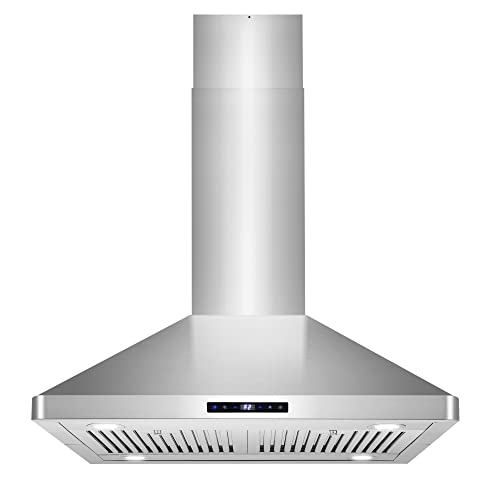


As an Amazon Associate we earn from qualifying purchases at no extra cost to you. Ratings are shown as listed on Amazon.
Quick picks by kitchen situation
| Situation | Best hood type | Useful target | Why it fits |
|---|---|---|---|
| 30-inch electric or induction cooktop | 30- to 36-inch ducted canopy hood | 300-600 CFM | Good capture without excessive airflow or noise |
| 36-inch gas cooktop | 36- to 42-inch ducted hood | 600-900 CFM | Handles wider burners and more heat |
| 48-inch professional-style range | 48- to 54-inch hood | 900-1,200+ CFM | Provides more capture area for high-output burners |
| No practical route outdoors | Recirculating hood with carbon filters | Highest available airflow, within local rules | Removes some grease and odor, but not moisture or heat |
| Open-plan kitchen and dining area | Quiet ducted hood with remote or low-speed operation | Under about 60 dBA at normal speed | Less disruptive during conversation |
How much CFM does an island hood need?
CFM means cubic feet per minute, but a larger number is not automatically better. The hood must capture contaminants, while the duct, makeup air, electrical circuit, and room pressure all remain within the requirements of local building codes.
For a typical electric or induction cooktop, a practical starting point is about 50 CFM per linear foot of cooking surface. A 30-inch cooktop is 2.5 feet wide, so the calculation is:
2.5 feet × 50 CFM = 125 CFM.
That is a minimum-style estimate, not necessarily the best purchase target for an island. Island hoods lose some capture efficiency because air can enter from all four sides, so a 30-inch island cooktop commonly benefits from a 300- to 600-CFM hood.
Gas cooking needs more airflow because it adds combustion heat and moisture. A common planning rule is 75 to 100 CFM per linear foot for a gas surface, with higher airflow for professional burners. For a 36-inch gas cooktop:
3 feet × 100 CFM = 300 CFM.
Again, that figure may be too low for an exposed professional range or frequent high-heat cooking. A 600- to 900-CFM hood is more appropriate in many such installations. Check the range manufacturer’s ventilation requirement before buying; it takes precedence over a general formula.
Ducted versus ductless: the most important choice
Ducted island hoods
A ducted hood exhausts air outdoors through a ceiling or roof route. It is the better choice for frying, searing, wok cooking, grilling, and gas burners because it removes grease, smoke, heat, odors, and cooking moisture rather than merely filtering some of them.
Look for a smooth, rigid metal duct with a diameter that matches the hood’s specification. A 600-CFM hood may specify an 8-inch duct, while a higher-output model may require 10 inches. Reducing the duct size, adding sharp elbows, or using long sections of flexible duct can make the hood louder and reduce actual airflow.
Ductless or recirculating hoods
A ductless hood draws air through a grease filter and a charcoal or other odor filter, then returns the air to the room. It can work where a ceiling route is impossible, but it does not remove heat or humidity and will not match a ducted hood’s smoke control.
Ductless performance depends heavily on filter maintenance. Washable metal grease filters should usually be cleaned every one to three months, depending on cooking frequency. Charcoal filters are consumables and often need replacement every three to six months; follow the specific manufacturer’s schedule. A saturated filter can restrict airflow and allow odors to linger.
Island hood sizing and ceiling-height fit
The hood should generally be at least as wide as the cooktop. For an island installation, going one size wider improves capture: a 36-inch hood over a 30-inch cooktop is often more forgiving than a hood exactly 30 inches wide. A large hood must still leave safe clearance from surrounding cabinets, lighting, and walkways.
Depth matters too. The hood should cover the front burners, not just the rear half of the cooking surface. Many island canopies are approximately 24 to 27 inches deep, while slim chimney and ceiling-mounted designs may provide less effective front capture. If your cooktop is unusually deep, compare the hood’s actual capture area rather than its headline width.
| Ceiling height | Typical installation issue | What to verify before ordering |
|---|---|---|
| 8 feet | Most standard chimney kits can fit | Minimum and maximum mounting heights, plus duct outlet position |
| 9 feet | Standard chimney may need an extension | Optional extension kit and total chimney length |
| 10 feet or higher | Many stock hoods cannot bridge the distance | Custom duct cover, longer chimney, or ceiling-mounted design |
| Sloped or vaulted ceiling | Vertical chimney may not sit plumb | Angled-ceiling adapter and a safe mounting structure |
Measure from the finished cooking surface to the ceiling, then subtract the hood body height, chimney or cover range, and the required cooking clearance. The remaining distance must fall inside the hood’s adjustment range. Do not choose a hood based only on the advertised minimum height.
Noise: compare operating levels, not just CFM
Noise is usually specified in sones or decibels. Sones are easier for casual comparison, while decibels are more technical. A quiet low setting may be around 1 to 2 sones, a normal setting around 3 to 5 sones, and a high setting can exceed 7 sones. Actual sound depends on duct length, elbows, roof caps, installation quality, and whether the hood is recirculating.
A 900-CFM hood may be tolerable on low speed but loud at full power. If you cook often in an open-plan room, prioritize a hood with several speed settings, a strong low setting, and published sound figures at more than one speed. A remote blower can move the motor away from the kitchen, though it costs more and requires compatible ducting and wiring.
Decision matrix for choosing the right hood
| Your priority | Recommended choice | Trade-off |
|---|---|---|
| Lowest initial cost | Basic 30- or 36-inch canopy hood, roughly 300-600 CFM | Fewer controls and less flexible chimney adjustment |
| Frequent frying or searing | Wider ducted hood with baffle filters and 600+ CFM | Higher installation cost and possible makeup-air requirements |
| Induction cooking and low noise | Moderate-CFM hood with efficient capture and insulated rigid duct | May not suit high-heat wok or professional gas cooking |
| Rental or no exterior route | Recirculating hood with replaceable charcoal filters | Heat and moisture remain indoors |
| High ceiling | Hood with a manufacturer-approved extension or custom cover | More measuring and installation expense |
Features worth paying for
- Baffle filters: Stainless-steel baffles are durable and effective for heavier grease loads. They are usually easier to clean than disposable mesh filters.
- Delayed shutoff: A timer can keep the fan running for several minutes after cooking, clearing residual moisture and odors.
- Bright, replaceable lighting: LED lights use little power, but check whether bulbs or modules can be replaced without changing the entire control assembly.
- Makeup-air compatibility: High-CFM systems may require a makeup-air damper or interlock. This is especially important in tightly sealed homes.
- Accessible controls: Front-facing push buttons or physical controls are often easier to use with greasy hands than hidden touch panels.
Ownership realities and common mistakes
The filters usually wear first, followed by lights, switches, blower bearings, and electronic control components. Cleaning the filter does not replace cleaning the hood’s interior and the area around the blower. Wipe grease from those surfaces periodically with a suitable degreaser, following the manufacturer’s instructions.
Do not vent an island hood into an attic, ceiling cavity, or wall void. That can deposit grease and moisture inside the building. Do not assume a powerful hood will compensate for a narrow duct, and do not install a hood so high that the capture area is above the rising smoke plume. A slightly wider hood installed at the correct height often outperforms a much stronger hood installed poorly.
Bottom line
For most homes, the best island range hoods are ducted models one size wider than the cooktop, with approximately 300-600 CFM for ordinary electric or induction cooking and 600-1,200 CFM for larger or gas-powered surfaces. Match the duct diameter, verify the ceiling-height range, compare noise at usable speeds, and budget for professional installation when the duct route, electrical work, or makeup-air requirements are complex. Choose ductless only when outdoor ventilation is impractical and you accept the extra filter maintenance and reduced control of heat and moisture.


Write Your Review
No reviews yet. Be the first to share your experience!