

Key takeaways
- Buy the Paperwhite if you want one Kindle that handles the widest range of everyday reading. Choose the basic Kindle when light weight and price outweigh warm lighting and water resistance. Choose the Colorsoft only when color or larger illustrated files are central to your…
The best Kindle e-readers in 2026 are the Paperwhite for most readers, the basic Kindle for the lowest-cost compact option, the Colorsoft for illustrated and color-heavy books, and the Scribe for large pages, PDFs, and handwritten notes.
Our top picks


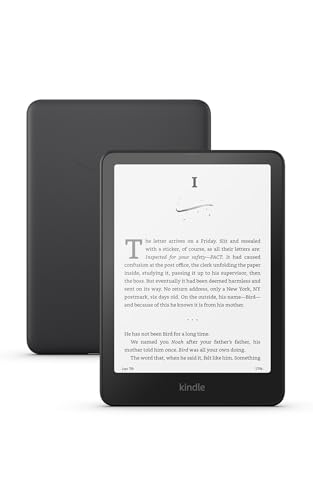

As an Amazon Associate we earn from qualifying purchases at no extra cost to you. Ratings are shown as listed on Amazon.
Best Kindle e-readers compared
| Model | Screen and resolution | Weight | Storage | Warm front light | Waterproofing | Typical market range |
|---|---|---|---|---|---|---|
| Kindle (2024 basic) | 6-inch, 300 ppi black and white E Ink | Approx. 158 g | 16 GB | No | No | About $100–$130 |
| Kindle Paperwhite (2024) | 7-inch, 300 ppi black and white E Ink | Approx. 211 g | 16 GB | Yes | IPX8 | About $150–$190 |
| Kindle Colorsoft | 7-inch color E Ink, black-and-white text at 300 ppi | Approx. 219 g | 32 GB | Yes | IPX8 | About $250–$300 |
| Kindle Scribe (2024) | 10.2-inch, 300 ppi black and white E Ink | Approx. 433 g | 16, 32, or 64 GB | Yes | No | About $350–$450 |
Prices vary with storage, included accessories, advertisements, and seasonal promotions, so the ranges are more useful than a single advertised price. All four use USB-C charging and are designed for long battery life measured in weeks rather than hours. Actual runtime depends on brightness, wireless use, audiobook playback, and how often the front light is enabled.
Kindle Paperwhite: the best choice for most people
The 2024 Paperwhite is the strongest all-rounder because its 7-inch display adds reading area without becoming awkward to carry. The 300 ppi panel makes ordinary text sharp, while adjustable warm lighting is useful for evening reading. The warm setting changes the screen tone from a cooler white to an amber-like appearance; it does not eliminate the need for sensible room lighting, but it can make nighttime reading feel less visually harsh for some people.
Its IPX8 water resistance is the major practical advantage over the basic Kindle. A reader who uses the device beside a bath, at a pool, or on a beach has more protection against accidental immersion. Waterproofing is not permission to charge the device while wet, and salt water, soap, sand, and a damaged seal can still create problems.
Choose the Paperwhite if you read several times a week, prefer novels over comics, want warm light, or expect to keep one reader for years. Its 16 GB capacity is ample for thousands of text-heavy books. Large audiobooks, comics, and illustrated titles use storage much faster.
Basic Kindle: the value pick for commuters and occasional readers
The basic 2024 Kindle is the smallest and lightest option. Its 6-inch, 300 ppi screen is easy to hold in one hand and fits more readily into a coat pocket or small bag. The display remains crisp despite the lower price, so the compromise is not text resolution.
The compromises are a lack of adjustable warm light and no waterproofing. Its front light is suitable for reading in dim conditions, but readers who read in bed every night may prefer the Paperwhite’s warmer color control. The basic Kindle also has less physical protection around wet environments, so a case and a dry storage habit are sensible.
This is the right purchase when portability and price matter more than premium lighting. It is also a good first e-reader for someone unsure whether they will use one regularly. The typical market price of roughly $100 to $130 makes the cost of experimenting relatively low, while the 16 GB storage avoids the limitations of older entry-level readers.
Kindle Colorsoft: worth it when color changes the reading experience
The Colorsoft is aimed at readers who want color covers, maps, travel guides, cookbooks, graphic novels, children’s books, or other illustrated material. Its 7-inch format matches the Paperwhite’s general footprint, but color E Ink is a specialized display rather than a replacement for a bright tablet screen. Colors are muted compared with an LCD or OLED phone, and page changes can feel less immediate in image-heavy content.
Text remains the priority: black-and-white text is rendered at 300 ppi, while color imagery uses the display’s color layer. The 32 GB capacity is helpful because illustrated books and comics can be substantially larger than ordinary novels. Warm lighting and IPX8 water resistance make it more flexible than the basic Kindle for evening and travel use.
For someone reading almost exclusively black-and-white novels, the Colorsoft’s extra cost buys little. For illustrated nonfiction or color-dependent content, however, it avoids the inconvenience of switching to a separate tablet. Consider it a purpose-built compromise: easier on battery life and glare than a tablet, but less vivid and versatile.
Kindle Scribe: the large-format option for PDFs and notes
The Scribe’s 10.2-inch display is the clearest choice for readers who find a 6- or 7-inch screen cramped. It provides more room for PDFs, textbooks, technical documents, sheet music, and side-by-side page layouts. The included stylus supports writing and annotations, making the device useful as a reading-and-notetaking tool rather than a pocket novel reader.
The size is also its main drawback. At approximately 433 g before adding a case, it is more like a slim tablet or paper notebook than a compact e-reader. It is comfortable on a desk, but less convenient for one-handed reading on public transport. It is not waterproof, so it is a poor match for poolside or bath reading.
Storage choices of 16, 32, and 64 GB are more relevant here because PDFs and notebooks can grow quickly. Select 16 GB for books and occasional notes, 32 GB for regular document work, and 64 GB if the Scribe will hold a large reference library or many handwritten notebooks.
Choose by reading situation
| Your situation | Best match | Why | Main compromise |
|---|---|---|---|
| Lowest sensible cost | Basic Kindle | Sharp 300 ppi text, light body, 16 GB storage | No warm light or waterproofing |
| Daily novels and bedtime reading | Paperwhite | Warm light, larger screen, waterproof body | Heavier and more expensive than the basic model |
| Comics, maps, cookbooks, and illustrated books | Colorsoft | Color display, 32 GB storage, waterproofing | High price and subdued color compared with a tablet |
| PDFs, manuals, and handwritten notes | Scribe | 10.2-inch workspace and stylus support | Large, heavy, and not waterproof |
| Frequent travel or one-handed reading | Basic Kindle or Paperwhite | Much easier to carry than the Scribe | Less room for complex documents |
How much storage do you need?
Storage estimates are easier to understand by content type. A typical text novel may occupy only a few megabytes, so 16 GB can hold far more novels than most people will ever read at once. The practical limit arrives sooner with graphic novels, illustrated reference books, downloaded audiobooks, and large PDF files.
For example, suppose an illustrated book averages 250 MB. A 32 GB reader has roughly 29,000 MB available after allowing space for system software and ordinary overhead. Dividing 29,000 by 250 gives about 116 books before other content is added. That is not a guarantee of usable capacity, but it shows why 32 GB is valuable for image-heavy libraries while unnecessary for a text-only collection.
Ownership details that affect the choice
Cases are worth considering for every model, particularly because E Ink screens can be damaged by pressure even when the surrounding shell looks intact. Avoid placing a Kindle under heavy books in a bag, bending it in a back pocket, or carrying loose keys against the display. A cover with a rigid front panel provides more protection than a thin sleeve.
Waterproof models still need care. Rinse off salt or chlorinated water with clean fresh water, dry the exterior before opening ports or charging, and do not use compressed air to force moisture from openings. Waterproofing also tends to become less dependable after drops, screen repairs, or years of seal wear.
The front-light setting is a trade-off, not a permanent rule. Use a lower brightness in a dark room and increase it in bright surroundings so the page remains comfortable to read. If the device feels slow after loading a large book, allow indexing to finish; repeatedly restarting during indexing can make the problem appear worse.
Final verdict
Buy the Paperwhite if you want one Kindle that handles the widest range of everyday reading. Choose the basic Kindle when light weight and price outweigh warm lighting and water resistance. Choose the Colorsoft only when color or larger illustrated files are central to your library. Choose the Scribe when a large page and pen input matter more than portability. The best Kindle e-reader is therefore determined less by raw storage than by where you read, what your books contain, and whether you need a pocket reader or a desk-sized document workspace.


Write Your Review
No reviews yet. Be the first to share your experience!