

Key takeaways
- 7-inch saws: lighter, less expensive, and easier to store. They suit common ceramic wall tile, standard floor tile, and many medium-size porcelain pieces.
- 10-inch saws: deeper cutting capacity and longer tables make them better for 24-inch tile, thick porcelain, quarry tile, pavers, and repeated diagonal cuts.
- Continuous-rim blades: generally produce the cleanest edge on tile because they maintain constant contact with the material.
- Material-specific blades: porcelain, glass, and natural stone each place different demands on the rim and diamond bond. A blade designed for ceramic may cut porcelain slowly or chip it badly.
The best wet tile saws for most renovation work are the DEWALT D24000 for maximum cutting capacity, the SKIL 3550-02 for affordable DIY projects, and the MK-370EXP for compact professional-quality cutting; the right choice depends on tile size, material, workspace, and how often you will use it.
Our top picks


As an Amazon Associate we earn from qualifying purchases at no extra cost to you. Ratings are shown as listed on Amazon.
Best wet tile saws at a glance
| Saw | Blade size | Approx. cutting capacity | Approx. weight | Best for |
|---|---|---|---|---|
| DEWALT D24000 | 10 in. | 24 in. rip; 18-3/8 in. diagonal | 69 lb. saw only | Large-format tile and frequent renovation work |
| RIDGID R4092 | 10 in. | 24 in. rip; about 18 in. diagonal | About 75 lb. | Large tile with an integrated stand |
| SKIL 3550-02 | 7 in. | 18 in. rip; 14 in. diagonal | About 28 lb. | Budget-conscious bathroom and kitchen projects |
| MK-370EXP | 7 in. | 18 in. rip; approximately 13 in. diagonal | About 33 lb. | Portable, repeatable cuts on ceramic and porcelain |
Capacities can vary slightly with the installed blade, cutting method, and whether the saw is using a plunge or straight-cut configuration. Check the current manual before buying oversized tile.
Our picks by situation
Best overall for large-format tile: DEWALT D24000
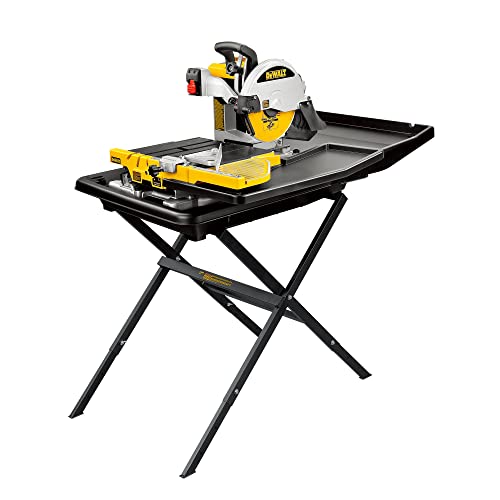
The DEWALT D24000 is the most versatile choice when the project includes 12-by-24-inch porcelain, thick quarry tile, or repeated diagonal cuts. Its 10-inch blade and roughly 24-inch rip capacity reduce the need to rotate or reposition large pieces. The saw also uses a sliding table, adjustable rip guide, plunge-cut capability, and removable water trays that make it easier to control both the cut and the cleanup.
Its two adjustable spray nozzles help direct water toward the blade, while the surrounding tray helps contain overspray. This is particularly useful indoors, where uncontrolled water can damage subfloors or finished cabinetry. The trade-off is weight: the saw is portable in the sense that one person can move it short distances, but it is not a casual carry-upstairs tool. Add the optional stand if you need a working height, but expect a heavier setup.
Best materials: porcelain, ceramic, quarry tile, natural stone, and many pavers when paired with the correct continuous-rim blade.
Best large-tile alternative with a stand: RIDGID R4092
The RIDGID R4092 targets the same broad category as the DEWALT: a 10-inch wet saw for long rip cuts and large diagonal cuts. Its integrated stand is valuable for remodelers who do not want to build a work surface or purchase a separate support system. The stand improves setup speed, although it also makes storage more demanding.
This is a sensible option when the job involves many long cuts and you want a more complete out-of-the-box station. Before choosing it over a lighter saw, measure the available vehicle and storage space. A 10-inch tile saw occupies substantially more floor and transport space than a 7-inch model, even when its cutting capacity is not needed every day.
Best materials: porcelain and ceramic, with suitable blades available for stone and masonry tile.
Best budget choice for occasional DIY work: SKIL 3550-02
The SKIL 3550-02 is built around a 7-inch blade and an 18-inch straight-cut capacity. Its HydroLock water-containment system places the water near the cutting area and helps reduce spray, making it more practical for a garage, patio, or carefully protected indoor workspace. At roughly 28 pounds, it is far easier to move and store than a 10-inch contractor saw.
The limitation is capacity rather than basic usefulness. It is well suited to standard bathroom and backsplash tile, including many 12-inch and 13-inch pieces, but a 24-inch large-format tile will require a different cutting strategy or a larger saw. Its table and water system also reward frequent rinsing; accumulated tile sludge can interfere with smooth sliding and accurate alignment.
Best materials: ceramic and moderate-thickness porcelain. Use a blade specifically rated for porcelain rather than assuming the included blade is ideal for every material.
Best compact professional-style saw: MK-370EXP
The MK-370EXP is a practical middle ground for installers and serious DIY users who value portability but still need a stable sliding table and dependable repeat cuts. Its 7-inch blade is appropriate for many wall and floor tiles, while the compact design is easier to carry between rooms or job sites than a 10-inch saw.
A smaller blade does not automatically mean a less accurate cut. It does mean less depth and less room for oversized diagonals. For dense porcelain, feed the tile steadily instead of forcing it through the blade; excessive pressure can produce edge chipping, slow the motor, and shorten blade life.
Best materials: ceramic, porcelain, glass tile with the proper blade, and thinner natural stone. For thick stone slabs or large pavers, move up to a 10-inch saw.
How blade size changes the buying decision
- 7-inch saws: lighter, less expensive, and easier to store. They suit common ceramic wall tile, standard floor tile, and many medium-size porcelain pieces.
- 10-inch saws: deeper cutting capacity and longer tables make them better for 24-inch tile, thick porcelain, quarry tile, pavers, and repeated diagonal cuts.
- Continuous-rim blades: generally produce the cleanest edge on tile because they maintain constant contact with the material.
- Material-specific blades: porcelain, glass, and natural stone each place different demands on the rim and diamond bond. A blade designed for ceramic may cut porcelain slowly or chip it badly.
Measure the actual tile, not just the advertised nominal size. A tile sold as 24 inches may be slightly larger or smaller, and the required diagonal capacity is calculated across the tile’s corners. If diagonal cuts are central to the design, leave extra capacity instead of buying a saw that only matches the measurement on paper.
Water management matters more than it appears
A wet saw is only clean and precise when water reaches the blade consistently. Look for a pump or reservoir that is easy to remove, a tray that can be emptied without carrying the entire saw, and spray controls that keep water on the cutting path. A movable nozzle is helpful when switching between straight cuts, bevels, and plunge cuts.
For indoor work, place the saw on a level surface over a waterproof sheet with a raised edge or a purpose-built containment mat. Keep a separate bucket nearby for dirty water. Do not allow slurry to return continuously to the pump: fine tile dust can reduce water flow and wear the impeller. When practical, use a two-bucket system—one for collecting dirty water and one with cleaner water for the pump.
Ownership costs and maintenance
The diamond blade is normally the first consumable to show wear. Signs include slower cutting, increased chipping, burning, or the need to push harder. A blade may last through one small bathroom project or many larger jobs; tile hardness, thickness, cutting speed, and blade quality make a fixed hour estimate unreliable.
A simple budgeting example illustrates why the cheapest saw is not always the cheapest approach. Suppose a $250 saw is used for one $1,000 project and then stored, while a $700 saw is used on 12 projects. Ignoring blades and labor, the saw cost is $250 per project in the first case versus about $58 per project in the second. For one renovation, portability and purchase price may dominate. For recurring work, table rigidity, replacement parts, pump access, and blade availability matter more.
After every session, unplug the saw, remove the tray, rinse away slurry, and clean the pump intake. Wipe the table and dry metal parts to limit corrosion. Check that the fence remains square; a fence that shifts by even a small amount can create cumulative errors across a long row of tile. Never run the pump dry, and never reach near the blade while it is coasting.
Decision matrix: which saw fits your project?
| Your situation | Recommended type | Why |
|---|---|---|
| One backsplash or small bathroom | 7-inch budget saw | Enough capacity for common tile without paying for a heavy contractor machine |
| Several rooms with 12-by-24-inch porcelain | 10-inch sliding-table saw | Longer rip capacity and better support reduce repositioning |
| Limited storage or frequent stair transport | Compact 7-inch saw | Lower weight and smaller footprint make setup more realistic |
| Regular installer or remodeler use | 10-inch saw with serviceable pump and trays | Durability, capacity, and maintainability outweigh the initial price |
| Glass accents or delicate polished tile | Compatible saw plus material-specific blade | Blade selection and water control are more important than motor size alone |
Final buying advice
Choose a 7-inch saw when most of your work is standard ceramic or medium-size porcelain and storage is a concern. Choose a 10-inch saw when large-format tile, thick material, diagonal cuts, or repeated professional use is likely. Among the models above, the DEWALT D24000 is the strongest all-around capacity choice, the SKIL 3550-02 is the sensible occasional-user option, the MK-370EXP favors compact precision, and the RIDGID R4092 makes a strong case when an integrated stand is part of the value.




Write Your Review
No reviews yet. Be the first to share your experience!