

Key takeaways
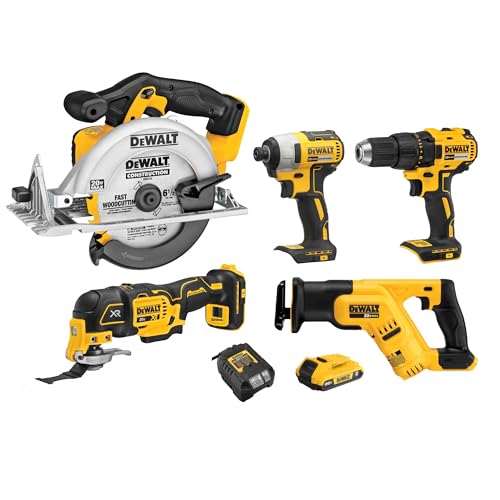
- Best basic combination: drill/driver, impact driver, circular saw, reciprocating saw and light.
- Best woodworking combination: drill/driver, impact driver, circular saw, orbital sander and oscillating multi-tool.
- Best trim and cabinet combination: compact drill, impact driver, oscillating tool, random-orbit sander and trim router, if offered.
- Useful extras: a belt clip, side handle, depth stop, dust bag, blade wrench and a second charger.
The best power tool combo kits for home workshops are usually the ones built around a battery platform you will keep using: choose a compact 18V/20V kit for general repairs, a brushless mid-range kit for frequent woodworking, or a higher-output kit if you regularly drill large holes, drive structural screws, or cut thick stock.
Our top picks


As an Amazon Associate we earn from qualifying purchases at no extra cost to you. Ratings are shown as listed on Amazon.
Quick picks by workshop situation
| Workshop situation | Best fit | Why it makes sense | Trade-off |
|---|---|---|---|
| Occasional repairs and furniture assembly | 5-tool 18V/20V kit with brushed or mixed motors | Usually includes a drill, impact driver, circular saw, reciprocating saw, light, two batteries and a charger | Shorter runtime and more frequent brush replacement on brushed tools |
| Regular woodworking in a garage | Brushless 18V/20V kit with a 4.0Ah or 5.0Ah battery | Better efficiency, less maintenance, and stronger sustained performance for saws and sanders | Higher purchase price and more expensive replacement batteries |
| Small workshop or apartment storage | Compact brushless kit with two 2.0Ah batteries | Smaller tools and batteries are easier to store and less tiring for overhead work | Less runtime on circular saws and reciprocating saws |
| Heavy renovation or construction-style work | High-output brushless platform with 5.0Ah or larger batteries | Better for thick lumber, masonry drilling, long screws and repeated cuts | Tools and batteries are heavier, and the kit may omit useful woodworking accessories |
What should a useful combo kit include?
A drill/driver and impact driver are the foundation. The drill handles controlled holes, countersinking and delicate fasteners; the impact driver handles long screws with less wrist torque. For a home workshop, the next most useful tool is usually a circular saw, followed by an oscillating multi-tool or reciprocating saw.
Kit names can be misleading, so read the actual contents. A “five-tool” kit may count a work light, while another five-tool kit may include an orbital sander. For woodworking, an orbital sander is generally more useful than a reciprocating saw. For remodeling, the reverse is often true.
- Best basic combination: drill/driver, impact driver, circular saw, reciprocating saw and light.
- Best woodworking combination: drill/driver, impact driver, circular saw, orbital sander and oscillating multi-tool.
- Best trim and cabinet combination: compact drill, impact driver, oscillating tool, random-orbit sander and trim router, if offered.
- Useful extras: a belt clip, side handle, depth stop, dust bag, blade wrench and a second charger.
A kit that includes only one battery can be frustrating: the battery is charging while the project stops. Two batteries are the practical minimum, and three are preferable when the kit contains a saw or sander.
Head-to-head: the major battery platforms
DeWalt 20V Max
DeWalt’s 20V Max system has a broad selection of drills, saws, sanders and workshop tools. Its standard 20V batteries work across the system, while higher-capacity and high-output packs can improve saw performance. Combo kits commonly balance a familiar full-size drill and impact driver with a circular saw, reciprocating saw and light.
Choose this platform if you want extensive tool availability and a traditional, jobsite-oriented feel. Pay attention to whether a kit contains compact batteries or larger packs; a circular saw paired with two small batteries may be convenient but will not deliver the same cutting coverage as a 5.0Ah pair.
Makita 18V LXT
Makita’s 18V LXT platform is known for a large tool range and generally refined ergonomics. Many kits use compact brushless tools, which suit furniture work, shelving and home maintenance. Makita also sells higher-output battery options, but the standard LXT line and its newer high-performance tools are not interchangeable in every direction, so check compatibility before expanding.
Makita is a strong choice for users who value balance, comfortable grips and a broad selection of saws and sanders. Its cases vary considerably, and some kits use molded cases while others arrive in soft bags.
Milwaukee M18
Milwaukee’s M18 system includes compact tools, brushless tools and the performance-focused M18 FUEL range. M18 FUEL tools use brushless motors and electronic controls aimed at demanding work. They are particularly attractive when a kit must cover drilling, fastening, cutting and repeated renovation tasks.
The cost is often higher, and larger M18 batteries add noticeable weight. If you only assemble flat-pack furniture and make occasional shelves, the extra output may not repay the difference. If you expect to add a rotary hammer, larger saws or plumbing tools later, the platform’s breadth can justify it.
Ryobi ONE+ and ONE+ HP
Ryobi ONE+ is one of the most approachable platforms for homeowners because the system includes an unusually wide range of outdoor, cleaning, automotive and workshop tools. Standard ONE+ batteries fit many tools, while ONE+ HP brushless tools are the better choice for demanding cutting and drilling.
Ryobi kits often offer strong tool count for the money. Inspect the motor type carefully: a kit with several brushed tools can be excellent for occasional use, but it is not equivalent to a smaller all-brushless kit for frequent work.
Brushless motors, battery size and real runtime
Brushless motors usually run more efficiently, generate less brush wear and regulate power electronically. They do not make a tool indestructible, and a brushless motor cannot compensate for a dull blade, overloaded gearbox or undersized battery.
| Battery class | Approximate energy at nominal voltage | Typical role | Practical limitation |
|---|---|---|---|
| 18V/20V, 2.0Ah | About 36–40Wh | Compact drill, impact driver and light | Limited saw and sander runtime |
| 18V/20V, 4.0Ah | About 72–80Wh | General workshop use and intermittent cutting | Heavier than compact packs |
| 18V/20V, 5.0Ah | About 90–100Wh | Circular saws, sanders and longer projects | Higher cost and greater tool weight |
| 18V/20V, 8.0Ah or larger | About 144–160Wh or more | High-demand saws and repeated construction work | Bulky; often unnecessary for light workshop tasks |
These are nominal energy figures, not guaranteed runtime. A simple estimate is useful when comparing batteries: a 5.0Ah pack at 18V stores roughly 90Wh. If a tool averages 300W while cutting, idealized continuous runtime is 90 ÷ 300 = 0.3 hours, or 18 minutes. Real cutting time is lower because of acceleration, pauses, material resistance and battery protection. This calculation explains why two 5.0Ah batteries are much more useful for a circular saw than two 2.0Ah packs.
Charger speed and case design matter more than they appear
Standard chargers are adequate for overnight charging, but a fast charger can change how a two-battery kit feels during a long project. Look for the manufacturer’s stated charge times for the exact battery size rather than assuming every charger is fast. Some kits include a rapid charger; others include a basic unit despite having high-capacity batteries.
Soft bags take less room and accommodate tools with different shapes, but they allow tools and batteries to collide. Molded cases provide better protection and make inventory easier, although they can waste space and may not have room for upgraded batteries. Modular cases are convenient when available, especially if you plan to buy bare tools later. For a workshop, a wall rack or open shelf may be more practical than storing everything in a case.
Durability and ownership costs
The first consumables to wear are usually drill bits, driver bits, saw blades, sanding discs and reciprocating-saw blades—not the motor. Budget for quality replacements. A premium kit with poor blades can cut worse than a basic kit with a sharp, appropriate blade.
- Clean sawdust from vents and switches with low-pressure air or a soft brush; do not force debris deeper into the housing.
- Keep batteries away from extreme heat and store them partially charged if the manufacturer recommends it.
- Do not leave a battery in a hot vehicle or charger indefinitely unless the charger is designed for maintenance charging.
- Use the correct blade for plywood, framing lumber, plastics or metal; excessive force is a common cause of poor cuts and battery drain.
- Check the saw base, chuck and accessory clamps periodically for looseness.
For example, if a $500 kit is used for 50 projects over five years, its tool cost works out to about $10 per project before blades and batteries. A $750 brushless kit used for 150 projects costs about $5 per project. Frequency of use matters more than the initial difference in price.
How to choose your kit in five steps
- List the next three projects. Choose tools that solve those jobs rather than buying the largest tool count.
- Choose the battery platform. Consider future tools, local battery availability and whether you already own compatible packs.
- Prioritize brushless tools selectively. Make the drill, circular saw and sander brushless first if those tools will work often.
- Count batteries and inspect their capacity. Two 4.0Ah or 5.0Ah batteries are usually more useful than three tiny packs.
- Compare the charger and storage system. A fast charger and sensible case can be worth more than an included light or redundant tool.
For most home workshops, the best power tool combo kits are a brushless 18V/20V set with a drill/driver, impact driver, circular saw, orbital sander or oscillating tool, two medium-capacity batteries and a reasonably fast charger. Buy into the platform that matches your likely future tools, then add specialty tools as individual bare units instead of accepting a kit’s least useful extra.




Write Your Review
No reviews yet. Be the first to share your experience!