

Key takeaways
- What wears first: leg locks and hinges on folding horses, and the top surface of 2×4 horses, which gets sawn up over time.
- Rust and weather: steel horses stored outdoors rust at the welds; a wipe of oil or paint helps.
- Stability: uneven ground makes horses rock. Use shims or choose adjustable feet.
- Misuse: standing on a horse rated only for tool loads is risky, so check the manual.
The best sawhorses for most woodworkers are a pair of folding metal or heavy-duty plastic horses rated for at least 1,000 pounds per pair with a working height near 32 to 34 inches, because they store flat, set up in seconds and support sheet goods and long boards. For clamping work and heavy timber, the Rockler Jawhorse-style workholding horse earns its higher cost, and for the cheapest strong option, a pair of 2×4 bracket-kit horses can be built in minutes. Choose by load rating, height and how often you carry them.
Our top picks


As an Amazon Associate we earn from qualifying purchases at no extra cost to you.
Quick comparison of sawhorse types
| Pick | Best for | Key specs | Price range |
|---|---|---|---|
| Folding metal sawhorse pair | Best overall: shop and jobsite | Steel legs, 30-34 in tall, 1,000-2,500 lb per pair rated, 10-15 lb each | Budget to mid-range |
| Stackable plastic sawhorse pair | Best budget and lightweight | Molded poly, 400-1,000 lb per pair, 5-8 lb each, nests flat | Budget |
| Rockler Jawhorse | Best for clamping and workholding | Foot-pedal clamp, about 1,500 lb clamping force (per Rockler), 20-30 lb | Upper mid-range |
| 2×4 bracket-kit sawhorse | Best DIY value | Metal brackets plus your own 2x4s, 31-36 in height as cut, 800-1,500 lb pair | Budget |
| Adjustable-height horse | Best for varying benches and stairs | Telescoping legs, about 24-40 in range, 1,000+ lb per pair | Mid-range |
| Bora Centipede-style workstand | Best for sheet goods | Folding 2 x 4 ft expandable platform, 20 lb, 1,000 lb capacity (per maker) | Mid-range |
Best overall: folding metal sawhorse pair
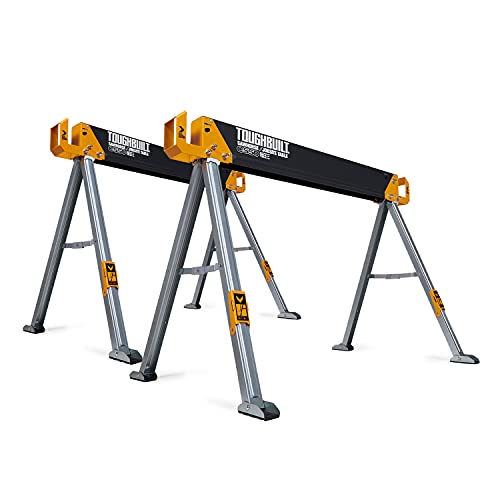
Folding steel horses balance strength, weight and price. Look for a heavy-gauge steel frame, a wide top rail (at least 2 inches) and non-slip feet. A pair rated at 1,000 pounds comfortably supports a full sheet of 3/4 inch plywood, which weighs about 70 pounds, plus tools. They fold to a few inches thick and hang on a wall. Check that the folded leg lock engages firmly: loose locks are the most common failure.
The trade-off: the tops are narrow, so small parts can tip, and cut-offs may hit the steel and nick a blade. Many woodworkers lay a 2×4 sacrificial rail across the top.
Best budget: stackable plastic sawhorses
Molded poly horses weigh just a few pounds, nest together and resist rust. They suit painting, light sawing and sanding. A typical pair is rated around 400 to 1,000 pounds, per the manufacturers’ labels.
The trade-off: they flex under heavy loads and can crack in cold weather or when dropped. They are not recommended for standing on.
Best for workholding: Jawhorse-style clamping horse
The Rockler Jawhorse combines a sawhorse with a foot-operated clamp that holds boards, doors and posts at working height. Rockler specifies roughly 1,500 pounds of clamping force and the jaws open wide enough for 4×4 stock and larger, with accessories for round and thin work. It doubles as a planing station, a door-hanging stand and a miter-saw support.
The trade-off: you pay several times more than for a basic horse and it is bulkier. For plain support of long boards, a standard horse is enough.
Best DIY value: bracket-kit horses
A pair of metal brackets plus 2×4 lumber makes a customizable horse in minutes. Cut the legs to give a working height of 32 to 34 inches for most adults. Wide-splay legs at 20 degrees or more give stability, and you can cut a new set if a leg breaks.
The trade-off: they do not fold, so they take space unless you disassemble them. Quality varies by bracket brand; check the stated load rating.
Best adjustable: telescoping sawhorses
Adjustable-height horses let you work from low (for sanding) to high (for matching an outfeed table). A range of roughly 24 to 40 inches is common. They are useful for outfeed support when a tablesaw’s table height differs from standard.
The trade-off: the adjustment locks add complexity, and cheaper ones wobble. Confirm the load rating at full extension, since it is often lower than at the lowest height.
Best for sheet goods: expandable workstand
A folding platform such as the Bora Centipede style supports an entire sheet from multiple points so the kerf stays open and the offcut does not pinch the blade. Used with a circular saw and a sacrificial foam board, it makes breaking down plywood easy.
The trade-off: it takes more space than two horses and is not meant for heavy beams.
How to choose sawhorses
Pick the right height
A common rule is to set the top at about the height of your hip bone, roughly 32 to 34 inches for a 5 foot 10 inch person. Lower (28 to 30 inches) suits hand sawing, where you push down with body weight. Match outfeed height to your tablesaw table, often 34 to 36 inches.
Read the load rating properly
A “1,000 pound” rating usually refers to the pair, with load evenly distributed, not each horse alone and not a point load. Divide by two for single use and by roughly two again if the load is concentrated in the center.
Consider the top surface
Wide, flat tops hold stock steadily. Narrow tubes are lighter but can mar the work. A removable sacrificial 2×4 protects both saw blades and the horse.
Think about storage and portability
A pair that folds to 3 inches thick takes almost no wall space. If you move a lot, weight is critical: 10 pounds each is manageable; 25 pounds each gets tiring.
Worked example: sheet-goods support
A 4 x 8 foot sheet of 3/4 inch birch plywood weighs about 65 to 75 pounds. Supported on two horses, each carries about 35 pounds, plus a circular saw at 10 pounds and your body leaning on the edge. Even a modest 1,000-pound pair is far above that margin. The limit comes from stability, not strength: set the horses about 3 to 4 feet apart so the sheet does not sag, and add a third support in the middle for a 4 x 8 sheet to keep the cut from closing on the blade.
Durability and ownership realities
- What wears first: leg locks and hinges on folding horses, and the top surface of 2×4 horses, which gets sawn up over time.
- Rust and weather: steel horses stored outdoors rust at the welds; a wipe of oil or paint helps.
- Stability: uneven ground makes horses rock. Use shims or choose adjustable feet.
- Misuse: standing on a horse rated only for tool loads is risky, so check the manual.
Material comparison
| Material | Typical weight per horse | Typical pair rating | Strength | Weakness |
|---|---|---|---|---|
| Folding steel tube | 10-15 lb | 1,000-2,500 lb | Strong, folds flat, long life | Hinges and locks wear, can rust |
| Molded polypropylene | 5-8 lb | 400-1,000 lb | Light, rustproof, stacks | Flexes, brittle in cold |
| Wood 2×4 with brackets | 12-20 lb | 800-1,500 lb | Cheap, repairable, custom height | Bulky, tops get cut up |
| Aluminum telescoping | 8-14 lb | 1,000+ lb | Light and adjustable | Locks loosen, higher cost |
| Cast or plate steel workholding | 20-35 lb | 1,000-1,500 lb | Clamps stock directly | Heavy, premium cost |
Common mistakes to avoid
- Cutting through the support: a circular saw blade that drops through a narrow top can bite into the horse. Set blade depth about 1/4 inch past the stock and place a sacrificial board underneath.
- Placing horses too close together: a short span lets the offcut fall and pinch the blade. Keep supports under both sides of the cut line.
- Ignoring uneven floors: a rocking horse is a safety hazard. Shim a leg or choose adjustable feet.
- Overloading one horse: a heavy workpiece should rest on both horses so the weight splits roughly evenly.
- Standing on narrow tops: most ratings assume a distributed load, not a person on a single rail. Use a platform or stepladder instead.
Frequently Asked Questions
How tall should a sawhorse be?
Most adults find 32 to 34 inches comfortable for sawing and layout. Shorter, around 24 to 28 inches, is better for hand sawing and sanding. Adjust to your own body and tasks.
How much weight can a sawhorse hold?
Ratings range from a few hundred pounds for plastic horses to 2,500 pounds or more for steel pairs. Always read whether the rating applies to the pair or to each horse.
Can I build my own sawhorses?
Yes. Bracket kits and 2×4 lumber produce a sturdy pair in under 30 minutes. For long-term use, glue and screw a plywood gusset or use through-bolts for stronger joints.
Are folding sawhorses stable?
Good ones are, provided the leg locks engage fully and the feet sit flat. Wide leg splay and a low center of gravity matter more than the folding mechanism.
Do I need a sawhorse with a clamp?
Not for basic support. A clamping horse is worthwhile if you plane, trim doors or work on posts, because it holds stock firmly without separate clamps.




Write Your Review
No reviews yet. Be the first to share your experience!