

Key takeaways
- Compare the best keyhole saws for drywall, wood and plastic cutouts, from fixed-blade jab saws to folding models, and pick the right saw for your work.
A keyhole saw earns its keep in the gaps other saws cannot reach. It punches through a sheet of drywall to start an outlet cutout, trims a notch in a board, and opens a hole in plywood without a drill.
The name causes some confusion. Sellers call these tools keyhole saws, jab saws, drywall saws, and sheetrock saws, often for the same product. The job is the same either way: plunge the pointed tip into the material, then saw a line with short strokes. Coping saws are a different tool, built for fine curved cuts in trim.
As an Amazon Associate, I earn from qualifying purchases.
How to Choose a Keyhole Saw
Blade length and tooth count. Most keyhole saws run between 5 and 6.5 inches of blade. A shorter blade turns tighter corners and fits in cramped wall cavities, while a longer blade cuts deeper material and tracks straighter on long runs. Coarser teeth near 7 TPI cut drywall fast, while finer teeth near 8 or 9 TPI leave a cleaner edge in wood and plastic.
Fixed or folding blade. A fixed-blade saw is always ready and usually cheaper, but the exposed point can chew up a tool bag. A folding saw tucks the blade into the handle for safe carry. Some folding models accept standard reciprocating saw blades, which turns one handle into a whole set of cutting options.
Cutting direction and blade steel. Many jab saw blades cut on both the push and pull strokes, which speeds the work. Bi-metal blades hold an edge longer than plain carbon steel, especially when the saw meets the occasional screw or nail hidden in a wall.
Rasp and jab-tip features. A sharpened tip is what lets the saw start a cut without a drilled hole. Some models add a rasp edge along the side of the blade, which lets you widen a hole or smooth a rough edge without switching tools.
Grip comfort. Keyhole saws are used with short, fast strokes, so the handle takes a beating from your hand. A cushioned, slip-resistant grip keeps blisters away on long jobs.
Comparison Table
| Saw | Blade | Style | Best For |
|---|---|---|---|
| Stanley FatMax 20-556 | 6 in, 7 TPI | Fixed | Everyday drywall and wood cutouts |
| Milwaukee 48-22-0305 | 6 in, 8 TPI | Folding | Swapping in reciprocating blades |
| IRWIN ProTouch 2014100 | 6.5 in | Fixed | Long, straight cuts in drywall |
| DEWALT DWHT20123 | 5.25 in jab, 4 in rasp | Folding | Cutting and shaping in one tool |
| Goldblatt G08501A | 5 in, 8 TPI | Folding | Tight spots and pouch carry |
Best Keyhole Saws
1. Stanley FatMax Jab Saw 20-556

The FatMax 20-556 is the classic fixed-blade jab saw. Its 6-inch carbon steel blade uses Stanley SharpTooth geometry, which cuts on both the push and pull strokes and bites faster than a standard tooth pattern. The sharpened tip punches through drywall with a firm push, so most cutouts start without a drill. The cushioned two-material handle resists slipping when hands get dusty.
The fixed blade is the trade-off. It is always ready, but the point stays exposed, so it needs a sheath or a dedicated slot in the toolbox. The 7 TPI tooth count cuts fast in drywall and leaves a rougher edge in wood than a finer blade would.
- Specs:
- Blade length: 6 inches
- Teeth: 7 TPI, cuts on push and pull strokes
- Blade: hardened and tempered carbon steel
- Tip: sharpened jab tip for plunge starts
- Handle: cushioned two-material grip
- Cuts: drywall, plywood, plastic
2. Milwaukee Folding Jab Saw 48-22-0305

The Milwaukee 48-22-0305 takes a different approach: the handle accepts standard Sawzall reciprocating blades, so the saw changes character with a blade swap. It ships with three blades, one for wood, one for metal, and one for general purpose work. The 6-inch blade folds into the handle, so the point cannot poke through a tool bag. Tool-free blade changes keep the work moving.
The trade-off is size and weight. The handle has to house a folded blade and a blade-change mechanism, so it is bulkier than a simple fixed-blade saw. It is built for people who already own reciprocating blades; without spare blades, the swap feature goes unused.
- Specs:
- Blade length: 6 inches
- Teeth: 8 TPI general purpose blade
- Blades included: wood, metal, and general purpose
- Blade system: accepts standard Sawzall blades
- Style: folding blade with tool-free change
- Handle: rubber overmold grip
3. IRWIN ProTouch Drywall/Jab Saw 2014100
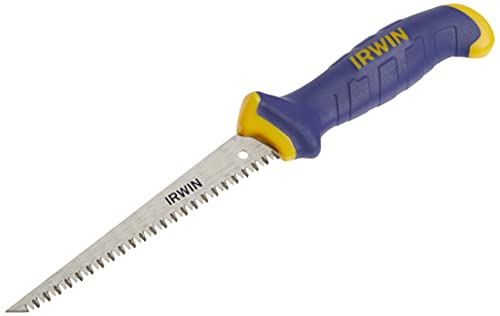
The IRWIN ProTouch 2014100 is the long-reach pick of this group, with a 6.5-inch blade that covers deeper material and tracks straighter on long cuts. The extra half inch matters when you cut through thick drywall or a double layer. The full-size ProTouch rubber grip fills the hand and stays comfortable on long runs. The thick-body blade resists flexing, so cuts stay on the line instead of wandering.
The fixed blade is exposed in storage, like the Stanley, so it needs a sheath or a safe spot in the box. The longer blade also turns a slightly wider arc, so it is less handy than the 5-inch models in very tight corners.
- Specs:
- Blade length: 6.5 inches
- Blade: rigid thick-body design
- Handle: ProTouch rubber grip
- Style: fixed blade
- Cuts: drywall, wood, plastic
- Best for: long, straight cutouts
4. DEWALT DWHT20123 Folding Jab Saw and Rasp

The DEWALT DWHT20123 packs two tools into one handle. One side carries a 5.25-inch jab saw blade with triple-ground teeth, and the other side carries a 4-inch stainless steel rasp. Cut the hole with the saw, then flip the tool and widen or smooth the opening with the rasp, all without reaching for a second tool. Both blades fold into the handle for safe carry.
The compromise is blade length. At 5.25 inches, the jab blade is shorter than the fixed-blade picks, so it suits shallow cutouts better than deep ones. The rasp is a handy addition, but it is a shaping tool, not a replacement for a file on fine work.
- Specs:
- Jab blade length: 5.25 inches, 8 TPI
- Rasp blade length: 4 inches, stainless steel
- Style: folding, two-in-one jab saw and rasp
- Teeth: triple-ground for fast cutting
- Handle length: 6.5 inches
- Cuts: drywall, wood, plastic
5. Goldblatt Folding Drywall Saw G08501A

The Goldblatt G08501A is the compact pick, built for tight spots and easy carry. Its 5-inch bi-metal blade is the shortest in this group, which makes it the easiest to turn in a cramped wall cavity or a small cutout. The blade locks into the handle and releases with a red button. The 8 TPI bi-metal teeth cut on both the push and pull strokes, and the bi-metal construction holds an edge longer than plain carbon steel when the blade meets hidden fasteners.
The short blade is also the limit. Five inches of blade means shorter strokes and slower progress on long cuts.
- Specs:
- Blade length: 5 inches
- Teeth: 8 TPI, bi-metal, cuts both strokes
- Tip: sharpened jab tip
- Style: folding blade with lock and release button
- Handle: soft grip with hang hole
- Cuts: wallboard, drywall, plywood, PVC
Which Keyhole Saw Should You Pick
For general shop use, pick the Stanley FatMax 20-556. It is the simplest tool here, always ready, with a blade that cuts fast in drywall and wood.
For a tool bag, pick a folding model. The Milwaukee 48-22-0305 suits anyone who already owns reciprocating blades, since one handle covers wood, metal, and general purpose cutting. The Goldblatt G08501A is the better choice if you want the smallest, lightest folder for tight spots.
For long, straight cutouts, pick the IRWIN ProTouch 2014100. The 6.5-inch blade and rigid body keep the line true on large openings.
For cutting and shaping in one tool, pick the DEWALT DWHT20123. The built-in rasp saves a tool swap every time a hole needs widening or an edge needs smoothing.
Match the saw to the work. A short folding blade wins in a cramped cavity, and a long fixed blade wins on a big opening.
FAQ
Can a keyhole saw cut wood?
Yes. Keyhole saws cut drywall, wood, plywood, and plastic. Wood takes more effort, and a finer tooth count leaves a cleaner edge. A bi-metal blade holds up better in wood that hides nails or screws.
Do I need to drill a starter hole first?
Usually not. The sharpened tip on a jab saw is made to punch through drywall with a firm push. In hardwood or thick plywood, a small drilled starter hole makes the job easier and keeps the blade from wandering.
What is the difference between a keyhole saw and a coping saw?
A keyhole saw has a narrow, pointed blade that plunges into the middle of a panel to start a cutout. A coping saw has a thin blade held in a frame, built for fine curved cuts in trim and molding. They serve different jobs, and one does not replace the other.
How do I keep the blade from wandering?
Start with the tip on the marked line, use short strokes until the kerf is set, then lengthen the strokes. Let the teeth do the work rather than forcing the saw sideways.
Conclusion
A keyhole saw is a small tool that solves a specific problem: starting a cut in the middle of a panel. The Stanley FatMax 20-556 is the best all-round pick for most shops, the Milwaukee 48-22-0305 is the most flexible thanks to its swappable blades, the IRWIN ProTouch 2014100 handles the longest cuts, the DEWALT DWHT20123 adds a rasp for shaping, and the Goldblatt G08501A is the most compact folder for tight spots. Pick the one that matches where and how you cut.
More from Amazon
Programs that pair well with the guide above. Offers and eligibility are set by Amazon and may change.
A free business account with business pricing and bulk-buying tools for work, shop or home office.
Create a business accountFree shipping on eligible items, Prime Video and more. Eligible new members can start with a free trial.
Start a Prime free trialAudiobooks and podcasts to listen to on the go. Eligible new members can start with a free trial.
Try Audible freeAd-free music streaming. Eligible new subscribers can start with a free trial.
Try Music Unlimited freeAs an Amazon Associate we earn from qualifying purchases.
Write Your Review
No reviews yet. Be the first to share your experience!