

Key takeaways
- Very limited counter space: Pick a small 4-tablespoon crock with a footprint under 4 inches. It saves room but requires more frequent filling.
- Daily toast or sandwiches: Choose a standard 1/2-cup stoneware crock with a wide bell opening and a deep moat.
- Large household: Consider a 3/4- to 1-cup model, provided the kitchen stays reasonably cool and the crock can be cleaned easily.
- Warm or humid kitchen: Use a smaller capacity, change the water more often, and keep the crock in the coolest shaded counter location.
- Budget priority: Favor a plain glazed model with a stable base over painted decoration, unusual shapes, or an oversized capacity.
- Frequent baking: A wider opening is more useful than a very deep bell because it makes packing and removing firm butter easier.
Best Butter Bell Crock for Counter: Keep Butter Fresh
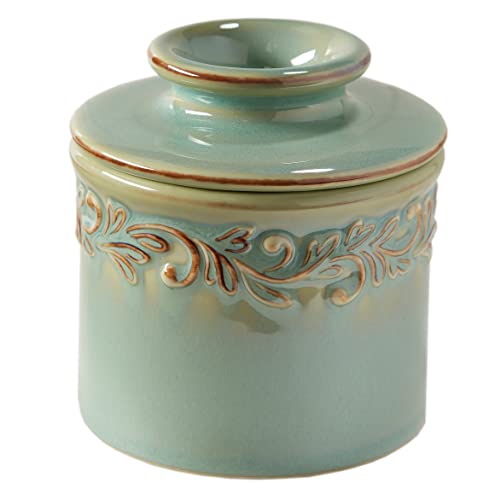
The best butter bell crock for a counter is a compact stoneware model holding about 1/2 cup of butter, with a deep water moat, a stable base, and an opening narrow enough to form a reliable seal without taking up unnecessary space.
For most kitchens, choose a crock with an overall footprint of roughly 4 to 5 inches, a bell that holds one standard stick of butter, and a lid that is easy to lift with one hand. Smaller ceramic crocks suit limited counter space and light use; larger stoneware crocks are better for families or households that refill butter less often.
Our top picks


As an Amazon Associate we earn from qualifying purchases at no extra cost to you. Ratings are shown as listed on Amazon.
What a Butter Bell Crock Actually Does
A butter bell crock stores softened butter upside down in a removable bell. You press the butter into the bell, add a small amount of cool water to the base, and invert the bell into that water. The water forms a barrier between the butter and the surrounding air.
The system is designed to keep butter spreadable at room temperature while limiting exposure to air and kitchen odors. It is not a refrigerator substitute, and it should not be treated as a way to store butter indefinitely. The water needs regular replacement, and the crock works best when kept away from direct sun, a cooktop, and other sources of heat.
Capacity and Counter-Fit Comparison
| Crock size | Approximate butter capacity | Typical footprint | Best for | Main trade-off |
|---|---|---|---|---|
| Small | 4 tablespoons | 3.25–3.75 inches wide | One person, occasional toast | Needs frequent refilling |
| Standard | 8 tablespoons / 1/2 cup | 4–4.75 inches wide | Most households | Uses more vertical space than a butter dish |
| Large | 12–16 tablespoons | 5–6 inches wide | Frequent baking or family use | Heavier and more difficult to clean |
Measure the available counter area before buying. Leave at least 1 inch around the crock so you can grip the base and remove the bell without knocking into a wall, backsplash, appliance, or utensil holder. Also measure vertical clearance: a standard crock commonly stands about 5 to 6 inches tall when assembled.
A useful sizing calculation is simple: if your household uses two tablespoons of butter per day, a 1/2-cup crock lasts about four days. That is often a practical balance between freshness and convenience. A large 1-cup crock would last about eight days at the same rate, but keeping that much butter at room temperature may be less suitable in a warm kitchen.
Seal Design: The Feature That Matters Most
Deep water moat
The base should have a continuous moat deep enough to hold water around the bell without overflowing when the bell is inserted. A moat around 1/2 to 3/4 inch deep is a useful target for a standard crock. A shallow decorative groove may look attractive but can evaporate quickly or fail to make consistent contact.
Bell-to-base fit
The bell should sit securely in the moat without rocking. A loose fit allows the water seal to break, while an overly tight fit can make the bell hard to remove and may force water onto the counter. Look for a broad bell rim and a base with a clearly defined receiving channel.
Stable base
Choose a base with a flat underside and enough weight to resist sliding. Cork or silicone feet can protect a finished counter, but they are also potential wear points. If the feet loosen, the crock may become less stable and collect moisture underneath.
Ventilation and lid shape
A bell that is completely enclosed by the base is preferable to a decorative lid that merely rests on top. The inverted bell needs to displace little water and should not trap large air gaps around the butter. A knob or textured top makes daily removal easier, especially when your hands are wet or greasy.
Ceramic Versus Stoneware Durability
Stoneware is a type of fired ceramic, so these terms are not true opposites. In product descriptions, “ceramic” often refers broadly to earthenware, porcelain, or an unspecified clay body, while “stoneware” usually indicates a denser, higher-fired material.
| Material description | Typical characteristics | Durability considerations | Best counter situation |
|---|---|---|---|
| Earthenware ceramic | Often lighter, more porous, and available in bright finishes | More vulnerable to chips, crazing, and water absorption if the glaze is compromised | Light use and careful handling |
| Stoneware | Dense, heavy, and generally better suited to everyday use | Resists moisture better, but can still crack from impact or thermal shock | Frequent refilling and busy family kitchens |
| Porcelain ceramic | Hard, smooth, and usually relatively thin-walled | Nonporous when properly glazed, but sharp chips can occur after drops | Compact counters and easy cleaning |
For a working butter crock, a well-glazed stoneware body is usually the safest default. Its weight helps the base stay put, and its dense surface is less likely to absorb water or odors. However, heavier does not mean unbreakable. Do not move a cold crock directly onto a hot surface, pour boiling water into it, or place it where it can be struck by a cast-iron pan.
Best Choice by Counter and Usage Situation
- Very limited counter space: Pick a small 4-tablespoon crock with a footprint under 4 inches. It saves room but requires more frequent filling.
- Daily toast or sandwiches: Choose a standard 1/2-cup stoneware crock with a wide bell opening and a deep moat.
- Large household: Consider a 3/4- to 1-cup model, provided the kitchen stays reasonably cool and the crock can be cleaned easily.
- Warm or humid kitchen: Use a smaller capacity, change the water more often, and keep the crock in the coolest shaded counter location.
- Budget priority: Favor a plain glazed model with a stable base over painted decoration, unusual shapes, or an oversized capacity.
- Frequent baking: A wider opening is more useful than a very deep bell because it makes packing and removing firm butter easier.
Setup and Maintenance That Prevent Common Problems
- Wash and dry every part first. Residual manufacturing dust or detergent can affect the butter and water.
- Soften the butter, but do not melt it. Pressable butter packs tightly into the bell. Melted butter can leave air pockets and leak around the rim.
- Pack the bell firmly. Push butter into the sides and bottom, then smooth the exposed surface. Loose butter is more likely to fall out when inverted.
- Fill the moat to the maker’s intended level. If there is no marked line, use enough water to contact the bell rim without spilling when assembled. More water is not automatically a better seal.
- Change the water at least every two to three days. Replace it sooner if it becomes cloudy, develops an odor, or the room is hot.
- Wash the crock during each butter refill. Use warm water and mild dish soap, then dry it thoroughly before adding fresh butter.
The parts that usually wear first are not the stoneware itself but silicone feet, decorative knobs, painted surfaces, and glaze around the bell rim. Inspect the rim for chips before use: a damaged edge can prevent a consistent seal and create sharp fragments. If the crock develops a crack, persistent odor, or visible moisture absorption through an unglazed area, replace it rather than relying on the water barrier.
Bottom Line
For most counters, the best butter bell crock is a 1/2-cup glazed stoneware model with a 4- to 4.75-inch footprint, a 1/2- to 3/4-inch water moat, a stable flat base, and a bell that lifts without sticking. Choose smaller capacity when space or warm-room storage is the main concern, and choose a larger crock only when your household uses butter quickly enough to justify its extra footprint.

Write Your Review
No reviews yet. Be the first to share your experience!