

Key takeaways
- Consistent heat without replacing fuel cans.
- Lower operating noise than many countertop cooking appliances.
- Removable pans that can often go in a dishwasher, subject to the manufacturer’s instructions.
- Better suitability for indoor homes with children or pets than exposed flame.
The best buffet warmers for most home hosts are electric 3-pan servers with adjustable heat, while stainless-steel chafing dishes are the better choice for large, flexible layouts or outdoor entertaining where an outlet is inconvenient.
Choose based on four practical questions: how much food you need to hold, whether you have a safe power source, how precisely the food must be heated, and how much cleanup you are willing to do afterward. A warmer is designed to keep already-cooked food at serving temperature; it is not usually a fast cooking appliance.
Our top picks


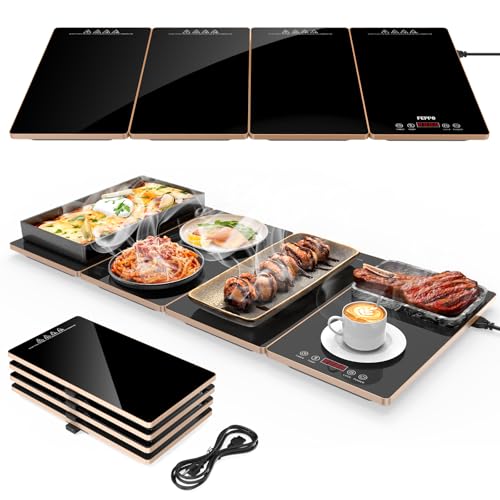

As an Amazon Associate we earn from qualifying purchases at no extra cost to you. Ratings are shown as listed on Amazon.
Best buffet warmer by situation
| Situation | Best format | Useful capacity | Why it fits | Main compromise |
|---|---|---|---|---|
| Apartment or occasional dinner | Electric 2- or 3-pan server | 6–9 quarts total | Compact, easy temperature control, no fuel storage | Needs an outlet and takes counter space |
| Family holiday meal | Electric 3-pan buffet warmer | 9–12 quarts total | Separate pans for sides, sauces, and vegetables | Limited by one appliance’s footprint |
| Large indoor gathering | Full-size chafing dishes | 8–9 quarts per dish | Easy to arrange in a line and refill independently | More washing and fuel management |
| Outdoor event without reliable electricity | Fuel-heated chafer | 4–8 quarts per pan | Works away from outlets and can scale to several dishes | Less precise heat control and an open flame |
| Small portions or frequent entertaining | Two 1.5–2-quart electric pans | 3–4 quarts total | Less food waste and easier storage | Not suitable for a crowd |
Electric buffet warmers: the easiest choice for home use
An electric buffet server normally has a heated base, removable stainless-steel or aluminum pans, clear lids, and either one thermostat or separate heat controls. The most useful household size is three pans holding roughly 2 to 3 quarts each. That arrangement accommodates a main side, a second side, and gravy or another sauce without requiring three separate appliances.
Look for a thermostat that begins at a genuinely low warming setting and rises to at least medium-high heat. A simple low-to-high dial is adequate for mashed potatoes, vegetables, pulled meat, and cooked pasta, but separate controls are more valuable if one pan contains delicate sauce while another holds dense food. Indicator lights are helpful, although they show that the heater is powered—not that the food has reached a safe serving temperature.
Some electric servers use a shallow water reservoir beneath the pans. This gentler, humid heat helps reduce drying, particularly with rice, poultry, and casseroles. The trade-off is added setup and cleanup: the water tray must be emptied and dried after every use. Direct-contact heated bases are quicker to assemble but may create hotter spots, especially when a pan is nearly empty.
What electric models do well
- Consistent heat without replacing fuel cans.
- Lower operating noise than many countertop cooking appliances.
- Removable pans that can often go in a dishwasher, subject to the manufacturer’s instructions.
- Better suitability for indoor homes with children or pets than exposed flame.
Where electric models fall short
A single 1,200–1,500-watt warmer can use a substantial portion of a household circuit. Avoid connecting several high-wattage warmers to one overloaded extension lead. Use a properly rated, grounded outlet and keep cords away from serving traffic. An extension cable rated for the appliance’s wattage may be acceptable for some setups, but a power strip or lightweight indoor extension cord is a poor choice for a hot buffet.
Fuel chafing dishes: flexible and scalable
Traditional chafing dishes use a water pan, one or more food pans, a frame, and canned or wick-style fuel. Sterno is the best-known fuel brand, and compatible gel or wick cans are widely available. Standard full-size food pans are commonly about 20.75 by 12.75 inches and hold approximately 8.5 quarts, although filling them completely is not practical for every food.
Fuel warmers make sense when the buffet is outdoors, spread across a long table, or large enough that several independent heating positions are more convenient than one electric appliance. They also keep working if guests are being served far from the kitchen. Half-size pans, typically around 4 quarts, are easier to lift and better suited to smaller quantities.
The main limitation is control. Fuel produces heat at a relatively fixed rate, so a water bath is important: it distributes heat and reduces scorching. A chafer can keep food warm, but it is not a precision temperature-control device. Wind can reduce performance outdoors, while closing the lid can trap condensation and soften fried or crisp foods.
Never move a lit chafer, refill a fuel container while hot, or leave an open flame unattended. Place the unit on a stable, heat-resistant surface away from tablecloth edges and serving traffic. Follow the fuel manufacturer’s instructions rather than improvising with candles or combustible liquids.
Pan capacity: calculate before buying
Capacity estimates are more useful than the number of included pans. As a starting point, allow approximately 0.5 to 0.75 quart of side dish per person for a mixed meal, divided among the sides. For a buffet serving 12 people with three sides, a reasonable calculation is:
12 guests × 0.6 quart per person = 7.2 quarts of side dishes.
A three-pan electric warmer with 2.5-quart pans provides 7.5 quarts nominally, but food should not be filled to the rim. That leaves little reserve, so an 8- to 10-quart usable capacity is more comfortable. For a main dish such as chili or pulled pork, plan separately; dense foods are heavy to lift and often need a deeper pan or a second batch kept in the kitchen.
Remember that a pan’s capacity does not equal its serving capacity. A 2-quart pan filled to about 80 percent holds 1.6 quarts. If each guest takes roughly 4 ounces, or 0.125 quart, that serves about 12 small portions before replenishing.
Temperature control and food quality
Use the warmer to maintain already-hot food, not to bring a cold roast or refrigerated casserole up to temperature. Heat food thoroughly in an oven, on the stove, or in a suitable cooking appliance first, then transfer it to the preheated warmer. Keep lids closed except when serving; repeated opening releases heat and moisture.
For quality, match the food to the pan:
- Mashed potatoes and rice: benefit from covered pans and gentle, moist heat.
- Gravy and cheese sauce: need stirring because edges can thicken or form a skin.
- Fried food: becomes soft in a covered water-bath chafer; use a vented lid or serve promptly.
- Meat: stays more palatable with sauce or broth and smaller replenished batches.
Use a food thermometer when holding perishable dishes. As a general food-safety practice, keep hot food at or above 140°F, and follow local guidance for time limits and discard rules. A warmer’s dial setting is not a substitute for checking the food itself, since pan depth, starting temperature, lid position, and room temperature all affect results.
Cleanup and durability: what matters after the party
The parts most likely to cause ownership trouble are the thermostat, power cord, pan coating, lid hinges, and fuel residue. Stainless-steel pans tolerate utensils and repeated washing better than thin nonstick inserts. If a model includes nonstick pans, use silicone or wooden utensils and avoid abrasive pads. Scratched coating is difficult to restore.
For an electric unit, unplug it and let the base cool before removing spills. Never immerse the heated base or pour water over its controls. Soak removable pans in warm, soapy water rather than scraping dried starch aggressively. A water-bath tray should be dried completely to prevent mineral deposits and corrosion around seams.
For a fuel chafer, allow the canister to cool fully before disposal or storage. Wipe soot from the underside of the water pan and inspect the frame for bent legs. Fuel cans are consumables, so include their recurring cost when comparing formats. In general market terms, a basic electric server often costs about $40–$100, while a stainless-steel chafer may range from $50–$180, with heavier commercial units costing more. Fuel and replacement pans add to the long-term cost of the latter.
Bottom line
Choose an electric three-pan warmer with roughly 9–12 quarts of total capacity for most indoor home entertaining. Prioritize removable stainless-steel pans, a low-to-high thermostat, secure lids, and a wattage that suits your outlet. Choose fuel chafers when portability, multiple serving stations, or outdoor use matters more than precise temperature adjustment. Whichever format you buy, size it by usable capacity, preheat it before serving, keep the lids closed, and plan cleanup before the guests arrive.

Write Your Review
No reviews yet. Be the first to share your experience!