

Key takeaways
- Compare the best handheld belt sanders for fast stock removal, from a compact budget 3 x 18 model to a premium 4 x 24, with maker specs and buying advice.
- Top Pick: Makita 9903 Variable Speed Belt Sander
- Runner-up: Makita 9403 Belt Sander
- Also consider: WEN 6321 Belt Sander
A belt sander is the fastest handheld way to level a glued-up panel, strip an old finish, or flush up a frame-and-panel door. Nothing else in the shop removes stock as quickly, and nothing else punishes a moment of carelessness as quickly either, which is why choosing the right size, motor and speed range matters more here than with almost any other sander. The five machines below cover the three belt sizes that dominate woodworking, from a compact 3 x 18 inch model for small parts to a heavy 4 x 24 inch workhorse built for tabletops.
This guide compares maker-stated specifications only: motor amperage, belt size, belt speed, dust collection and weight. Each pick sits in a clear budget, mid-range or premium tier so you can match the tool to how often you actually flatten panels, and the buying advice further down explains when a belt sander is the right tool and when an orbital sander, a planer or a drum sander will serve you better.
As an Amazon Associate, we earn from qualifying purchases.
Quick answer
For most woodworkers, a 3 x 21 inch belt sander hits the sweet spot of power, control and belt availability. The Makita 9903 is the strongest all-round pick here, the WEN 6321 covers the budget tier, and the Makita 9403 is the premium choice when you need to flatten wide panels and tabletops fast.
1. Makita 9903 Variable Speed Belt Sander

The 9903 is the machine many cabinet shops reach for first, and the spec sheet explains why. Its 8.8 amp motor drives a 3 x 21 inch belt, and a variable speed dial lets you slow the belt right down for veneer, paint stripping and softwoods instead of plowing through them. Makita rates it at 85 decibels, which is comparatively civilized for this class of tool, and the long, flat top profile lets the sander sit stable and reach close to vertical surfaces. A dust bag is included, and the belt change and tracking adjustments follow the simple lever-and-knob layout Makita has used for years. If you buy one belt sander for general furniture work, this mid-range to premium model is the safest bet in the group.
Specs:
- Motor: 8.8 amp, corded electric
- Belt size: 3 x 21 inches
- Belt speed: variable, 690 to 1,440 feet per minute (maker-stated)
- Noise rating: 85 dB (maker-stated)
- Dust collection: dust bag included
- Tier: premium
2. Makita 9403 Belt Sander

The 9403 is the heavy lifter. A 4 x 24 inch belt covers far more surface per pass than any 3 inch machine, and the 11 amp motor keeps that wide belt moving at a maker-stated 1,640 feet per minute, so rough lumber, butcher block and wide door slabs flatten in fewer passes. At 13 pounds it is the heaviest sander here, but on horizontal work that weight works for you, keeping the platen planted while you steer. Makita rates it at 84 dB, and the dust bag swivels a full 360 degrees so it stays clear of the work and the cord. There is no variable speed, so finesse work belongs to a smaller tool. This is a premium-tier machine for people who regularly surface wide stock.
Specs:
- Motor: 11 amp, corded electric
- Belt size: 4 x 24 inches
- Belt speed: 1,640 feet per minute, single speed (maker-stated)
- Noise rating: 84 dB (maker-stated)
- Weight: 13 pounds
- Dust collection: dust bag with 360-degree swivel
- Tier: premium
3. WEN 6321 Belt Sander
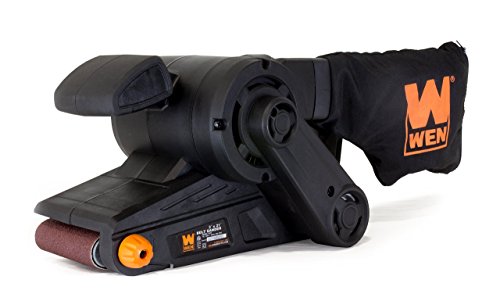
The WEN 6321 is the budget-tier entry point and a sensible first belt sander. The 7 amp motor turns a standard 3 x 21 inch belt at a maker-stated 13 feet per second, which is 780 feet per minute in the units most listings use, and at about six pounds it is easy to guide with one hand on the front knob during long sessions. A detachable dust bag, a lock-on button for continuous runs and a two-year maker warranty round out a short but honest spec sheet. It is a single-speed machine with less reserve power than the Makita models, so coarse work on dense hardwood takes more passes, but for flattening pine panels, doors and deck boards it covers the basics at the lowest tier in this guide.
Specs:
- Motor: 7 amp, corded electric
- Belt size: 3 x 21 inches
- Belt speed: 13 feet per second (maker-stated)
- Weight: about 6 pounds
- Dust collection: detachable dust bag
- Warranty: 2-year (maker-stated)
- Tier: budget
4. SKIL 7510-01 Sandcat Belt Sander

The SKIL 7510-01 is the compact option, built around a shorter 3 x 18 inch belt that makes the tool easier to control on narrow stock, chair parts and smaller panels. Its 6 amp motor is the mildest here, and SKIL pairs it with two features aimed squarely at beginners: a pressure control indicator that warns when you are leaning on the tool hard enough to gouge or stall it, and an Auto Track system that keeps the belt centered without constant knob adjustments. The micro-filtration dust canister traps finer dust than a plain bag, and the port accepts standard 1-1/4 inch vacuum hoses for cleaner work. Belts in the 3 x 18 size are slightly less common on store shelves than 3 x 21, which is the main trade-off of the smaller format.
Specs:
- Motor: 6 amp, corded electric
- Belt size: 3 x 18 inches
- Belt speed: 1,050 feet per minute (maker-stated)
- Features: pressure control indicator, Auto Track belt alignment
- Dust collection: micro-filtration canister, 1-1/4 inch vacuum port
- Tier: budget
5. BLACK+DECKER DS321 Dragster Belt Sander

The DS321 takes a different shape from everything else here. BLACK+DECKER’s Dragster design uses a low front roller and a retractable hood, so the belt can sand right up to vertical surfaces and into the tight spots under cabinets and toe kicks where a tall front knob gets in the way. The current listing carries a 7 amp motor driving a 3 x 21 inch belt, with an adjustable handle position for control on edges and a dust bag in the box alongside a starter belt. It is a single-speed machine aimed at remodeling and furniture refinishing rather than production panel work, and it sits in the budget to mid-range tier. Choose it when access and flush sanding matter more than raw stock removal.
Specs:
- Motor: 7 amp, corded electric
- Belt size: 3 x 21 inches
- Design: low-profile Dragster front with retractable hood for flush sanding
- Dust collection: dust bag included
- Includes: sander, dust bag, one sanding belt
- Tier: budget to mid-range
How to choose a belt sander
Start with belt size, because it decides both the work the tool suits and the belts you will buy for years. The 3 x 21 inch format is the default for furniture and general shop work: wide enough to flatten a panel without ridging, narrow enough to control, and the easiest size to find in every grit. A 4 x 24 inch machine like the 9403 earns its keep on tabletops, doors and wide glue-ups, where the extra width and weight cut the pass count, but it is tiring on vertical work. The 3 x 18 inch format trades coverage for maneuverability on small parts.
Motor amperage and belt speed work together. Higher amps hold speed under load on dense hardwood, while belt speed in feet per minute tells you how aggressively the tool cuts. Variable speed, as on the Makita 9903, is worth having if you strip paint, sand veneer or work softwoods, because a slower belt is far more forgiving. Single-speed machines are simpler and cheaper, and they are fine for rough stock removal where control comes from your hands rather than a dial.
Finally, look at tracking and dust. A belt that wanders forces constant adjustment, so systems like SKIL’s Auto Track or a well-made manual tracking knob matter more than they sound. Dust bags fill quickly and are the least effective option; a canister or a vacuum port, as on the SKIL, keeps the work visible and the air cleaner. Whatever you choose, plan to finish with an orbital or hand sanding at finer grits, because a belt sander is a shaping and leveling tool, not a finishing tool.
Who should skip these
Skip the belt sander entirely if your work is mostly finish sanding: a random orbital sander leaves a surface ready for finish, while a belt sander leaves scratches you will spend longer removing than you saved. Skip it if you mainly flatten one or two boards at a time and already own a thickness planer or a jointer, since those machines level stock with far less risk of gouging. Skip the big 4 x 24 inch format if you sand vertically, work overhead, or have limited hand and arm strength, because its weight becomes a liability off the bench. And skip every model here if your priority is delicate veneer or antique restoration on a budget; a variable speed machine helps, but a card scraper and patience are safer tools for that work.
FAQ
Which belt size is best for general woodworking?
The 3 x 21 inch belt is the best default. It balances flattening ability, control and belt availability, and it fits the widest range of machines in this guide. Move up to 4 x 24 inches only if you regularly surface wide panels and tabletops.
Do I need variable speed on a belt sander?
Only if your work goes beyond rough lumber. Variable speed helps when stripping paint, sanding softwood or touching veneer, because slowing the belt reduces burning and digging. For straightforward stock removal on hardwoods, a single-speed machine is simpler and usually cheaper.
Can a belt sander replace an orbital sander?
No. A belt sander removes material quickly but leaves a scratched surface that still needs refinement. The normal sequence is belt sander for leveling, then an orbital sander through finer grits, or hand sanding, before any finish goes on.
How do I stop a belt sander from gouging the wood?
Keep the sander moving at all times, let the weight of the tool do the work instead of pressing down, and start the belt before it touches the surface. Coarser belts gouge faster, so step up through grits rather than trying to finish with a coarse belt.
Final verdict
For a single do-everything machine, the Makita 9903 is the pick: real variable speed, a strong motor and the standard 3 x 21 inch belt size. If your work is wide panels and tabletops, step up to the Makita 9403 and let its weight and 4 inch belt do the flattening. On a budget, the WEN 6321 covers honest general work, the SKIL 7510-01 suits smaller parts and newer users, and the BLACK+DECKER DS321 is the one to choose when flush sanding into tight corners is the whole point of the job.
More from Amazon
Programs that pair well with the guide above. Offers and eligibility are set by Amazon and may change.
A free business account with business pricing and bulk-buying tools for work, shop or home office.
Create a business accountFree shipping on eligible items, Prime Video and more. Eligible new members can start with a free trial.
Start a Prime free trialAudiobooks and podcasts to listen to on the go. Eligible new members can start with a free trial.
Try Audible freeAd-free music streaming. Eligible new subscribers can start with a free trial.
Try Music Unlimited freeAs an Amazon Associate we earn from qualifying purchases.


Write Your Review
No reviews yet. Be the first to share your experience!