

Key takeaways
- Compare the best drum sanders for woodworking, from a compact benchtop model to a dual-drum production machine, with widths, motors and feed rates.
- Top Pick: JET JWDS-1020 Benchtop Drum Sander
- Runner-up: JET JWDS-1632 Drum Sander with Open Stand
- Also consider: JET JWDS-2244 Drum Sander with Open Stand
A drum sander does the one job a planer and a random-orbit sander both struggle with: it brings glued-up panels, figured boards and thin stock to a dead-even thickness without tear-out or hours of hand work. A wide abrasive-wrapped drum takes off a few thousandths of an inch per pass while a conveyor feeds the workpiece through at a controlled rate, so cabinet doors, tabletops and cutting boards come out flat and ready for finish sanding.
The five machines below cover the full range of home and small-pro shop needs, from a 10-inch benchtop unit to a dual-drum production sander running two grits in one pass. Each is described from its published specifications: sanding width in one pass and two, maximum stock thickness, motor power, conveyor feed range and machine weight.
As an Amazon Associate, we earn from qualifying purchases.
Quick answer
For most woodworking shops, the JET JWDS-1632 is the sweet spot: a 16-inch open-end drum, 1.5 HP motor and load-sensing SandSmart conveyor on a standard 115V circuit. Tight on space, the benchtop JET JWDS-1020 covers the same jobs in miniature. The SuperMax 19-38 and JET JWDS-2244 add width, while the dual-drum Shop Fox W1678 suits production work.
JET JWDS-1020 Benchtop Drum Sander
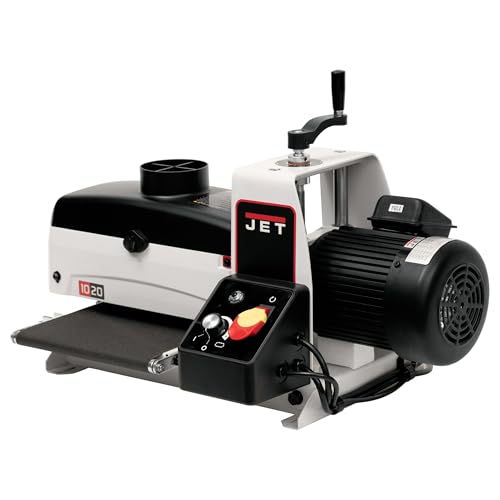
The JWDS-1020 is the compact entry point into drum sanding, built for shops where a floor-standing machine will not fit. Its 10-inch drum sits in an open-end frame, so stock up to 20 inches wide can be surfaced in two passes, and at 73 pounds it moves on and off a bench easily. A 1 HP motor spins the 5-inch diameter drum at 1,720 RPM, with a variable conveyor feed for figured grain or plain softwood.
Boards up to 3 inches thick fit under the drum, so the little JET handles everything from box lids and drawer fronts to resawn veneer work a planer would destroy. It ships with an 80-grit abrasive wrap preinstalled and carries JET’s 5-year warranty. This is the budget-tier pick of the group.
Specs
- Drum width: 10 inches; sands up to 20 inches wide in two passes
- Maximum stock thickness: 3 inches
- Motor: 1 HP, 115V, 8 amps
- Drum speed: 1,720 RPM
- Conveyor feed: variable, up to 12 FPM
- Drum diameter: 5 inches
- Weight: 73 pounds
- Dimensions: 26.85 x 17.9 x 17.87 inches
- Warranty: 5 years
JET JWDS-1632 Drum Sander with Open Stand

The JWDS-1632 is the machine most home furniture shops end up with. A 16-inch drum handles most panels in a single pass, and the open-end design doubles that to 32 inches in two passes, enough for dining tabletops and wide door glue-ups. The 1.5 HP motor runs on a 115V circuit with 20-amp service, turning a precision-machined, dynamically balanced aluminum drum.
The headline feature is SandSmart control, which monitors drum load and regulates conveyor speed automatically, infinitely variable up to 10 FPM. A tool-less parallelism dial keeps the conveyor level with the drum, and the shaped dust hood directs chips to a single 4-inch port. The included open stand adds a storage shelf and pre-drilled caster holes. It sits in the mid-range tier.
Specs
- Drum width: 16 inches; sands up to 32 inches wide in two passes
- Maximum stock thickness: 3 inches
- Motor: 1.5 HP, 115V, 20-amp service
- Drum speed: 1,725 RPM
- Conveyor feed: variable, 0 to 10 FPM with SandSmart load control
- Drum: 5-inch diameter extruded aluminum
- Dust port: 4 inches
- Weight: 137.7 pounds
- Warranty: 5 years
SuperMax 19-38 Drum Sander
SuperMax built its reputation on drum sanders, and the 19-38 is the brand’s most popular open-end model. The 19-inch drum covers a full cabinet door in one pass and reaches 38 inches in two, with the strongest single-drum motor here that still runs on household 110V power. Stock can be up to 4 inches thick and as thin as 1/32 inch, with a minimum length of just 2-1/4 inches, so small parts and shop-sawn veneer are both fair game.
SuperMax’s Intellisand technology plays the same role as JET’s SandSmart, adjusting conveyor speed to motor load to prevent gouging and burning. The drum carriage is bolted to the base so it cannot drift, a single nut sets conveyor parallelism, and the steel conveyor bed is precision-flattened. Shipping weight is 286 pounds in three boxes including the stand, so plan for a helper at setup. This is a premium-tier machine.
Specs
- Drum width: 19 inches; sands up to 38 inches wide in two passes
- Stock thickness range: 1/32 inch to 4 inches
- Minimum stock length: 2-1/4 inches
- Motor: 1-3/4 HP TEFC, 110V single-phase, 20-amp service
- Drum speed: 1,740 RPM
- Drum: 5 x 19-inch extruded aluminum
- Conveyor feed: variable, 0 to 10 FPM with Intellisand load control
- Dust port: 4 inches
- Shipping weight: 286 pounds including stand
JET JWDS-2244 Drum Sander with Open Stand

The JWDS-2244 is the step up for shops that regularly surface wide panels. Its 22-inch drum takes most tabletops and door slabs in a single pass, and the open end extends capacity to 44 inches in two passes. The 1-3/4 HP motor draws 15 amps on 115V power, and stock thickness runs from 1/32 inch up to 4 inches, with a minimum board length of 2-3/8 inches.
Like the smaller JET, it uses SandSmart load sensing to manage the variable conveyor, which runs from 0 to 10 FPM, and parallelism adjusts without tools. The mirrored dust hood directs debris to a 4-inch port, and JET recommends dust extraction of at least 550 CFM to keep up with it. At 177 pounds on its included open stand, it is a permanent shop fixture. It sits in the premium tier and carries the same 5-year warranty as the rest of the JET line.
Specs
- Drum width: 22 inches; sands up to 44 inches wide in two passes
- Stock thickness range: 1/32 inch to 4 inches
- Minimum stock length: 2-3/8 inches
- Motor: 1-3/4 HP, 115V, 15 amps
- Drum speed: 1,725 RPM
- Conveyor feed: variable, 0 to 10 FPM with SandSmart load control
- Dust port: 4 inches
- Weight: 177 pounds
- Dimensions: 42 x 24 x 52 inches
- Warranty: 5 years
Shop Fox W1678 26-Inch Double Drum Sander
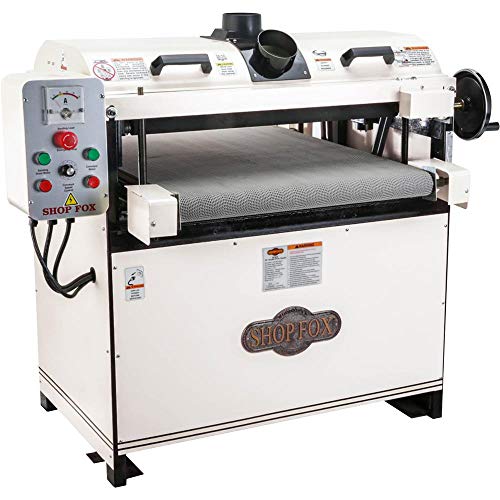
The W1678 plays a different game from the four open-end machines above. It is a closed-frame, dual-drum production sander: stock up to 26 inches wide passes under two 6-inch drums in a single pass, so a coarse grit on the front drum and a finer grit on the micro-adjustable rear drum finish both steps at once. There is no two-pass flipping, and the 26-inch width is a true single-pass figure.
A 5 HP motor on 220V single-phase service at 25 amps turns the drums at 3,450 RPM for a drum surface speed of 2,300 FPM, and the separate conveyor drive offers variable feed up to 20 FPM, twice the top rate of the single-drum machines here. Abrasive changes use a hook-and-loop attachment system, an amp meter on the control panel shows motor load, and twin 4-inch dust ports handle extraction. Maximum stock thickness is 4-1/4 inches. At roughly 546 pounds, this premium-tier machine needs a dedicated 220V circuit and a permanent home.
Specs
- Design: closed frame, dual drum
- Maximum stock width: 26 inches in a single pass
- Maximum stock thickness: 4-1/4 inches
- Motor: 5 HP, 220V single-phase, 25 amps
- Drum speed: 3,450 RPM; drum surface speed 2,300 FPM
- Drums: two, 6-inch diameter, hook-and-loop abrasive attachment
- Conveyor feed: variable, up to 20 FPM
- Dust ports: two 4-inch ports
- Weight: 546 pounds
- Warranty: 2 years
How to choose a drum sander
Start with width, because it decides the machine class. The headline number on an open-end sander is its two-pass capacity, so a 16-32 machine sands 16 inches in one pass and 32 inches across two flipped passes. If nearly all your panels are under 16 inches, a smaller drum is no compromise; wide-tabletop builders should look at 19-inch and 22-inch drums, or a closed-frame dual-drum machine.
Power and electrics come next. Every single-drum machine here runs on 115V or 110V household power, but the stronger motors want a 20-amp circuit, and the dual-drum Shop Fox needs 220V service entirely. After that, compare feed control: load-sensing systems such as SandSmart and Intellisand automatically slow the conveyor when the drum works hard, the biggest protection against burned, gouged panels.
Finally, weigh thickness range, dust collection and abrasive costs. Thin minimum ratings, down to 1/32 inch on several models, matter if you sand veneer or delicate inlay work. All of these machines need a real dust collector, not a shop vacuum, and abrasive wraps are a running cost.
Who should skip a drum sander
Skip the category if your work is mostly narrow boards and small parts. A planer followed by a random-orbit sander handles stock under 10 inches wide perfectly well, and a drum sander earns its floor space only when wide panels, glue-ups or figured wood are regular jobs. Woodworkers who mainly need heavy stock removal should also look elsewhere: a drum sander removes only a few thousandths per pass by design, so it complements a planer rather than replacing one.
Space and power are the other honest filters. Floor models here weigh from about 140 to over 500 pounds, and the wide ones demand serious dust collection and, in the Shop Fox’s case, a 220V circuit. If your shop is a shared garage with one 15-amp outlet, the benchtop JWDS-1020 is the only realistic pick.
FAQ
Can a drum sander replace a thickness planer?
No. A planer removes material quickly and sets rough thickness, while a drum sander removes only a few thousandths of an inch per pass. Its role is the finishing stage: flattening glue-ups, leveling figured wood without tear-out and dialing in final thickness. Most owners run both machines in sequence.
What grit should I run on a drum sander?
Most owners live between 80 and 120 grit for everyday panel work, dropping to 60 grit for heavy leveling of rough glue-ups and rising to 150 or 180 for final passes before hand sanding. Dual-drum machines such as the Shop Fox W1678 let you pair two grits, coarse in front and fine behind, in a single pass.
How wide a panel can an open-end drum sander handle?
Roughly twice its drum width. A 16-inch drum sands 16 inches in one pass and up to 32 inches by flipping the panel and making a second, overlapping pass. Careful parallelism keeps the overlap line from showing.
Do I need a dust collector for a drum sander?
Yes. Drum sanders produce a heavy stream of fine dust, and every machine here uses a 4-inch port sized for a dust collector, with recommended airflow figures starting around 550 CFM on the JET JWDS-2244 and 600 CFM on the SuperMax 19-38. A shop vacuum cannot move enough air.
Final verdict
For the majority of woodworking shops, the JET JWDS-1632 remains the balanced choice: real 16-inch single-pass width, load-sensing feed control and a 5-year warranty on ordinary household power. Choose the JWDS-1020 if bench space rules your shop, the SuperMax 19-38 or JWDS-2244 if wide panels are your weekly work, and the Shop Fox W1678 if two-grit production sanding justifies a 220V circuit and a permanent footprint.
More from Amazon
Programs that pair well with the guide above. Offers and eligibility are set by Amazon and may change.
A free business account with business pricing and bulk-buying tools for work, shop or home office.
Create a business accountFree shipping on eligible items, Prime Video and more. Eligible new members can start with a free trial.
Start a Prime free trialAudiobooks and podcasts to listen to on the go. Eligible new members can start with a free trial.
Try Audible freeAd-free music streaming. Eligible new subscribers can start with a free trial.
Try Music Unlimited freeAs an Amazon Associate we earn from qualifying purchases.


Write Your Review
No reviews yet. Be the first to share your experience!