

Key takeaways
- Under about $300: Choose a 4- to 5-foot compact table if storage and price matter most. Expect lighter construction, smaller goals, and a blower intended for casual sessions.
- About $300–$800: A 6- or 7-foot recreational table is the strongest value for many families. Look for a 50- to 100-watt blower, stable legs, and a playfield that remains flat after assembly.
- About $800–$1,500: Move to a full-size 7- or 8-foot table with stronger airflow, thicker materials, electronic scoring, and better leveling hardware. This is the most suitable range for frequent home play.
- Above $1,500: Consider a commercial-style table from brands such as Gold Standard Games or Dynamo, provided the room, delivery route, and maintenance budget justify it. The benefit is usually consistency and serviceability rather than extra decorative features.
The best air hockey tables for a home game room are full-size 7- to 8-foot models with a powerful, evenly distributed blower, a thick playing surface, and enough clearance for players to move without striking walls or furniture.
Our top picks

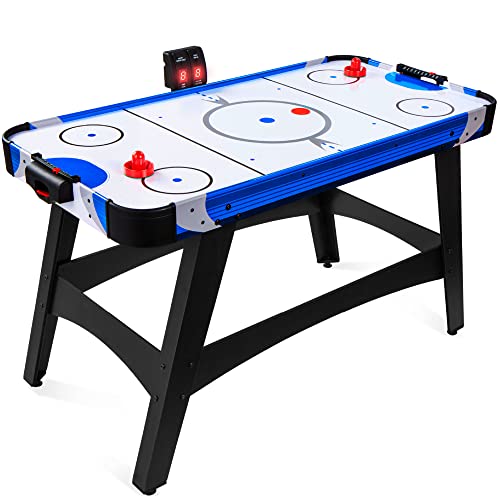
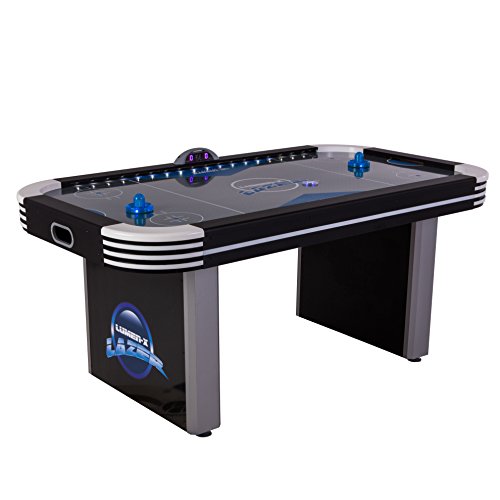
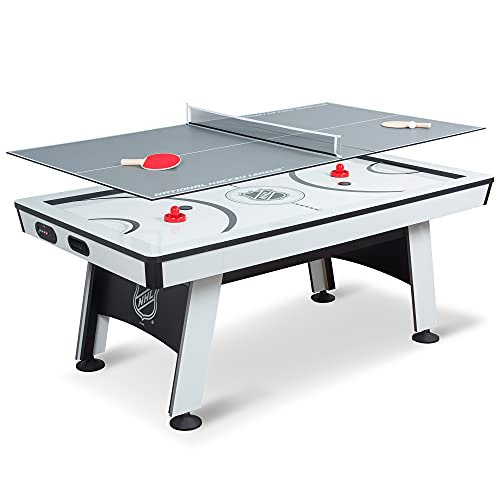
As an Amazon Associate we earn from qualifying purchases at no extra cost to you. Ratings are shown as listed on Amazon.
Quick picks by home situation
| Home situation | Best table type | Recommended size | What to prioritize | Typical market range |
|---|---|---|---|---|
| Apartment or multipurpose room | Compact tabletop or legged table | 4 to 6 feet | Low weight, storage, quieter blower | $150–$500 |
| Children and occasional family play | Mid-size recreational table | 6 to 7 feet | Simple assembly, rounded corners, stable legs | $300–$800 |
| Frequent adult and family use | Full-size home table | 7 to 8 feet | Strong blower, rigid cabinet, levelers | $700–$1,500 |
| Competitive-feeling play | Commercial-style table | 8 feet or larger | Thick playfield, fast rebound, serviceable parts | $1,500–$4,000+ |
How much room does an air hockey table need?
Table length is only the starting point. Players need room at both ends to swing a mallet, step sideways, and retrieve the puck. A useful planning rule is to add at least 4 feet to the table’s length and 3 feet to its width. For more comfortable adult play, allow 5 feet at each end and 3 to 4 feet along the sides.
For example, an 8-foot table is usually about 8 feet long and 4 feet wide. A practical minimum room footprint is therefore approximately 12 by 7 feet, while a more comfortable setup uses about 18 by 8 feet. Do not measure only the empty floor: account for doors, cupboards, sofas, pool cues, and walking paths.
A compact 4- or 5-foot table can fit a child’s bedroom or apartment recreation area, but it changes the experience. The playing surface is shorter, rebounds are less predictable, and two adults may feel crowded. Choose compact sizes for casual play and easy storage, not for tournament-style speed.
Size and construction compared
| Table size | Approximate weight | Typical blower power | Best use | Main compromise |
|---|---|---|---|---|
| 4–5 feet | 25–55 lb | 30–60 watts | Children, apartments, occasional play | Small goals and less realistic rebounds |
| 6 feet | 50–90 lb | 50–100 watts | Family rooms and younger players | Can feel cramped for adults |
| 7 feet | 90–150 lb | 80–150 watts | Most home game rooms | Needs careful leveling and a permanent location |
| 8 feet | 130–250 lb | 100–200 watts | Frequent, fast-paced home play | Delivery and assembly are more demanding |
| 8 feet or larger commercial style | 200–400+ lb | 150–300+ watts | Heavy use and competition-style play | Cost, noise, weight, and service requirements |
These figures are useful comparison ranges rather than universal standards. Blower wattage alone does not determine performance: fan design, air-channel layout, hole spacing, and playfield flatness matter just as much.
What makes the best air hockey tables perform well?
Blower power and airflow
The blower should create a consistent cushion of air across the entire playfield, including near the rails. Weak airflow causes the puck to drag, stop near the center, or behave differently from one side to the other. A 7- or 8-foot home table generally benefits from a blower rated around 100 watts or more, while larger commercial-style tables may use 150 to 300 watts.
Look for a perforated playfield with evenly spaced holes and a blower that is accessible for cleaning or replacement. A powerful but poorly distributed fan can be noisier without making the table faster. If possible, choose a model with a separate on/off switch for the blower and electronic scoring; it is easier to troubleshoot and less wasteful between games.
Playing surface and rails
The playfield is commonly made from coated medium-density fiberboard or particleboard. A smooth, sealed coating is adequate for recreational use, but thin panels can flex, chip, or develop low spots after repeated moving. Higher-quality tables use a thicker board, a more durable laminate or polymer coating, and a reinforced underside.
Rails should be rigid enough to return the puck at a consistent angle. Thin plastic edging may look attractive but can produce dead spots and loosen over time. Aluminum or steel rail construction generally holds up better, although a well-reinforced composite rail can also work in a home setting.
Cabinet, legs, and leveling
Furniture-grade laminate over engineered wood keeps cost and weight manageable. Solid wood is not automatically better: it is heavier, more expensive, and can move with changes in humidity. A rigid engineered-wood cabinet with a thick top and metal bracing is often the sensible choice for home use.
Prioritize wide leg bases, cross-bracing, adjustable levelers, and a cabinet that does not twist when pushed from the side. An uneven table changes puck speed and can make one player’s side noticeably faster. Fixed levelers are acceptable for a permanent installation, but threaded adjustable feet are worth paying for in a basement or older home with an uneven floor.
Best choices by budget and playing frequency
- Under about $300: Choose a 4- to 5-foot compact table if storage and price matter most. Expect lighter construction, smaller goals, and a blower intended for casual sessions.
- About $300–$800: A 6- or 7-foot recreational table is the strongest value for many families. Look for a 50- to 100-watt blower, stable legs, and a playfield that remains flat after assembly.
- About $800–$1,500: Move to a full-size 7- or 8-foot table with stronger airflow, thicker materials, electronic scoring, and better leveling hardware. This is the most suitable range for frequent home play.
- Above $1,500: Consider a commercial-style table from brands such as Gold Standard Games or Dynamo, provided the room, delivery route, and maintenance budget justify it. The benefit is usually consistency and serviceability rather than extra decorative features.
Assembly: what to expect before ordering
Compact tables may arrive nearly assembled, while full-size tables commonly require attaching legs, installing the scoring unit, connecting the blower, fitting goals, and leveling the cabinet. A 6-foot table may take two adults one to two hours. A heavy 7- or 8-foot table can require two to four adults and several hours, especially when the cabinet arrives in separate sections.
Check the packaged dimensions and weight before purchase. A table that fits the game room may not fit through a stairwell, narrow hallway, or sharp doorway. Plan to carry heavy cabinets on their side only when the manufacturer permits it, and protect corners during movement.
A reliable setup sequence
- Place the table in its final position before attaching accessories.
- Install every leg and brace loosely, then tighten hardware gradually and evenly.
- Use a long spirit level in several directions, not just across the center.
- Adjust each leveler until the cabinet is stable and the playfield is flat.
- Run the blower and test the puck across the center, corners, and rail edges.
- Confirm that the score sensors, goal returns, and power cord are secure.
Do not use the table as a workbench while assembling it. A dropped tool can dent the playfield, and tightening one corner fully before the others can twist the cabinet.
Ownership realities: what wears first?
The puck and mallets are consumables. Rough edges, grit, and chipped mallets can scratch the playfield and increase drag. Keep several spare pucks of the correct diameter and weight, and replace any puck with a burr or crack.
Dust is another common cause of poor performance. Unplug the table, vacuum the blower intake and cabinet vents, and wipe the playfield with a dry or barely damp microfiber cloth. Avoid wax, silicone spray, furniture polish, and household cleaners unless the manufacturer specifically approves them; residues can clog air holes or make the puck behave unpredictably.
Inspect leg bolts and braces every few months if the table is used frequently. Vibration gradually loosens hardware, producing rattles and an uneven surface. Keep drinks away from the cabinet, and avoid leaning on the rails, which can loosen rail mounts or distort the cabinet.
Final buying recommendation
For most dedicated home game rooms, the best air hockey tables are 7-foot models with a rigid engineered-wood cabinet, adjustable levelers, a blower of roughly 80 to 150 watts, and accessible replacement parts. Choose 6 feet or less when space and storage dominate the decision. Choose an 8-foot commercial-style table only when you can provide the required clearance, carry it into the room safely, and expect enough use to justify its weight and cost.

Write Your Review
No reviews yet. Be the first to share your experience!