

Key takeaways
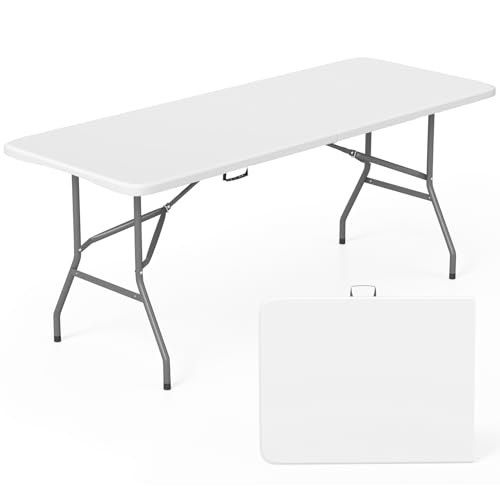
- Best all-purpose choice: A 6-foot rectangular plastic folding table, such as the Lifetime 6-Foot Folding Table, balances seating, buffet space, durability, and manageable transport.
- Best for the smallest storage area: A 4-foot center-fold table with a built-in carrying handle. It fits in many closets and car trunks but provides less room for serving or seating.
- Best for frequent event transport: A 6-foot table with a suitcase-style center fold, recessed handle, and locking panel. The folded footprint is more important than a few pounds of weight.
- Best for a more polished indoor setting: A folding banquet table with a laminate or plywood top. It looks more like conventional furniture, though it is usually heavier and less tolerant of rain.
- Best for maximum seating: An 8-foot rectangular table. It can seat eight to ten people, but its length and folded weight make it a poor choice for tight storage or one-person setup.
- Best for flexible layouts: A 60-inch round folding table. It is useful for conversation and dining, but its circular shape uses more floor area and is harder to stack efficiently.
The best folding tables for most events and small spaces are 6-foot rectangular models with a 1.75-inch blow-molded plastic top, powder-coated steel legs, a center-fold design, and a working capacity of at least 300 pounds; choose a 4-foot table when storage and transport matter more than seating or surface area.
Our top picks



As an Amazon Associate we earn from qualifying purchases at no extra cost to you. Ratings are shown as listed on Amazon.
Best folding tables by situation
- Best all-purpose choice: A 6-foot rectangular plastic folding table, such as the Lifetime 6-Foot Folding Table, balances seating, buffet space, durability, and manageable transport.
- Best for the smallest storage area: A 4-foot center-fold table with a built-in carrying handle. It fits in many closets and car trunks but provides less room for serving or seating.
- Best for frequent event transport: A 6-foot table with a suitcase-style center fold, recessed handle, and locking panel. The folded footprint is more important than a few pounds of weight.
- Best for a more polished indoor setting: A folding banquet table with a laminate or plywood top. It looks more like conventional furniture, though it is usually heavier and less tolerant of rain.
- Best for maximum seating: An 8-foot rectangular table. It can seat eight to ten people, but its length and folded weight make it a poor choice for tight storage or one-person setup.
- Best for flexible layouts: A 60-inch round folding table. It is useful for conversation and dining, but its circular shape uses more floor area and is harder to stack efficiently.
Folding table comparison
The following figures represent common specifications for established consumer and commercial-style tables. Exact capacity can vary by model, so check the manufacturer’s label before using a table for unusually heavy equipment.
| Table type | Open size | Typical weight | Typical evenly distributed capacity | Top and frame | Folded storage profile |
|---|---|---|---|---|---|
| Compact rectangular | 4 ft x 2 ft x 29 in | 19–28 lb | 250–300 lb | Blow-molded HDPE; powder-coated steel | Approximately 24–30 x 24 x 4 in |
| Standard rectangular | 6 ft x 2.5 ft x 29 in | 30–48 lb | 300–1,000 lb, depending on model | HDPE or laminate; steel legs and rails | Approximately 36 x 30 x 4–6 in |
| Long rectangular | 8 ft x 2.5 ft x 29 in | 45–65 lb | 500–1,000 lb, depending on model | HDPE, laminate, or plywood; steel frame | Approximately 48 x 30 x 4–6 in |
| Round event table | 60 in diameter x 29 in | 35–50 lb | 300–1,000 lb, depending on model | HDPE or laminate; folding steel base | Usually half-folded, about 30 x 30 x 5–7 in |
What matters more than the advertised weight capacity
Dimensions and usable surface
A nominal 6-foot table is usually 72 inches long, but the usable area may be reduced by rounded corners, a center seam, or a raised edge. A 30-inch-wide table is easier to carry through doorways than a 36-inch model, while a 24-inch-wide table is better for narrow buffet lines and temporary workstations.
For seating, allow about 24 inches of table edge per adult. A 6-foot table therefore works comfortably for six adults, or eight if the arrangement is less spacious. A 4-foot table is more suitable for four adults or for a serving station. A round 60-inch table commonly accommodates six people without crowding.
Weight capacity and how loads are placed
Capacity ratings generally assume an evenly distributed load on a fully opened, locked table. They do not mean that a 300-pound object can safely sit on one corner. Keep dense items such as beverage coolers, tools, or equipment over the leg rails or near the table’s center, and do not sit or stand on the tabletop.
For ordinary food, decorations, paperwork, and serving equipment, a 300-pound rating is ample. Choose a commercial-style table with a higher published rating when you expect concentrated loads or repeated daily use. A stronger table may add 10 to 20 pounds, so the benefit is durability rather than portability.
Materials
Blow-molded high-density polyethylene tops are the practical default. They resist spills, do not need refinishing, and tolerate outdoor event use better than unfinished wood. The trade-offs are a slightly hollow feel, visible molded texture, and a center seam on many folding designs.
Laminate tops look more furniture-like and can feel stiffer, but chipped edges and water intrusion are difficult to repair. Plywood or solid-wood banquet tables offer the best appearance for indoor venues, yet they are heavier and require more care around moisture. Powder-coated steel legs are preferable to painted thin steel because the coating better resists ordinary scuffing and corrosion.
Fold mechanisms and transport
A center-fold “suitcase” table is usually the easiest option for one person. Both halves close together, protecting the top during transport, and a handle keeps the load close to your body. Look for automatic or manual safety locks that prevent the halves from opening while carried.
Legs that fold underneath the tabletop create a long, thin package and can be easier to stack in a closet. However, the table may be awkward to carry because its full length remains exposed. Gravity-locking legs are quick to deploy, while ring locks or slide bolts provide a more deliberate secondary safeguard. Before buying, check that the locking hardware can be reached without turning the table upside down.
Decision matrix for choosing the right table
| Your situation | Recommended format | Target specifications | Why |
|---|---|---|---|
| Used once or twice a year on a limited budget | 4- or 6-foot HDPE table | Under 45 lb; 250 lb or higher capacity | Low purchase cost, easy cleaning, adequate event strength |
| Stored in an apartment closet | 4-foot center-fold table | Folded width under 30 in; carrying handle | More likely to fit upright beside shelving or behind a door |
| Frequent catering or community events | 6-foot commercial-style table | 300 lb or higher capacity; reinforced rails; locking folds | Better resistance to repeated setup, loading, and transport |
| Indoor dining where appearance matters | 6-foot laminate or wood banquet table | 29–30 in height; protected edge; padded storage | Looks less utilitarian but needs more careful handling |
| Long buffet or registration line | 8-foot rectangular table | 30 in width; at least two people for carrying | Provides useful linear space, but demands more storage room |
Storage and room-fit calculation
Measure the storage location before comparing open dimensions. For example, suppose a closet has 32 inches of clear width and 12 inches of usable depth beside a shelf. A 6-foot table that folds to 36 x 30 x 4 inches will not fit in that space, even though its thickness is only 4 inches. A 4-foot center-fold model measuring roughly 24 x 24 x 4 inches will fit with room to remove it without dragging against the door frame.
For event planning, allow roughly 30 inches of table depth plus 36 inches of walking clearance on the active side. A buffet row against a wall therefore needs about 66 inches of floor depth. If guests must pass on both sides, plan for approximately 102 inches. This often makes a 24-inch-wide table the better choice in a narrow room, even though a 30-inch table offers more surface area.
Ownership issues that appear after repeated use
The first parts to wear are usually leg-lock springs, plastic feet, hinge rivets, and the underside cable or bracket that synchronizes folding legs. On plastic tables, the top itself generally lasts longer than the hardware. Avoid dragging a loaded table, because side loads can bend leg brackets and loosen rivets.
Clean HDPE and laminate tops with mild dish soap and water, then dry the underside and hinge areas. Do not use abrasive pads on laminate or strong solvents on plastic. For outdoor use, dry the table before folding it; trapped moisture around the center seam and steel hardware encourages rust and unpleasant odors.
Store tables vertically only when they are secured against falling. Do not stack them on uneven floors, and place cardboard or a furniture pad between laminate tops to prevent edge damage. If a locking pin does not fully engage, take the table out of service until the mechanism is repaired or replaced. A partially locked leg is a larger safety concern than a slightly scratched tabletop.
Bottom line
For most households and event organizers, a 6-foot HDPE center-fold table is the best folding table because it combines useful seating capacity with manageable transport and simple maintenance. Select a 4-foot model when closet and vehicle space are the limiting factors, an 8-foot model when continuous serving space is the priority, and a laminate or wood table when indoor appearance justifies additional weight and care. Whichever format you choose, verify the folded dimensions, locking design, and capacity rating—not just the open tabletop size.

Write Your Review
No reviews yet. Be the first to share your experience!