

Key takeaways
- Compare six portable table saws for job sites by blade size, rip capacity and stand, from the DEWALT DWE7491RS to SKIL, Delta and compact 8-1/4 inch saws.
The DEWALT DWE7491RS is the best overall portable table saw for job sites on this list: a 10-inch, 15-amp saw with a 32-1/2 inch rip capacity and a foldable rolling stand, built so one person can wheel it into place, rip a full sheet and fold it back into a truck. Portable here means a bench-top or stand-mounted jobsite saw, usually with a universal motor, a rack-and-pinion fence and a folding stand, as opposed to a heavy cabinet saw. If you only need to rip a sheet in half and want a lighter package, the 8-1/4 inch DEWALT compact models are the lighter alternative.
Quick List
- SKIL TS6307-00 10-Inch Jobsite Saw – best for a 10-inch saw with a built-in folding stand
- DEWALT DWE7491RS 10-Inch Saw – best overall for rip capacity and a rolling stand
- SKIL SPT99-11 Worm Drive Saw – best for deep cuts and a heavy-duty worm-drive motor
- DEWALT DWE7485 8-1/4 Inch Compact Saw – best for the lightest carry and tight spaces (saw only)
- Delta 36-6023 10-Inch Saw – best for wide rips with a folding stand
- DEWALT DWE7485WS 8-1/4 Inch Saw with Stand – best for a compact saw that comes with its own stand
Which One Is Right for You?
| If you… | Choose |
|---|---|
| rip full sheets and want the widest capacity with a rolling stand | DEWALT DWE7491RS |
| need to cut 4×4 stock in a single pass and want a worm-drive motor | SKIL SPT99-11 |
| want the lightest saw and a stand included for a crew truck | DEWALT DWE7485WS |
| already have a stand or bench and only need the saw body | DEWALT DWE7485 |
| want a 10-inch saw that folds with its stand in one step | Delta 36-6023 |
| want a straightforward 10-inch saw with a folding stand attached | SKIL TS6307-00 |
Rip capacity and weight are the two numbers that decide most purchases. A 10-inch saw handles 2x stock and sheet goods with more headroom, while an 8-1/4 inch saw wins on carry weight. Use the table above as a shortcut, then read the sections that follow for the trade-offs.
All 6 Picks in Detail
1. SKIL TS6307-00 10-Inch Jobsite Saw with Folding Stand – Best Integrated Folding Stand
As an Amazon Associate we earn from qualifying purchases at no extra cost to you.
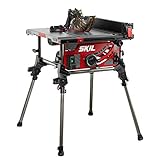
The TS6307-00 is a 15-amp, 10-inch jobsite saw with a folding stand. Per manufacturer and retailer information, it has a rack-and-pinion fence, rip capacity of about 25-1/2 inches to the right of the blade, and a maximum depth of roughly 3-1/2 inches at 90 degrees. It is a sensible option for the contractor or homeowner who wants a 10-inch blade.
The practical advantage is setup speed. With the stand attached, you unfold the legs, lock them, plug in and start working, which suits punch-list days where the saw goes in and out of several rooms. The listed 4,600 RPM no-load speed and 24-tooth blade are aimed at general framing and sheet work rather than fine furniture cuts, so plan on swapping to a higher tooth-count blade if you cut trim or veneered plywood. Its table height when unfolded is listed around 32 inches, which is a comfortable working height for many users.
SKIL’s specifications also mention a maximum dado width of about 5/8 inch with an 8-inch dado set, so basic grooves are possible. The stand folds so the saw can be carried to a job and set up quickly.
- 10-inch blade, 15-amp motor
- Rip capacity about 25-1/2 inches right of the blade
- Depth of cut about 3-1/2 inches at 90 degrees
- Rack-and-pinion fence
- Integrated folding stand
Pros
- Stand is part of the package
- Rip capacity handles a half sheet
Cons
- Less rip capacity than the DEWALT and Delta 10-inch saws
- Dado capacity is limited
Compared with the DEWALT DWE7491RS, the SKIL gives up some rip width but keeps the setup simple.
2. DEWALT DWE7491RS 10-Inch Saw with Rolling Stand – Best Overall
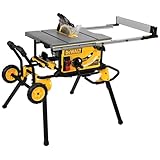
The DWE7491RS pairs a 15-amp motor running at 4,800 RPM with a 10-inch blade and a rip capacity of 32-1/2 inches. The foldable rolling stand lets you lift the saw onto its wheels and move it across a site. That capacity is enough to rip a 4 by 8 sheet down the middle with room left over, and the saw’s wide table gives better support for long boards.
What makes this saw a common choice is the combination of capacity and mobility. A rolling stand turns a heavy saw into something you can steer through a doorway, and the 32-1/2 inch rip lets you break down plywood without a circular-saw guide. Because it is a 10-inch saw, it handles thick lumber better than the 8-1/4 inch DEWALT models. Think about vehicle space: the folded stand and saw together take up more room than a compact saw, so measure your truck bed or van before you commit.
This is the saw to pick if the job involves frequent sheet goods and you want a stand that rolls rather than carries. The listing does not state weight or depth of cut, so confirm them on the product page; one source puts cut depth at roughly 3 inches at 90 degrees.
- 10-inch blade, 15-amp motor, 4,800 RPM
- 32-1/2 inch rip capacity
- Foldable rolling stand
- Rack-and-pinion fence per DEWALT’s design
- Depth of cut: confirm on the listing
Pros
- Wide rip capacity for a portable saw
- Rolling stand eases transport
Cons
- Heavier than the 8-1/4 inch models
- Package is bulky in a small vehicle
Next to the Delta 36-6023, the DEWALT is the more established jobsite choice, and the Delta matches its rip width.
3. SKIL SPT99-11 Worm Drive Table Saw – Best for Deep Cuts

The SPT99-11 uses a worm-drive gear system, a design associated with torque on framing saws. Manufacturer and retailer sources list a 15-amp motor, about 5,000 RPM no-load speed, rip capacity of about 30-1/2 inches to the right of the blade and about 16-1/2 inches to the left, and a depth of cut around 3-5/8 inches. That is enough to cut through a 4×4 in a single pass.
Worm-drive saws are known for strong torque and a quiet, steady feel under load, which can matter when ripping wet pressure-treated lumber or thick hardwood. The depth near 3-5/8 inches is its signature advantage, because it clears a nominal 4×4 in one pass. The tradeoff is weight: at roughly 94 pounds assembled it is a two-person lift into a truck, so it suits crews that leave the saw on a site or have a lift gate. Large wheels help move it over rough ground.
The assembled weight is listed around 94 pounds, which is a lot for one person, but the stand has large wheels and a rack-and-pinion fence. It is the choice when cut capacity matters more than weight.
- 10-inch blade, 15-amp worm-drive motor
- Rip capacity about 30-1/2 inches right of the blade
- Depth of cut about 3-5/8 inches
- Rack-and-pinion fence, stand with wheels
- Assembled weight listed around 94 pounds
Pros
- Deep cut handles thick stock
- Robust worm-drive design
Cons
- Heaviest saw on the list
- Bulkier and more involved to set up than the compact models
Compared with the SKIL TS6307, this saw is the heavier-duty option with more depth and a stronger drive.
4. DEWALT DWE7485 8-1/4 Inch Compact Saw – Best Lightest Carry (Saw Only)

The DWE7485 is a 15-amp, 8-1/4 inch compact jobsite table saw. Retailer sources list about 24-1/2 inches of rip capacity to the right of the blade, a no-load speed around 5,800 RPM, a 5/8-inch arbor, and a depth of cut around 2-9/16 inches at 90 degrees. The listing name does not mention a stand, so treat this as the saw only and confirm what is in the box.
Compact saws exist for people who value portability over capacity. The 8-1/4 inch blade spins faster, at around 5,800 RPM per retailer sources, which keeps the cut lively in plywood and trim, and the smaller body slides under a bench or onto a shelf. Because the title does not mention a stand, it is a sensible match for someone who already owns a saw stand or builds a bench top. Keep in mind that an 8-1/4 inch blade has less cut depth and limits dado options, so check the manual if you plan on grooves.
It is the pick for finish carpenters and remodelers who need a saw that fits into a small space, perhaps one that sits on a bench or on a stand they already own. The 24-1/2 inch rip is just enough to cut a 4-foot-wide sheet in half.
- 8-1/4 inch blade, 15-amp motor
- Rip capacity about 24-1/2 inches right of the blade
- Depth of cut about 2-9/16 inches at 90 degrees
- No-load speed around 5,800 RPM
- Stand: confirm whether included
Pros
- Light and compact
- Enough rip to halve a sheet
Cons
- Shallower depth of cut than 10-inch saws
- Smaller table than the others
Compared with the DWE7485WS, this is the same class of saw without the stand named in the title.
5. Delta 36-6023 10-Inch Saw – Best Wide-Rip Folding Saw
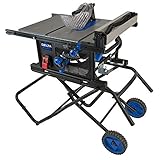
The Delta 36-6023 is a 10-inch portable contractor-style saw with a 15-amp motor and a 32.5 inch rip capacity to the right of the blade. Sources list about 5,000 RPM, a 5/8-inch arbor, around 3-1/2 inches of depth of cut at 90 degrees, and a one-step folding stand. One source lists the dado capacity as about 13/16 inch with an 8-inch stack.
The Delta lands between the compact saws and the heavy worm-drive in weight, and its 32.5 inch rip capacity is the widest on the list tied with the DEWALT. A one-step folding stand is an appealing detail for crews that set up and tear down daily. Specifications for this saw vary across sources, particularly the bevel direction and motor speed, so read the product page carefully and check the owner’s manual for details such as the blade tilt and dado limits before you buy.
Weight is listed around 77 pounds, so it is a middle-weight option. The wide rip capacity is the reason to pick it: it can handle larger panels than the SKIL TS6307.
- 10-inch blade, 15-amp motor
- 32.5 inch rip capacity right of the blade
- Depth of cut about 3-1/2 inches at 90 degrees
- Folding stand with wheels, per retailer sources
- Weight listed around 77 pounds
Pros
- Wide capacity at a moderate weight
- Stand folds quickly
Cons
- Fewer brand-specific accessories than the DEWALT line
- Sources disagree on a few specifications, so confirm them
Next to the DEWALT DWE7491RS, the Delta matches the rip width with fewer matching accessories.
6. DEWALT DWE7485WS 8-1/4 Inch Saw with Stand – Best Compact Saw with Stand

This is the compact DEWALT with a stand included. The listing says the saw offers up to 48 degrees of bevel, which gives a little extra range for angled cuts. Like the DWE7485, it uses an 8-1/4 inch blade and a 15-amp motor, with a rip capacity around 24-1/2 inches to the right of the blade per other sources.
Bundling a stand removes one shopping decision. Owners of the compact DEWALT often want a stand that is light enough to carry by hand, and a package that includes one makes the saw ready the day it arrives. The extended bevel range mentioned in the listing helps with cutting angled trim, such as 45-degree miters in baseboard stock and picture frames. Check how tall the stand sets the table and whether its design lets you fold it with the saw attached.
It suits tradespeople who want to set up fast, cut trim, plywood and shelving, and pack the saw in a truck without a heavy stand. Confirm the stand type and weight before you order.
- 8-1/4 inch blade, 15-amp motor
- Bevel up to 48 degrees per the listing
- Stand included
- Rip capacity around 24-1/2 inches per related sources
- Depth of cut about 2-9/16 inches at 90 degrees (confirm)
Pros
- Stand included in the package
- Compact enough for tight rooms
Cons
- Limited rip compared with 10-inch saws
- Smaller blade limits cut depth
Compared with the DWE7485, this version adds the stand and the extended bevel mention.
Specs Compared
| Model | Blade | Motor | Rip capacity (right) | Depth at 90 degrees | Stand |
|---|---|---|---|---|---|
| SKIL TS6307-00 | 10 in | 15 A | About 25-1/2 in | About 3-1/2 in | Folding stand |
| DEWALT DWE7491RS | 10 in | 15 A, 4,800 RPM | 32-1/2 in | Confirm on listing | Foldable rolling stand |
| SKIL SPT99-11 | 10 in | 15 A worm drive | About 30-1/2 in | About 3-5/8 in | Stand with wheels |
| DEWALT DWE7485 | 8-1/4 in | 15 A | About 24-1/2 in | About 2-9/16 in | Confirm whether included |
| Delta 36-6023 | 10 in | 15 A | 32.5 in | About 3-1/2 in | Folding stand |
| DEWALT DWE7485WS | 8-1/4 in | 15 A | About 24-1/2 in | Confirm on listing | Stand included |
How We Chose These
This ranking is based on research of listings and manufacturer information. We began with the portable table saws in the current catalog and cross-checked each listing name against manufacturer pages and retailer specification fields. The criteria were blade size, rip capacity, depth of cut, stand design, weight, and whether the package includes the stand. Where sources disagreed, for example on weight or motor speed, we described the range and told the reader to confirm. We do not report cut quality, accuracy or durability measurements, since we did not measure them.
What to Look For
Blade Size and Cut Depth
A 10-inch blade cuts about 3 to 3-1/2 inches deep, enough for most framing lumber and thick stock. An 8-1/4 inch blade cuts roughly 2-1/2 inches. A 2×4 is 1-1/2 inches thick, so both can cut it, but a 4×4 measures 3-1/2 inches, which is borderline for many 10-inch saws and out of reach for an 8-1/4 inch saw. Ask what thickness you cut regularly before choosing.
Rip Capacity
Rip capacity is the distance from the blade to the fence at its far position. To rip a 4-foot sheet in half you need at least 24 inches, so an 8-1/4 inch saw with 24-1/2 inches just manages it, with only a half inch to spare. A 10-inch saw with 30 to 32 inches gives room for wider panels or a generous margin. If you rip long stock often, add outfeed support as well.
A worked example: you want to cut a 4 by 8 sheet of 3/4-inch plywood into two 24-inch strips and a few narrower pieces. With a 24-1/2 inch fence limit you can set the fence at 24 inches with half an inch of margin. With 32-1/2 inches you can also rip a 30-inch cabinet panel without turning the sheet around.
Stand and Weight
A rolling stand means less lifting but more bulk, and a folding stand with wheels is easier on a site with stairs. A stand that does not lock firmly in both folded and open positions is a hazard. Weights vary by listing, with compact saws roughly half the weight of heavy worm-drive models, so check the actual number if you must lift it into a truck bed.
Fence, Riving Knife and Dust Port
A rack-and-pinion fence keeps the fence parallel as you move it, which saves time on repeated cuts. A riving knife that stays in line with the blade reduces kickback. A dust port helps with cleanup but does not replace a dust mask. A blade guard that can be removed without tools is useful, as long as you put it back for through cuts.
Table Size, Bevel and Accuracy Features
A larger table gives a stable surface for long boards, and a flat table matters more than extra inches. Compact saws have a smaller work surface, so feed long pieces with outfeed support or a helper. Bevel range also matters: most portable saws tilt to 45 degrees, and a few go slightly past in either direction. Check that the bevel scale is readable and that the lock is firm, then verify the angle with a square before you cut good stock. Expect to tune the fence parallel to the blade when you first set up, since a fence that toes in toward the blade can pinch the board and cause kickback.
Many jobsite saws also have a miter slot that is shallower or narrower than a cabinet saw, so aftermarket miter gauges and sleds may need adapting. If you plan to make a crosscut sled, check the slot width and depth first.
Transport and Storage
Consider the trip as much as the cut. A saw that fits in the back of a sedan is easier to take to a weekend project, and a folding stand that collapses to a few inches thick saves floor space in a garage. Look at where the carry handles are, whether the fence stores on the saw, and whether the power cord has a wrap. If you climb stairs with the saw, weight and balance matter more than any other number on the specification sheet.
Power and Safety on Site
A 15-amp saw draws a lot of current at startup, so use a heavy-duty extension cord: 14-gauge for runs up to roughly 25 feet and 12-gauge up to about 50 feet. Plug into a ground-fault circuit interrupter outlet when working outdoors or in damp spaces. Keep the blade guard and riving knife in place, use push sticks near the blade, and unplug the saw before changing the blade. Never use the miter gauge and rip fence together to trap a workpiece.
Questions
Is an 8-1/4 inch saw good enough for job sites?
For trim, shelving and plywood, yes. It cuts shallower than a 10-inch saw, so it is less suited to thick framing stock, but it is easier to carry and set up.
How much rip capacity do I need?
To split a 4-foot sheet, at least 24 inches. For wider panels or cabinet work, 30 inches or more is more comfortable.
Can I use a dado stack on a portable saw?
Only if the manual allows it. Some saws support an 8-inch stack up to about 5/8 or 13/16 inch wide; others do not. Check the arbor length and the throat plate.
Do portable saws need a separate stand?
Some include one, some do not. The DWE7485 listing does not mention a stand, while the DWE7485WS and the 10-inch models listed here include one. Confirm what comes in the box.
What size extension cord should I use?
A 14-gauge cord is fine for short runs of about 25 feet, and a 12-gauge cord is better up to roughly 50 feet. Longer runs call for heavier wire.
Is a worm-drive saw better than a standard motor?
Worm-drive designs deliver torque and depth, but they add weight. For most job site work, a standard universal motor with a good blade is enough.
Update History
- October 20, 2026 – Initial publication; product set drawn from current catalog listings.
- Check the product page for current specifications and availability before buying.
Sources
- Manufacturer product and specification pages for SKIL, DEWALT and Delta portable table saws
- Retailer listing titles and specification fields for each saw
- Owner’s manual guidance on riving knives, guards and dado limits




Write Your Review
No reviews yet. Be the first to share your experience!