

Key takeaways
- Staggered pocket widths: Narrow sleeves (1.5-2 inches) for bar spoons, muddlers, and thermometers, medium sleeves (2.5-3 inches) for jiggers and Hawthorne strainers, and one or two wide pockets (4-5 inches) for shaker tins. Uniform pockets let tools slide side-to-side.
- Pocket depth variation: Shallow front pockets for peelers and channel knives, deep pockets (8-10 inches) for 12-inch bar spoons and Boston shaker sets. A roll that is only 12 inches tall will leave spoon handles exposed.
- Total count: 8 pockets is the minimum for a core kit (2 tins, jigger, strainer, spoon, muddler, peeler, bottle opener). 10-12 pockets covers a full competition kit with fine mesh strainer, tweezers, and garnish scissors without overcrowding.
- Interior flap or zippered pouch: A full-length flap between tools and the outer shell prevents metal-on-metal scratching and stops small items like pour spouts or caps from falling out when unrolled. A small zippered pocket for caps, tasting spoons, or business cards is useful, but mesh pockets tear faster than canvas.
The best bar tool roll up bag for storage is a 16 to 20-inch wide waxed canvas or heavy ballistic nylon roll with 8 to 12 tailored pockets, a full-length protective flap, and a dual-strap or buckle closure, because it secures odd-shaped tools without shifting, resists spills, and stays compact for travel.
Our top picks


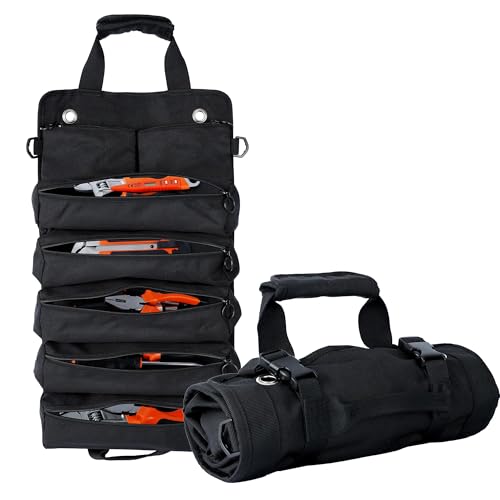
As an Amazon Associate we earn from qualifying purchases at no extra cost to you. Ratings are shown as listed on Amazon.
How to Choose a Bar Tool Roll: The 4 Criteria That Matter
Unlike a toolbox or knife roll, a bar tool roll has to handle long, thin, heavy, and fragile items together. The right bag balances capacity with protection and keeps everything from migrating when rolled.
1. Capacity and Pocket Layout
Pocket count and sizing determine whether tools actually stay put. Look for:
- Staggered pocket widths: Narrow sleeves (1.5-2 inches) for bar spoons, muddlers, and thermometers, medium sleeves (2.5-3 inches) for jiggers and Hawthorne strainers, and one or two wide pockets (4-5 inches) for shaker tins. Uniform pockets let tools slide side-to-side.
- Pocket depth variation: Shallow front pockets for peelers and channel knives, deep pockets (8-10 inches) for 12-inch bar spoons and Boston shaker sets. A roll that is only 12 inches tall will leave spoon handles exposed.
- Total count: 8 pockets is the minimum for a core kit (2 tins, jigger, strainer, spoon, muddler, peeler, bottle opener). 10-12 pockets covers a full competition kit with fine mesh strainer, tweezers, and garnish scissors without overcrowding.
- Interior flap or zippered pouch: A full-length flap between tools and the outer shell prevents metal-on-metal scratching and stops small items like pour spouts or caps from falling out when unrolled. A small zippered pocket for caps, tasting spoons, or business cards is useful, but mesh pockets tear faster than canvas.
2. Material Durability
- Waxed canvas (16-18 oz): The most common professional choice. Water-resistant, develops patina, easy to spot-clean, and stiff enough to protect without being bulky. Requires re-waxing every 12-18 months with heavy use.
- Ballistic nylon (1000D) or Cordura: Lighter than canvas, highly abrasion-resistant, and machine-washable on gentle cycle. Less spill resistance unless coated, but dries faster than canvas.
- Full-grain leather: Most durable and protective, excellent for storage at home, but heavy (adds 1-2 pounds), needs conditioning, and is sensitive to citrus and vermouth stains if not wiped quickly. Top-grain or genuine leather splits and stretches faster.
- Lining: Unlined canvas is fine for dry storage. A wipe-clean nylon or waxed lining inside is better for mobile bartenders who deal with syrup and juice spills.
3. Closure Security
Closure type determines whether the roll stays tight in a duffel or backpack.
- Leather or canvas straps with D-rings/buckles: Most secure, allows tension adjustment as the roll fills. Two straps are better than one for rolls wider than 16 inches.
- Tie closure: Classic look, but cord can loosen and slip if not double-knotted. Prone to fraying at the anchor point.
- Elastic and snap: Fast to close but elastic loses tension after 12-24 months and offers less compression for heavy tins.
Also check stitching at stress points: double-stitched pocket seams and bar-tacked strap anchors last significantly longer than single stitching, especially where heavy shaker tins sit.
4. Rolled Size and Portability
For storage, a rolled diameter of 4 to 6 inches fits in a standard backpack or drawer. Unrolled length of 17 to 20 inches protects full-length spoons, while total weight under 2.5 pounds empty keeps travel weight manageable.
Best Bar Tool Roll Up Bags by Situation
Instead of one overall winner, these picks map to how you actually store and travel with tools.
Best for Most Home and Mobile Bartenders: Waxed Canvas Roll with Flap and Buckle Closure
This is the type sold by brands like Cocktail Kingdom and A Bar Above, typically 18 inches wide by 13 inches tall unrolled, with 10-12 staggered pockets and two buckle straps. The waxed canvas repels spills, the full flap prevents tools from scratching each other, and the buckle closure stays tight whether the roll is full or half-empty. It holds a complete kit including two Boston tins, both Hawthorne and julep strainers, without stretching pockets. Market range is typically $45 to $85. Choose this if you store tools at home but also take them to pop-ups, classes, or friends’ houses a few times per month.
Best for Frequent Travel and Catering: Ballistic Nylon Roll with Wipe-Clean Lining
The lightweight roll offered by Barfly Mixology Gear and similar pro-gear makers uses 1000D ballistic nylon or Cordura, weighs 13 to 18 ounces empty, and includes a coated interior. It is less stylish than canvas but resists abrasion from being tossed in a gear bag and can be wiped clean after a sticky service. Look for YKK-style zippers on the small accessory pocket and reinforced edge binding. Market range is typically $30 to $60. Ideal if you travel weekly, work catering gigs, or need to wash the bag after events.
Best for Compact Storage: 8-Pocket Slim Roll
An 8-pocket roll measuring 14 to 16 inches wide is best when you own a minimal kit and want to store it in a kitchen drawer or small apartment. It fits the essentials without wasted space and rolls down to about 3.5 inches in diameter. The trade-off is you cannot add a second jigger or large muddler later without forcing pockets. Brands such as True and generic barware makers offer this size in canvas or denim, often in the $25 to $45 range. Choose this if you make drinks at home, rarely travel, and prioritize drawer-friendly storage.
Best for Display and Long-Term Storage: Full-Grain Leather Roll
Leather rolls from makers like Hide & Drink and other leather goods workshops offer the best puncture and crush protection for long-term storage. A 16-18 oz full-grain roll with suede or canvas lining will protect tools for years if conditioned every 6 months. It is heavier at 2 to 3.2 pounds empty and typically costs $80 to $160. Best if your kit stays mostly at a home bar and you want maximum protection and presentation, not ultralight travel.
Spec Comparison Table
Measurements are for common market configurations in 2026, empty weight without tools.
| Type | Unrolled Size (W x H) | Rolled Diameter | Empty Weight | Pockets | Material | Closure |
|---|---|---|---|---|---|---|
| Waxed Canvas Standard | 18″ x 13″ | 4.5″ – 5.5″ | 1.4 – 1.9 lbs | 10-12 staggered | 16 oz waxed canvas, nylon lining | 2 buckle straps |
| Ballistic Nylon Travel | 17″ x 12.5″ | 4.0″ – 5.0″ | 0.8 – 1.1 lbs | 10-12 staggered + zip pocket | 1000D nylon, coated lining | 2 straps with D-rings |
| Compact 8-Pocket Canvas | 15″ x 12″ | 3.5″ – 4.2″ | 0.9 – 1.3 lbs | 8 uniform | 14 oz canvas, unlined | 1 tie or single strap |
| Full-Grain Leather | 18″ x 14″ | 5.0″ – 6.0″ | 2.1 – 3.2 lbs | 8-10 staggered | Full-grain leather, suede lining | 2 buckle straps |
Decision Matrix: Which Roll Fits Your Situation
| Your Situation | Priority | Recommended Type | Why |
|---|---|---|---|
| Home bartender, stored in drawer or shelf | Low bulk, easy access | Compact 8-Pocket or Waxed Canvas Standard | Fits in kitchen storage, enough pockets for core kit |
| Mobile bartender, 2+ gigs per month | Spill resistance + light weight | Ballistic Nylon Travel | Wipe-clean, light in transit, secure closure |
| Competition or pop-up with full kit | Capacity + protection | Waxed Canvas Standard, 12 pockets with flap | Holds tins, two strainers, tweezers without shifting |
| Collector / long-term display storage | Maximum protection | Full-Grain Leather | Best crush resistance, ages well with conditioning |
| Tight budget, first roll | Value and durability | Ballistic Nylon or 14 oz Canvas | Lower price, still holds up with double-stitched seams |
Durability and Ownership Realities
Product pages rarely show what fails first. For bar rolls, it is usually not the fabric itself.
- First wear points: Strap anchor stitching, elastic keepers, and the bottom corners of pockets where tins rest. Check for bar-tacking and double stitching there before buying.
- Waxed canvas care: Wipe syrup and citrus quickly with a damp cloth. Re-wax once a year if water stops beading. Never machine wash waxed canvas; it strips the coating.
- Nylon care: Can be hand-washed with mild soap and air-dried. Avoid high heat, which warps coating.
- Leather care: Condition with leather balm every 6 months, wipe spills immediately, and store unrolled or loosely rolled in a dry place to prevent mildew.
- Common packing mistakes: Overloading a pocket stretches it permanently; leave 0.5 inch of clearance at the top. Storing wet tools causes rust on strainer springs and jiggers and stains the bag. Always dry tools fully before rolling.
- Closure test at home: Load the roll, close it, and shake gently. If you hear clinking or feel tools shifting, pockets are too wide for your tins. A proper fit is snug without forcing the strap.
Worked Calculation: Will Your Kit Fit?
Measure before buying. Add up the width of your tools at their widest point, plus 1 inch between each for seam allowance.
Example core kit: 2 Boston tins (3.5″ each) + Hawthorne strainer (3″) + jigger (2.5″) + bar spoon (1.5″) + muddler (2″) + julep strainer (3″) + fine mesh strainer (3″ handle folded) = 21.5 inches of tool width. A 15-inch wide 8-pocket roll forces you to double-up pockets or leave tools behind. An 18-inch wide 12-pocket roll gives you 1.5 inches per pocket on average, which fits this kit with room to spare. If your total is over 20 inches, choose 18-inch width and 10+ pockets.
Cost per use logic: A $65 waxed canvas roll used 3 times per month for travel and kept for 4 years costs about $0.45 per use, compared with replacing a $25 unlined canvas roll every 12-18 months because tie closures fray and pockets stretch. Durability lowers long-term cost more than upfront price.
How to Pack and Store for Best Protection
- Place heaviest items (tins, muddler) closest to the strap anchor side so weight does not pull the roll open.
- Alternate handle direction: one tool handle up, next handle down, to keep rolled thickness even.
- Fold the flap over tools before rolling, then roll tightly from the side opposite the straps to push air out.
- Store horizontally if tools are inside long-term; vertical storage lets heavy tins slide and stretch the bottom of pockets.
- For flights or checked bags, wrap shaker tins in a bar towel inside the roll for extra shock absorption and keep the roll in the middle of your luggage, not against the hard shell.
Frequently Asked Questions
Can I use a knife roll for bar tools?
You can in a pinch, but knife rolls have tall narrow pockets sized for blades. Shaker tins and strainers will not fit securely and will stretch the seams. A bar-specific roll with varied pocket widths protects better.
Do I need a padded roll?
Light padding helps if you fly or toss the roll in a car trunk with other gear. For home drawer storage, padding adds bulk without benefit. A canvas flap provides enough scratch protection for most home use.
How do I clean syrup spills inside?
For waxed canvas and nylon with lining, wipe with warm water and mild dish soap on a cloth, then air dry fully unrolled. For unlined canvas, spot clean only. For leather, wipe with a damp cloth and condition after drying. Do not soak any roll or put it in a dryer.



Write Your Review
No reviews yet. Be the first to share your experience!