

Key takeaways
- Compare the best woodworking adzes for hewing beams, hollowing bowls, and shaping timber. Straight, curved, and gutter profiles explained here.
An adze is an axe turned sideways. The blade sits at a right angle to the handle, so each swing pulls a shaving toward you instead of driving a wedge into end grain. That single difference makes the adze the traditional tool for flattening a log into a beam, hollowing a bowl, shaping a chair seat, and smoothing a timber joint.
This guide covers hand adzes, the short-handled tools most woodworkers use at the bench or on a log held low. None of the five picks below is a full-size foot adze for standing hewing work.
As an Amazon Associate, I earn from qualifying purchases.
How to Choose a Woodworking Adze
Start with blade shape, because it decides what the tool can do. A straight blade leaves a flat surface and suits hewing beams, flattening log faces, and trimming joints. A curved blade, often called a gutter adze, scoops material out of a hollow and suits bowls, troughs, spoons, and chair seats.
Next, check the bevel. An outside bevel puts the flat side against the wood and works well for smoothing a surface you can see. An inside bevel puts the cutting edge on the hollow side and suits deep hollowing, where the blade must bite into a curve without the corners digging in.
Handle length controls leverage and control. Short handles, around 11 to 16 inches, give fine control for carving and let you choke up close to the head for detail work. Longer handles add power for rough shaping but demand more space and a steadier stance. Wood handles, usually ash or beech, absorb shock and can be reshaped or replaced. Fiberglass handles resist weather but transmit more vibration.
Steel matters because an adze edge takes hard knocks. Forged high-carbon steel holds an edge longer than soft stamped steel and can be resharpened many times. Expect to sharpen a new adze before serious work.
Safety deserves a plain warning. An adze swings toward your body, legs, and feet. Work with the timber held low and stable, keep your feet out of the swing path, and stop when you are tired. Wear eye protection and sturdy footwear, keep the edge covered when the tool is not in use, and never swing an adze with a loose head.
Comparison Table
| Adze | Blade | Handle | Best For |
|---|---|---|---|
| BeaverCraft AX2 | Curved | Ashwood | Bowls, spoons, and gutters |
| Narex 890950 | Curved, 2 inch, outside bevel | Ash | Bowl hollowing |
| Mapsyst Set of 2 | Curved, large and small | Wood | Learning two hollow profiles |
| Mapsyst Straight Adze 1.7LB | Straight, 3 inch | Wood | Flat hewing and trimming |
| ZUZUAN Forged Adze Pick | Hoe and pick, 1.57 inch | Fiberglass | Rough outdoor shaping |
BeaverCraft AX2 Curved Adze

The BeaverCraft AX2 is a compact curved adze built for hollowing. Its curved blade suits bowls, spoons, ladles, and gutters, where a straight edge would skid across the hollow or dig in at the corners. The short handle keeps the work close, so you can feel each cut and stop before taking too much.
The head is forged from 1066 high-carbon steel, a tough grade that holds an edge through long carving sessions. The ash handle is treated with linseed oil and wax, and a genuine leather sheath with a belt loop covers the edge in storage. Expect to hone the edge to your own angle before the first bowl. This is a carving tool, not a hewing tool, and it is too light for rough timber framing.
- Specs:
- Blade steel: 1066 high-carbon steel, forged
- Blade shape: curved, for bowls, spoons, and gutters
- Handle: ashwood, treated with linseed oil and wax
- Sheath: genuine leather, with belt loop
-
Best for: bowl and spoon carving
Narex 890950 Curved Bowl Adze

The Narex 890950 is a hand-forged Czech adze with a 2-inch curved blade and an outside bevel. At 11.5 inches overall, it is a true hand adze, made to be used with one hand while the other steadies the workpiece. The outside bevel leaves the flat side of the blade against the wood, which helps when smoothing the inside of a bowl.
The short length makes it easy to control, but it also limits power, so this is a shaping and finishing tool rather than a roughing tool. Work in thin shavings and keep the bevel flat against the hollow to avoid gouging.
- Specs:
- Blade: 2 inch, curved, outside bevel
- Overall length: 11.5 inches
- Handle: grained ash
- Sheath: leather, included
- Origin: made in the Czech Republic
-
Best for: hollowing and smoothing bowls
Mapsyst Set of 2 Curved Bowl Adzes

This Mapsyst set pairs a large curved adze with a small curved adze, both with outside bevels. Use the large blade to remove waste fast, then switch to the small blade for tighter curves and cleaner finishing cuts. For a carver still learning which sweep suits their work, buying two profiles at once is cheaper than buying two single tools separately.
Both heads are high-carbon steel with wood handles. The set weighs 3.08 pounds in total, which tells you these are solid hand tools rather than light detail carvers. Keep both edges sharp, because a dull adze needs force, and force is what causes slips.
- Specs:
- Set contents: large curved adze and small curved adze
- Blade edge: curved, outside bevel on both
- Blade material: high-carbon steel
- Handle material: wood
- Set weight: 3.08 pounds
-
Best for: learning two hollow profiles
Mapsyst Straight Adze, 1.7LB
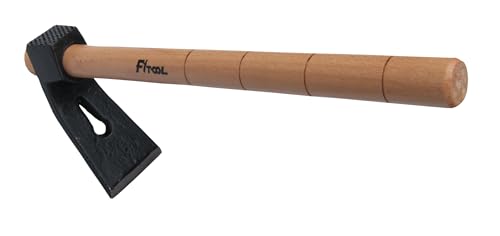
This is the straight-blade pick of the group, and the one to choose for flat work. The 3-inch straight edge is made for hewing and trimming: flattening a log face, levelling a beam, cleaning up a joint, and removing bark and high spots. Where the curved adzes above scoop, this one planes. If your projects involve timber rather than bowls, start here.
The head and handle weigh 1.7 pounds in total, and the handle measures about 15.7 inches, long enough for a controlled two-handed swing but short enough for bench work. The poll doubles as a claw hammer, with a nail hole for pulling fasteners, which is handy on reclaimed timber.
- Specs:
- Blade: 3 inch, straight edge
- Total weight: 1.7 pounds
- Handle: wood, about 15.7 inches
- Poll: doubles as a claw hammer, with nail hole
- Head: forged steel
-
Best for: flat hewing, trimming, and levelling timber
ZUZUAN Forged Adze Pick

The ZUZUAN is the odd one out, and it is worth including for that reason. It is a double-headed pick mattock with a hoe blade on one side and a pointed pick on the other, built on a 15.1-inch fiberglass handle. It is not a fine carving tool. It is a rough-shaping tool for outdoor work: grubbing, clearing roots, breaking ground, and rough-shaping green timber where a fine edge would chip.
The head is drop-forged from ASTM 1065 carbon steel, and the hoe edge is 1.57 inches wide. The fiberglass handle is coated for grip and resists weather. The head ships unmounted and needs to be tapped firmly onto the handle before use. Do not buy this one for bowls or fine joinery.
- Specs:
- Overall length: 15.1 inches
- Total weight: 1.4 pounds
- Hoe width: 1.57 inches
- Handle: fiberglass with rubber grip
- Steel: ASTM 1065 carbon steel, drop forged
-
Best for: rough outdoor shaping and grubbing
Which Woodworking Adze Should You Pick
Match the blade to the job, then let the rest follow. For bowls, spoons, and chair seats, pick a curved blade: the BeaverCraft AX2 for a compact single tool, or the Narex 890950 for a short, controlled hand adze. For learning two hollow profiles at once, the Mapsyst set of two gives you a large and a small curved blade in one purchase.
For flat work, the Mapsyst straight adze is the only straight blade in this group, and it is the right tool for hewing a beam face, levelling timber, and trimming joints. Add the ZUZUAN only for rough outdoor shaping. If you can buy only one adze and your work mixes flat and hollow shaping, start with the straight adze and add a curved adze later.
FAQ
What is a woodworking adze used for?
An adze shapes wood with a blade set at a right angle to the handle. Woodworkers use it to hew logs into beams, hollow bowls and troughs, shape chair seats, trim joints, and smooth curved surfaces that a plane cannot reach.
Should I choose a straight or a curved adze?
Choose a straight adze for flat surfaces, hewing, and trimming. Choose a curved adze for hollowing bowls, troughs, and chair seats. If you do both, you will eventually want one of each.
How do I sharpen an adze?
Remove the head if it has a slip-fit handle, then work the bevel on a file or a coarse stone, keeping the original angle. Follow with a finer stone and a strop until the edge cuts cleanly. Hone often, and oil the blade lightly before storage.
Is an adze safe for a beginner?
Yes, if you respect it. Keep the timber low and stable, keep your feet out of the swing path, take light cuts, wear eye protection and sturdy footwear, and keep the edge covered when the tool is not in use.
Conclusion
A good adze earns its place by doing work that no other hand tool does as fast: flattening a log, hollowing a bowl, and shaping a curve. Start with the blade shape your projects need, pick a handle length you can control, and plan to sharpen the edge to your own angle. Choose the shape first, learn the swing, and let the tool teach you the rest.
More from Amazon
Programs that pair well with the guide above. Offers and eligibility are set by Amazon and may change.
A free business account with business pricing and bulk-buying tools for work, shop or home office.
Create a business accountFree shipping on eligible items, Prime Video and more. Eligible new members can start with a free trial.
Start a Prime free trialAudiobooks and podcasts to listen to on the go. Eligible new members can start with a free trial.
Try Audible freeAd-free music streaming. Eligible new subscribers can start with a free trial.
Try Music Unlimited freeAs an Amazon Associate we earn from qualifying purchases.
Write Your Review
No reviews yet. Be the first to share your experience!