

Key takeaways
- 15–30 seconds: suitable for grabbing one item from a small closet.
- 45–90 seconds: better for dressing, sorting laundry, or using several shelves.
- 2 minutes or more: useful in a walk-in closet, but it consumes more battery.
Best Motion Sensor Closet Lights
The best motion sensor closet lights are rechargeable LED bars with a 120-degree sensor, a 6- to 10-foot detection range, adjustable brightness, and magnetic or screw mounting; choose a wired light instead when the closet is used frequently or needs dependable all-night illumination.
Quick Picks by Closet Situation
| Situation | Best light type | Useful target specifications | Why it fits |
|---|---|---|---|
| Small reach-in closet | Rechargeable LED bar | 8–12 inches long, 100–250 lumens, 3–6 ft sensor range | Enough light for shelves and hanging clothes without frequent recharging |
| Deep or wide walk-in closet | Two LED bars or a wired ceiling fixture | 400–800 total lumens, 6–10 ft range, 120-degree detection | Reduces dark corners and avoids relying on one sensor from the doorway |
| Rental or damage-sensitive installation | Magnetic rechargeable bar | Removable magnetic strip, 12–24 inch body, USB-C charging | Can be removed for charging without drilling into the wall |
| Frequently used closet | Hardwired or plug-in LED fixture | 600–1,200 lumens, 90–120 second timeout, 3,000–4,000K color temperature | Lower maintenance and consistent brightness |
| Low-budget occasional use | Battery-powered puck light | 40–100 lumens, 2–5 ft range, replaceable AAA or AA cells | Inexpensive and simple, though coverage and battery life are limited |
What Matters Most When Choosing
Sensor range and detection angle
A closet light can have a bright LED and still perform poorly if its sensor cannot see you. For a shallow closet, a 3- to 6-foot range is usually sufficient. In a walk-in closet, look for approximately 6 to 10 feet and a detection angle close to 120 degrees.
Our top picks


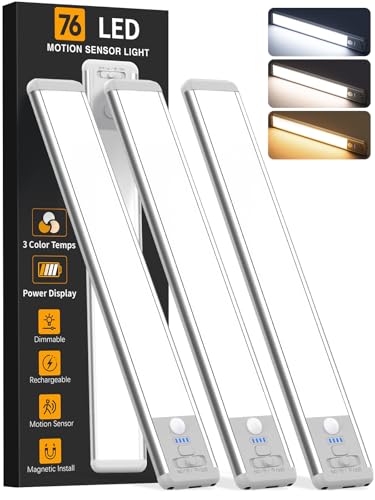
As an Amazon Associate we earn from qualifying purchases at no extra cost to you. Ratings are shown as listed on Amazon.
Sensor placement matters as much as the advertised range. A bar mounted under a shelf may detect movement directly below it but fail to activate when you enter from the side. Mount the sensor toward the doorway or aisle rather than facing a solid wall of clothing. Passive infrared sensors respond best to movement across their field of view, not a person standing still directly in front of them.
Activation timing and timeout
Good closet lights normally activate within about 0.5 to 1.5 seconds. A noticeable delay is irritating when you are carrying clothes or opening a drawer. The more important setting is the timeout: common options range from 15 seconds to 2 minutes.
- 15–30 seconds: suitable for grabbing one item from a small closet.
- 45–90 seconds: better for dressing, sorting laundry, or using several shelves.
- 2 minutes or more: useful in a walk-in closet, but it consumes more battery.
Choose a model with an “auto” mode rather than one that only switches on with a physical button. A manual override is useful, but it should not be the only way to keep the light on while you are moving slowly.
Brightness and light distribution
For a small closet, 100 to 250 lumens is generally adequate. A long or deep closet is better served by 300 to 600 lumens, while a walk-in closet with dark shelves may need 600 lumens or more. More lumens are not automatically better: a narrow, very bright beam can create glare and leave the corners dark.
Look for a diffused cover or a frosted lens. These spread light across clothing and shelves more evenly than exposed point LEDs. A color temperature between 3,000K and 4,000K gives a useful balance: warmer light is comfortable in a bedroom, while neutral white makes clothing colors easier to distinguish. Very cool light above 5,000K can appear harsh in a small enclosed space.
Battery, rechargeable, or wired power
Rechargeable lights are convenient and usually use lithium-ion batteries in the range of 500 to 2,000 mAh. In motion-sensor mode, a practical interval between charges may be several weeks in an occasional-use closet, but only several days in a busy household. Manufacturers often quote continuous runtime rather than real motion-activated use, so treat claims such as “up to 30 hours” as a comparison point, not a schedule.
Replaceable AA or AAA batteries are easy to swap and can be preferable where charging cables are inconvenient. Their drawback is recurring cost and reduced brightness as the cells discharge. A plug-in or hardwired fixture avoids this problem and is the better choice for a closet used many times per day.
Mounting methods
- Magnetic mounting: fastest to remove for charging; best when the mounting plate stays attached and the light detaches cleanly.
- Adhesive strips: suitable for smooth, clean painted surfaces; less reliable on dusty, textured, or freshly painted walls.
- Screws: most dependable for heavier bars and walk-in closets, particularly under wooden shelves.
- Plug-in or hardwired mounting: best for permanent installations, but cable routing and electrical work require more planning.
Do not place adhesive directly on dusty shelf undersides. Clean the surface, allow it to dry, press firmly for the recommended time, and avoid loading the mount immediately. Heat from a light and repeated charging can eventually weaken inexpensive adhesive.
Rechargeable Bar Versus Puck Light
A rechargeable bar is usually the strongest all-around choice because its LEDs spread light across a larger area. A 12- to 24-inch bar can illuminate a hanging rail and the shelf below it, while a puck light mainly creates a pool of light around its mounting point. Pucks are useful for individual cabinets or narrow linen closets, but several may be needed for even coverage.
For a 6-foot-wide reach-in closet, two 12-inch bars mounted under the front shelf often work better than one high-output puck. Place them roughly one-third and two-thirds across the width, with the sensors angled toward the entrance. This arrangement reduces shadows from clothing and makes activation more reliable.
A Simple Coverage and Runtime Calculation
Suppose a rechargeable light provides 200 lumens and is active for 60 seconds each time the door opens. If the closet is opened 12 times per day, its daily illuminated time is:
12 activations × 1 minute = 12 minutes per day.
Even a quoted continuous runtime of 8 hours would represent 480 minutes, or approximately 40 days at that usage level. Real results will be lower because standby electronics consume power, batteries age, and some sensors keep the LEDs on longer than their nominal timeout. A reasonable planning estimate is two to four weeks between charges for moderate use, rather than assuming the best-case figure.
This calculation also explains why a 1,000-lumen light is often unnecessary for a small closet: higher output usually means higher power consumption, while good placement and diffusion improve visibility more efficiently.
Installation Tips for Different Closet Sizes
Small reach-in closet
Install a 200- to 400-lumen bar under the front shelf, near the center or slightly toward the door. Keep the sensor unobstructed by a shelf lip. If the closet is deeper than about 24 inches, mount the bar toward the front half so its light reaches into the clothing rather than being blocked by garments at the entrance.
Wide reach-in closet
Use two shorter bars or one long bar with a wide diffuser. Separate multiple lights by 24 to 36 inches and avoid pointing both sensors directly at each other, which can create inconsistent activation. A 30- to 60-second timeout is normally enough.
Walk-in closet
A single doorway-mounted light often leaves the back wall dark. Use a ceiling fixture, two wall-mounted bars, or one bar on each side of the main aisle. Target at least 400 total lumens for a compact walk-in and 600 lumens or more for a larger room with dark shelving. A longer timeout of 90 to 120 seconds prevents the light from switching off while you are examining clothes.
Ownership Issues That Affect Long-Term Value
The first parts to cause trouble are usually the adhesive mount, charging cable, battery capacity, and sensor lens—not the LEDs themselves. Dust and lint can reduce sensor responsiveness, so wipe the lens and diffuser with a dry microfiber cloth every few months. Avoid spraying cleaner directly onto the housing.
Rechargeable batteries gradually lose capacity. If the light once lasted three weeks but now needs charging every few days, replacement may be more practical than repeatedly repositioning it. Some sealed units cannot accept a new battery, so a removable battery module or a replaceable-cell design has a longer ownership advantage.
Common mistakes include mounting the sensor behind clothing, installing the light where a swinging door blocks its view, using adhesive on a greasy surface, and choosing a short timeout for a closet used as a dressing area. Correcting placement often improves performance more than buying a brighter light.
Bottom Line
For most homes, choose a rechargeable LED bar delivering 100 to 250 lumens for a small closet or 300 to 600 lumens for a wide closet, with a 120-degree sensor, at least a 6-foot detection range, and a 30- to 90-second adjustable timeout. Pick magnetic mounting for flexibility, screws for a permanent shelf installation, and wired power for a heavily used walk-in. The best motion sensor closet lights are not necessarily the brightest; they are the ones whose sensor sees the doorway, whose beam covers the shelves, and whose power system matches how often the closet is opened.



Write Your Review
No reviews yet. Be the first to share your experience!