

Key takeaways
- Wheels wear first. Look for uneven coning, flat spots, or a visibly reduced diameter. Rotate wheels periodically if wear is uneven.
- Bearings dislike water and grit. Wipe the board dry after damp rides, avoid puddles, and clean bearings only with an appropriate solvent before applying a small amount of skate bearing lubricant.
- Check hardware regularly. Inspect truck mounting bolts, kingpins, axle nuts, and deck cracks every few rides. Replace damaged hardware rather than repeatedly tightening it.
- Do not overtighten trucks. The correct feel is smooth lean and a reliable return to center. If the truck binds, change bushing setup or inspect the pivot cup.
- Protect the deck. Store it indoors, away from prolonged heat and moisture. Water can damage wood laminates and corrode metal parts.
- Set wheel clearance before riding. Lean the board hard while stationary and verify that the wheel cannot contact the deck. Add risers or reduce wheel size if necessary.
The best longboard depends on where you ride: choose a 38–42-inch drop-through for stable cruising, a 34–40-inch top-mount or drop-platform for carving, and a 36–42-inch stiff downhill board only when speed control is your priority.
Our top picks
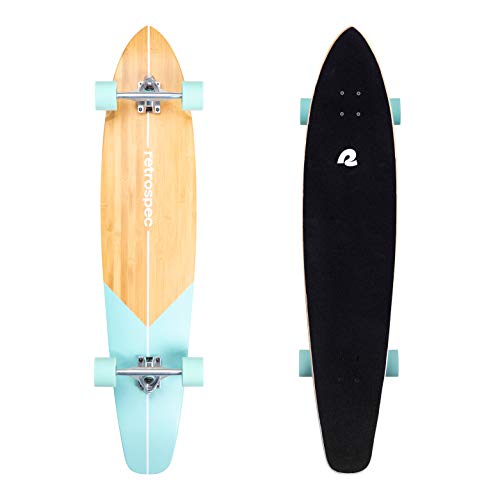


As an Amazon Associate we earn from qualifying purchases at no extra cost to you. Ratings are shown as listed on Amazon.
Best longboards by riding goal
| Riding goal | Best board style | Typical deck and flex | Wheel and truck setup | Why it works |
|---|---|---|---|---|
| First board and relaxed cruising | Drop-through cruiser | 38–42 in; medium flex | 70–75 mm wheels; 50° reverse-kingpin trucks | Low standing height, predictable steering, and good stability |
| Carving on smooth roads | Top-mount or drop-platform carver | 34–40 in; medium to lively flex | 65–72 mm wheels; responsive reverse-kingpin trucks | Quick edge changes and a strong pumping feel |
| Long-distance pushing | Low drop-through or drop-deck | 40–48 in; medium flex | 70–80 mm wheels; 50° trucks | Efficient foot placement and less leg fatigue |
| Fast downhill riding | Stiff drop-platform or downhill top-mount | 36–42 in; very stiff | 65–75 mm wheels; 40–45° precision-style geometry | Controlled weight transfer and reduced speed wobble |
| Compact city transport | Short freeride or mini-cruiser | 28–35 in; stiff to medium | 60–70 mm wheels; risers and wheel-well clearance | Easier carrying and tighter turning in crowded spaces |
Deck length and flex: stability versus responsiveness
Deck length affects more than portability. A longer wheelbase generally feels calmer because your feet are farther apart and the board reacts less abruptly to small movements. Boards around 38–42 inches are the safest general-purpose range for new riders. A 44–48-inch distance board gives excellent directional stability, but it is less convenient to carry and can feel slow in tight corners. Boards below 35 inches turn quickly and fit urban routes, although they demand more precise foot placement.
Flex changes how the deck loads and unloads under your weight. A flexible deck absorbs rough pavement and can make carving feel springy, but excessive flex becomes tiring at speed and may cause the deck to bottom out. Medium flex is the most versatile choice for cruising. Stiff decks transfer steering input immediately and are preferable for downhill or heavier riders.
Manufacturers often label flex by rider weight, but those labels are not standardized. As a practical starting point, riders under 140 pounds often suit medium or medium-soft decks, riders from 140 to 200 pounds usually fit medium flex, and riders above 200 pounds should look for medium-stiff or stiff construction. Treat those ranges as a starting point, then check the deck’s published weight guidance.
Wheel size and contact patch
Wheel diameter determines how easily the board rolls over cracks, pebbles, and rough asphalt. Wheels from 60–65 mm accelerate quickly and suit short commutes. Wheels from 70–75 mm are the best compromise for general cruising because they maintain speed and smooth out ordinary road defects. Wheels from 75–80 mm roll efficiently over poor surfaces, but they add weight, raise the standing height, and need adequate wheel clearance.
Wheel width and contact patch affect grip. A narrow or rounded wheel usually releases more easily for sliding and feels playful. A wider wheel with a square or radiused edge provides more grip for carving and controlled downhill riding. Softer urethane, commonly around 78A–80A, is comfortable on rough pavement; harder wheels, around 83A–86A, slide more readily but transmit more vibration.
Do not choose large wheels without checking wheel-bite clearance. When a wheel touches the deck during a turn, it can stop suddenly. A board may need riser pads, wheel wells, or smaller wheels. For many setups, a 1/8-inch riser and correctly tightened trucks are enough, but the deck manufacturer’s clearance guidance is more reliable than a universal rule.
Truck geometry: the overlooked buying decision
Reverse-kingpin trucks are the usual choice for cruising, carving, and freeride longboards. Their taller, more open geometry gives a broad turning range and makes pumping easier. A 50° baseplate is a stable all-round setting. Lower angles around 40–45° reduce steering sensitivity and are better suited to speed-focused setups.
Traditional kingpin trucks sit lower and are common on compact cruisers and street-oriented boards. They turn sharply and are easy to find in smaller widths, but they are not automatically better for a full-size longboard. Match truck width to the deck: a truck axle roughly 0.25–0.5 inches narrower than the deck at the mounting area can help avoid excessive leverage and unwanted wheel bite.
Truck bushings are a tuning component, not merely a replacement part. Softer bushings make turning easier for lighter riders; harder bushings resist lean and are more suitable for heavier riders or higher speeds. Tightening the kingpin is not a substitute for suitable bushings: over-tightening can make the truck feel sticky and prevent a smooth return to center.
Stability, turning, and board style compared
Drop-through cruisers
The trucks mount through the deck, lowering the rider’s center of gravity. That makes pushing easier and gives beginners confidence, particularly on bike paths and gentle slopes. The trade-off is reduced leverage for aggressive carving and less deck stiffness in some budget constructions. A 40-inch drop-through with 70–75 mm soft wheels is a dependable first longboard.
Drop decks and drop platforms
A drop deck places the feet lower between the trucks, while a drop platform lowers the standing platform without necessarily enclosing the feet. Both improve stability and braking control. They are strong choices for commuting and moderate freeride, but the lower clearance can make curb hops and rough obstacles more difficult.
Top-mount carvers
Top-mount boards place the deck above the trucks, increasing leverage and making turns feel energetic. They are excellent for carving and pumping, especially on smooth, winding roads. They feel less forgiving when standing still and can be more demanding for a beginner. Choose a medium-length board with moderate concave rather than an extreme downhill shape if carving is the goal.
Downhill boards
Downhill boards prioritize predictable tracking over easy pushing. They are usually stiff, have strong concave to lock the feet in place, and use lower-angle trucks or precision-style components. A downhill board is a poor first choice for casual sidewalk cruising: it may be heavy, uncomfortable to push, and unnecessarily specialized. Downhill riding also requires a suitable helmet, slide gloves, protective pads, and controlled terrain.
A decision matrix for choosing your board
| Your situation | Recommended target | Avoid |
|---|---|---|
| Budget under $150 and occasional rides | 38–42-inch drop-through, 70 mm wheels, standard 50° reverse-kingpin trucks | Very cheap bearings, unbranded trucks, and oversized wheels without clearance |
| New rider who values confidence | 40–42 inches, medium flex, generous wheelbase, 70–75 mm soft wheels | Short top-mount boards and very loose trucks |
| Experienced rider who wants deep carving | 34–40-inch top-mount or drop-platform, medium flex, 65–72 mm grippy wheels | Excessively stiff distance decks |
| Daily commute with rough pavement | 40–46-inch low platform, 75–80 mm soft wheels, durable trucks | Hard wheels below 65 mm and a deck too long to store safely |
| Speed and downhill progression | 36–42-inch stiff deck, 40–45° trucks, secure concave, quality wheels | Flexible decks, loose trucks, and unprotected practice runs |
How much does a longboard really cost to use?
Consider a $180 complete used for commuting twice a week for a year. Two rides per week over 52 weeks equals 104 rides, so the board costs about $1.73 per ride before maintenance. Add approximately $25–$50 for replacement bearings or bushings and $40–$80 for wheels when the original set wears out. At 150 rides, a realistic ownership cost may be $1.63–$1.90 per ride, excluding safety equipment.
This calculation explains why the cheapest complete is not always the best value. A board with replaceable, standard-size trucks and bearings can remain serviceable for years, while a poorly assembled board may require immediate replacement parts.
Durability and maintenance realities
- Wheels wear first. Look for uneven coning, flat spots, or a visibly reduced diameter. Rotate wheels periodically if wear is uneven.
- Bearings dislike water and grit. Wipe the board dry after damp rides, avoid puddles, and clean bearings only with an appropriate solvent before applying a small amount of skate bearing lubricant.
- Check hardware regularly. Inspect truck mounting bolts, kingpins, axle nuts, and deck cracks every few rides. Replace damaged hardware rather than repeatedly tightening it.
- Do not overtighten trucks. The correct feel is smooth lean and a reliable return to center. If the truck binds, change bushing setup or inspect the pivot cup.
- Protect the deck. Store it indoors, away from prolonged heat and moisture. Water can damage wood laminates and corrode metal parts.
- Set wheel clearance before riding. Lean the board hard while stationary and verify that the wheel cannot contact the deck. Add risers or reduce wheel size if necessary.
Final recommendation
For most buyers, the best longboard is a 38–42-inch drop-through or drop-platform with medium flex, 70–75 mm wheels around 78A–80A, and 50° reverse-kingpin trucks. Choose a shorter top-mount board if carving matters more than stability, a longer low platform for frequent commuting, and a stiff 36–42-inch downhill deck only for dedicated speed riding. Match the deck, wheels, trucks, and bushings as one system; a balanced setup matters more than any single headline specification.





Write Your Review
No reviews yet. Be the first to share your experience!