

Key takeaways
- 1/4-inch tubing: Best for short branches, container clusters, and individual emitters. Keep branches relatively short—often 10 to 20 feet is a practical target—because small tubing loses pressure quickly.
- 1/2-inch poly tubing: The useful all-round choice for raised beds. It can serve multiple 1/4-inch branches or inline emitter tubing and is easier to expand.
- 5/8-inch or 3/4-inch supply tubing: Better for a long journey from the spigot to a distant garden or for feeding several zones. It is more expensive and less convenient inside narrow beds.
Best Drip Irrigation Kits for Gardens & Raised Beds
The best drip irrigation kits for most raised beds are 1/2-inch mainline systems with 1/4-inch branch tubing, while small containers are better served by compact 1/4-inch kits and large plots need a filter, pressure regulator, larger zones, and a timer with multiple start times.
Quick Picks by Garden Situation
| Garden situation | Best kit type | Typical coverage | Timer to choose | Why it fits |
|---|---|---|---|---|
| Two to four small raised beds | 1/2-inch poly mainline with 1/4-inch takeoffs | Up to about 500 square feet | Single-outlet battery timer | Simple layout, good pressure stability, easy expansion |
| Patio containers or one 4-by-8-foot bed | 1/4-inch tubing kit with adjustable emitters | About 50 to 150 square feet | One-outlet hose-end timer | Low cost and minimal installation |
| Several beds with different crops | 1/2-inch mainline divided into zones | About 500 to 1,500 square feet | Two- or four-outlet programmable timer | Lets thirsty crops run separately from herbs and seedlings |
| Large vegetable plot | 5/8-inch or 3/4-inch supply line feeding multiple 1/2-inch zones | 1,500 square feet or more | Multi-zone timer or irrigation controller | Reduces pressure loss and makes seasonal scheduling practical |
What to Compare Before Buying
Coverage area and usable tubing length
Kit coverage is usually stated as total tubing length, not the area that will be watered. A kit containing 100 feet of tubing does not necessarily cover a 100-square-foot bed. Tubing must follow rows, and some length is consumed by the run from the faucet, turns, connectors, and spacing between plants.
Our top picks


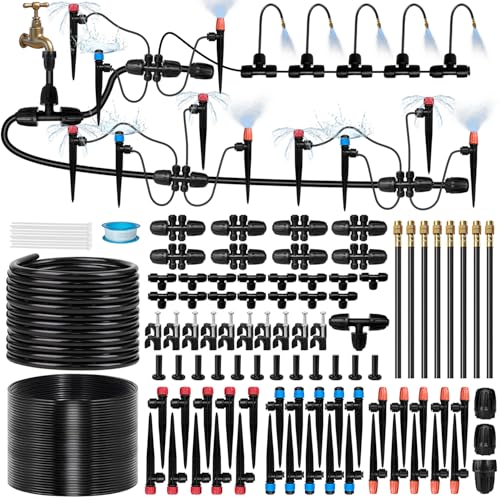

As an Amazon Associate we earn from qualifying purchases at no extra cost to you. Ratings are shown as listed on Amazon.
For a 4-by-8-foot raised bed with four planting rows, each 8 feet long, the row requirement is 32 feet. Add a 20-foot supply run and roughly 15 percent for routing and mistakes, and the practical requirement is about 60 feet. A 50-foot kit will be tight; a 100-foot kit gives useful room for a flush end and future changes.
For large plots, do not simply join several small kits end to end. The farthest emitters may receive less water as friction reduces pressure. A 1/2-inch mainline is normally more suitable than long runs of 1/4-inch tubing, and separate zones are preferable once the layout becomes difficult to water evenly.
Tubing diameter
- 1/4-inch tubing: Best for short branches, container clusters, and individual emitters. Keep branches relatively short—often 10 to 20 feet is a practical target—because small tubing loses pressure quickly.
- 1/2-inch poly tubing: The useful all-round choice for raised beds. It can serve multiple 1/4-inch branches or inline emitter tubing and is easier to expand.
- 5/8-inch or 3/4-inch supply tubing: Better for a long journey from the spigot to a distant garden or for feeding several zones. It is more expensive and less convenient inside narrow beds.
Make sure fittings match the tubing’s actual outside diameter. “1/4-inch” irrigation tubing is not always interchangeable between brands, and a loose connection can leak continuously. Barbed connectors should fit firmly without splitting the tube.
Emitters and flow rate
Pressure-compensating emitters are valuable when beds are long or slightly sloped because they deliver a more consistent flow across changing pressure conditions. Adjustable emitters are convenient for containers, but they can clog more easily and may be adjusted inconsistently from pot to pot.
Common drip emitter flow rates are 0.5, 1, and 2 gallons per hour. A 1-gallon-per-hour emitter running for 30 minutes applies approximately half a gallon, before accounting for pressure variation. Plants in sandy soil may need shorter, more frequent watering; clay soil generally benefits from slower application and time for infiltration.
Best Drip Irrigation Kits by Use Case
Best for most raised beds: a modular 1/2-inch system
Choose a kit built around 1/2-inch mainline tubing, a 120-mesh filter, a pressure regulator set near 25 psi, shutoff valves, and 1/4-inch branch connectors. This configuration is more dependable than a kit made entirely from thin 1/4-inch tubing.
It suits four or five beds, can be repaired with common barbed fittings, and makes it easy to add a second bed later. Gardena Micro-Drip-System components, Rain Bird residential drip components, and Orbit drip-irrigation fittings are examples of established product families that offer modular parts in this general category. Check each manufacturer’s tubing and connector compatibility before mixing brands.
Best for containers and a single small bed: a compact 1/4-inch kit
A 1/4-inch kit is the easiest choice for a balcony, greenhouse bench, or one small raised bed. Look for at least 20 to 50 feet of tubing, 10 or more stakes, adjustable emitters or button emitters, and a faucet timer.
This style keeps installation inexpensive, but it is less forgiving. Keep the supply run short, use a filter, and avoid attaching more emitters than the timer and faucet can supply. For a dozen containers, one emitter per pot may be sufficient; large tomato or pepper containers may need two.
Best for multiple beds: a multi-outlet programmable timer
When crops have different watering needs, a two- or four-outlet timer is more useful than a timer with elaborate smartphone features. One outlet can water seedling trays daily, another can water mature vegetables every other day, and a third can serve containers with their own schedule.
Choose a model with a replaceable battery, a rain-delay function, seasonal adjustment, and a manual run button. Wi-Fi or Bluetooth control can be convenient, but it does not compensate for undersized tubing, clogged filters, or a leaking connection.
Best for a large plot: zoned irrigation rather than one oversized kit
Large gardens are best treated as several smaller irrigation systems. Use a durable supply line from the faucet, place a filter and pressure regulator before the first manifold, then run separate 1/2-inch zones. A zone valve or multi-outlet timer can prevent the flow demand from becoming too high.
Dripline with built-in emitters is often easier than installing individual emitters along long vegetable rows. Use the emitter spacing recommended for the crop and soil; 12-inch spacing is a common general-purpose option, while closer spacing can suit densely planted greens.
Timer Choices: Mechanical, Digital, or Smart
| Timer type | Typical schedule control | Battery expectation | Best match | Main limitation |
|---|---|---|---|---|
| Mechanical dial | One run per day or simple interval | Usually one season to several seasons, depending on design | Small, uncomplicated gardens | Limited scheduling and less precise run times |
| Digital single-outlet | Multiple start times and selectable weekdays | Commonly one watering season per alkaline battery set | Most raised beds | One schedule for the entire connected system |
| Multi-outlet digital | Independent programs per outlet | Often one season, depending on valve use | Different crops or several garden areas | More fittings and programming complexity |
| Smart or weather-connected | App scheduling, remote control, weather adjustments | Varies; some use batteries and others need an outlet | Large or frequently changing gardens | Higher cost and dependence on connectivity |
Installation That Prevents the Most Problems
- Measure the route first. Sketch the faucet, beds, rows, and shutoff points. Add 15 to 20 percent to the tubing estimate.
- Install the filter before the regulator and tubing. The filter catches grit that would otherwise block emitters; the regulator protects small fittings from excessive pressure.
- Flush the mainline. Leave end caps or flush valves open while water runs briefly. This removes plastic shavings and dirt from installation.
- Add emitters after flushing. Installing them earlier can push debris directly into the narrow outlet.
- Run a timed test. Place identical measuring cups under several emitters, including the first and last. A large difference signals a clogged filter, excessive tubing length, poor pressure, or too many emitters on one zone.
- Cover or secure the tubing. Stakes prevent movement, while mulch reduces evaporation and protects tubing from sunlight. Do not bury ordinary above-ground tubing unless the manufacturer permits it.
Durability and Ownership Realities
Emitters and filters are usually the first parts to need attention. Fine sediment, algae, fertilizer residue, and insects can restrict flow. Clean or replace the filter periodically, flush lines at the start of the season, and keep spare couplers, end caps, stakes, and a few emitters on hand.
Ultraviolet light eventually makes exposed tubing brittle, especially inexpensive 1/4-inch tubing. Store removable components out of direct sun during winter. In freezing climates, disconnect the timer, open low points, and drain the lines; trapped water can split filters, regulators, and valves.
The most common mistake is watering by timer duration alone. Instead, check how much water reaches the soil. If a 1-gallon-per-hour emitter runs for 20 minutes, it applies about one-third of a gallon. Multiply that figure by the number of emitters, then inspect the soil several inches below the surface. Adjust the schedule for weather, mulch, soil type, and plant growth rather than assuming the same runtime works all season.
Bottom Line
For one small bed or a few containers, choose a filtered 1/4-inch kit with a simple digital timer. For most raised-bed gardens, spend more on a 1/2-inch mainline, pressure regulator, flushable ends, and a programmable timer. For large plots, prioritize tubing diameter and separate zones over a longer “all-in-one” kit. The right system is the one that matches both the garden’s coverage area and the number of independent watering schedules you actually need.

Write Your Review
No reviews yet. Be the first to share your experience!