

Key takeaways
- Compare the best blast gates for dust collection, from budget ABS gates to aluminum models, with port sizes, materials and fit notes for every shop layout.
- Top Pick: POWERTEC 70108 4-Inch Blast Gate
- Runner-up: POWERTEC 70373 4-Inch Clear Integrated Blast Gate
- Also consider: POWERTEC 70135V 4-Inch Aluminum Blast Gate
A blast gate is the sliding shut-off valve that sits on each branch of a dust collection system. Open the gate at the machine you are running, close the gates at every idle machine, and the collector’s suction stays focused where the dust is actually being made instead of leaking away through open branches. It is a small fitting, but on a multi-machine shop it is the difference between a collector that keeps up and one that leaves piles behind the table saw.
Gates look simple, yet the details decide how well they work: the port has to match your hose size, the blade has to slide without jamming on packed dust, and the body has to seal well enough that a closed branch does not whistle and steal airflow. This guide compares five blast gates sold on Amazon, covering the common 4-inch size, a smaller 2-1/2-inch gate for shop-vacuum lines, budget ABS bodies, a clear clog-resistant design, and an aluminum gate with a stainless blade for permanent duct runs.
As an Amazon Associate, we earn from qualifying purchases.
Quick answer
For most shops, the POWERTEC 70108 is the straightforward pick: a budget 4-inch ABS gate that fits standard hose on a typical table saw, jointer or planer branch. To see clogs before they jam the blade, choose the clear POWERTEC 70373. For permanent duct runs, the aluminum POWERTEC 70135V is the premium option, the POWERTEC 70133 handles 2-1/2-inch shop-vacuum branches, and the Rockler Dust Right adds a mounting bracket.
POWERTEC 70108 4-Inch Blast Gate
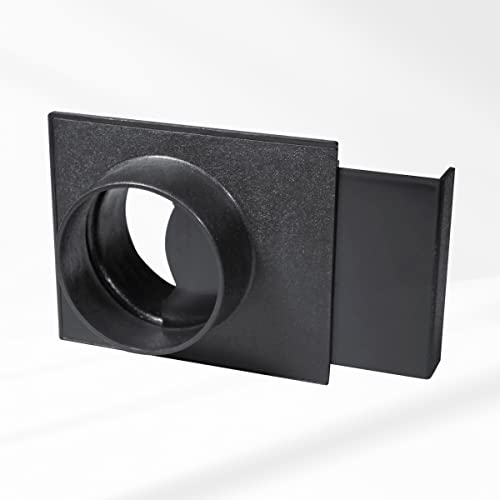
The 70108 is POWERTEC’s standard manual blast gate and the default starting point for a first branch system. Both ends are 4-inch outside-diameter outlets sized for 4-inch inside-diameter dust hose, which is the fitting size used on most hobby and mid-size collectors. The body is molded ABS plastic with what the maker describes as a thick, abrasion-resistant profile, built to tolerate the sawdust and wood chips that constantly scour the inside of a dust line.
Operation is a simple sliding blade you pull or push by hand, and the slip-style connection pushes into hose ends and clamps down. One fit note from the listing matters: because both outlets are 4-inch OD, the gate will not connect directly to another 4-inch OD port, such as the dust port on some machines. For those joints the maker points to a flex cuff, like the POWERTEC 70149, as the bridge. At 5.6 ounces it adds almost no weight to a hose run, so it hangs on a machine port without sagging the hose.
Specs
- Port size: 4-inch nominal OD on both ends, for 4-inch ID hose
- Material: ABS plastic body and blade
- Dimensions: 6.6 x 6.5 x 3.5 inches
- Weight: 5.6 ounces
- Connector type: slip fit
- Pack: single gate, model 70108
- Tier: budget
POWERTEC 70373 4-Inch Clear Integrated Blast Gate

The 70373 takes a different approach to the most common blast gate complaint: a blade that gradually jams as dust packs into the slide track. Its body is molded from clear ABS plastic, so you can see dust building up inside the gate before it stops the blade moving. POWERTEC describes the design as clog resistant with anti-gap tapered ports, meaning the port ends taper to close the small gaps that otherwise leak air around hose connections.
This is still a 4-inch gate for standard hose, and the clear body keeps the same abrasion-resistant ABS construction as the maker’s opaque gates. The trade-off: if your gates live in a dark corner under a bench, the visibility advantage shrinks. Where gates sit at eye level on a wall manifold, a glance shows whether the track needs a clean-out. It is sold as a single gate, and multi-packs of the same model are listed separately.
Specs
- Port size: 4-inch nominal, tapered anti-gap ports
- Material: clear ABS plastic
- Dimensions: 4.4 x 6 x 3.3 inches
- Design: integrated clog-resistant body, see-through housing
- Pack: single gate, model 70373
- Tier: mid-range
POWERTEC 70135V 4-Inch Aluminum Blast Gate

The 70135V is the metal option in this roundup, aimed at permanent ductwork rather than hose that gets moved around. The body is aluminum and the sliding blade is stainless steel, a pairing that shrugs off the dents and abrasion that slowly wear plastic gates on high-volume branches. It is the current version of POWERTEC’s long-running 70135 aluminum gate.
Fit is quoted more precisely than on the plastic gates: the nominal 4-inch OD actually tapers from 3-29/32 to 3-31/32 inches, which helps the port slip into 4-inch ID hose and seat tightly. At 9.5 inches long it is a bigger fitting than the ABS gates, so it suits fixed runs along a wall or ceiling better than a short hose drop. If your system mixes metal duct and hose, this is the gate that matches the duct’s service life, and the stainless blade avoids the rust that plain steel blades can develop in damp shops.
Specs
- Port size: 4-inch nominal OD, tapering 3-29/32 to 3-31/32 inches
- Material: aluminum body, stainless steel blade
- Dimensions: 9.5 x 5.5 x 2.16 inches
- Pack: single gate, model 70135V
- Tier: premium
Rockler Dust Right 4-Inch Ready-Mount Blast Gate

Rockler’s Dust Right gate is built around installation convenience. The reinforced high-impact polymer body carries a built-in mounting bracket, so the gate screws straight to a wall, bench leg or manifold board instead of floating in the middle of a hose run. A fixed gate is easier to open with one hand and does not twist the hose when you slide the blade.
Rockler describes the design as self-cleaning: the sliding gate is shaped to push dust out of its track as it moves, which addresses the same jamming problem as the clear POWERTEC gate, just mechanically rather than visually. Both ports are nominal 4-inch OD for 4-inch ID hose, and the grip on the blade is larger than on basic gates. If you are building a tidy manifold wall with one gate per machine, the bracket makes this the neatest option here; if your gates hang in-line on loose hose, the bracket adds little.
Specs
- Port size: 4-inch nominal OD on both ends, for 4-inch ID hose
- Material: reinforced high-impact polymer
- Design: self-cleaning sliding gate, built-in mounting bracket
- Pack: single gate, Dust Right model 65837
- Tier: mid-range
POWERTEC 70133 2-1/2-Inch Blast Gate

Not every branch is 4-inch. Shops that collect with a shop vacuum, or that run small 2-1/2-inch lines to a benchtop sander, router table or miter saw hood, need the smaller gate, and the 70133 is POWERTEC’s ABS model in that size. Both ends are 2-1/2-inch OD outlets for 2-1/2-inch ID hose, and the body is the same abrasion-resistant ABS as the 4-inch 70108.
The listing carries two practical notes. First, like its bigger sibling, it will not connect directly to another 2-1/2-inch OD port; a flex cuff bridges that joint. Second, the maker specifically advises regular cleaning of the groove the gate slides in, because fine dust packing into the track is what makes small gates stick. The wall thickness is listed at 0.125 inches and the gate weighs 5.6 ounces. For a vacuum-based system with two or three small machines, a row of these costs little and keeps the vacuum’s suction on the tool in use.
Specs
- Port size: 2-1/2-inch nominal OD on both ends, for 2-1/2-inch ID hose
- Material: ABS plastic body and blade
- Wall thickness: 0.125 inches
- Weight: 5.6 ounces
- Pack: single gate, model 70133
- Tier: budget
How to choose
Start with port size, because a gate that does not match your hose is useless no matter how well it is made. Measure the inside diameter of your hose: 4-inch hose takes a 4-inch nominal OD gate, and 2-1/2-inch vacuum hose takes the smaller gate. Remember that OD-to-OD joints do not mate directly, so budget for a flex cuff wherever a gate meets a machine port of the same outside diameter.
Next, pick a material for the branch’s workload. ABS gates like the 70108 and 70133 are light, cheap and perfectly durable on hose runs that move. Aluminum with a stainless blade, as on the 70135V, suits fixed ducting and high-volume branches where the gate cycles many times a day. Then think about clog management: a clear body (70373) lets you see buildup, a self-cleaning track (Rockler) pushes debris out as it slides, and plain gates need a scheduled clean of the slide groove, which the makers themselves flag as routine maintenance.
Finally, consider mounting. Gates in the middle of a hose run can float, but a manifold of several branches works better with each gate fixed in place, which is where a bracketed gate or wall-mount variants earn their keep. Count your branches before ordering: every machine that shares the collector needs its own gate, and multi-packs of the same model are listed for the most common gates.
Who should skip
Skip blast gates entirely if you run a single machine on a short hose straight into the collector; there is no branch to shut off, and a gate only adds a small restriction. Also skip manual gates if your system uses automatic tool-triggered switching with powered gates, which need their own matched components. If your ducting is spiral metal pipe in sizes above 4 inches, the gates here are the wrong range; look at the larger aluminum sizes in the same product families instead. And if your only dust problem is fine airborne dust rather than chip collection at the machine, a gate will not help; that is an air filtration problem, not a ducting one.
FAQ
How many blast gates do I need? One per branch. Every machine that tees off the main line gets a gate at its branch, so the collector pulls only through the open one. A table saw, jointer and planer sharing one collector means three gates.
Why does my blast gate stick or jam? Dust packs into the groove the blade slides in, especially fine sanding dust. The makers of these gates list groove cleaning as routine maintenance. Clear-bodied and self-cleaning designs reduce how often it happens, but no manual gate is maintenance-free.
Can I connect a blast gate straight to my machine’s dust port? Only if the port is sized to slip over or into the gate’s outlet. Most gates have OD outlets meant for ID hose; an OD machine port needs a flex cuff between the two. Check both diameters before ordering.
Do closed blast gates leak air? Some air can pass around a closed blade, and the tapered anti-gap ports on gates like the 70373 are designed to reduce leakage at the hose joints. In practice, one open branch with the rest closed still delivers far more suction to the running machine than leaving every branch open.
Final verdict
For a typical home shop, fit a POWERTEC 70108 on each 4-inch branch and be done; it is the budget gate that matches standard hose and standard collectors. Choose the clear POWERTEC 70373 where gates sit somewhere visible and clogging has been a problem, and step up to the aluminum 70135V for permanent duct runs that will cycle for years. The Rockler Dust Right is the tidy pick for a fixed manifold wall, and the little 70133 brings the same branch control to 2-1/2-inch shop-vacuum lines. Match the port size first, then let material and mounting decide.
More from Amazon
Programs that pair well with the guide above. Offers and eligibility are set by Amazon and may change.
A free business account with business pricing and bulk-buying tools for work, shop or home office.
Create a business accountFree shipping on eligible items, Prime Video and more. Eligible new members can start with a free trial.
Start a Prime free trialAudiobooks and podcasts to listen to on the go. Eligible new members can start with a free trial.
Try Audible freeAd-free music streaming. Eligible new subscribers can start with a free trial.
Try Music Unlimited freeAs an Amazon Associate we earn from qualifying purchases.



Write Your Review
No reviews yet. Be the first to share your experience!