

Key takeaways
- Best all-around: Therm-ic Heat Flat insoles with a compatible C-Pack battery. Their low-profile shape suits work boots that do not have much spare room.
- Best for long outdoor shifts: Hotronic XLP battery-and-insole systems, particularly when replaceable or higher-capacity battery options are more useful than minimum bulk.
- Best for occasional use: A rechargeable heated insole kit with an external battery and three heat settings. It usually costs less than a premium app-controlled system.
- Best for tight boots: A toe-heating insole or thin heated footbed rather than a thick full-length model. Toe-only heat sacrifices coverage but can prevent pressure points.
- Best for wet, dirty work: A removable battery system with washable or hand-cleanable insoles and sealed wiring. Do not assume “water resistant” means machine washable.
The best heated insoles for most cold-weather work are rechargeable, trim-to-fit models with separate battery packs: choose Therm-ic for a relatively slim everyday setup, Hotronic for long, controllable heating, and a budget wired kit if purchase price matters more than convenience.
Our top picks



As an Amazon Associate we earn from qualifying purchases at no extra cost to you. Ratings are shown as listed on Amazon.
Quick picks by use case
- Best all-around: Therm-ic Heat Flat insoles with a compatible C-Pack battery. Their low-profile shape suits work boots that do not have much spare room.
- Best for long outdoor shifts: Hotronic XLP battery-and-insole systems, particularly when replaceable or higher-capacity battery options are more useful than minimum bulk.
- Best for occasional use: A rechargeable heated insole kit with an external battery and three heat settings. It usually costs less than a premium app-controlled system.
- Best for tight boots: A toe-heating insole or thin heated footbed rather than a thick full-length model. Toe-only heat sacrifices coverage but can prevent pressure points.
- Best for wet, dirty work: A removable battery system with washable or hand-cleanable insoles and sealed wiring. Do not assume “water resistant” means machine washable.
Heated insole comparison
The figures below represent common specifications for current products in these categories. Exact runtime depends on battery capacity, selected temperature, ambient conditions, footwear, and whether the battery is carried inside or outside the boot.
| Type or example system | Typical runtime | Typical weight | Fit and sizing | Charging | Cleaning reality |
|---|---|---|---|---|---|
| Therm-ic heated insole with C-Pack battery | 5–19 hours, depending on pack and setting | About 90–140 g per pair of insoles; battery weight is additional | Trim lines commonly cover EU 36–48; check the exact model | Rechargeable lithium-ion pack; USB or proprietary charger varies by pack | Usually remove the battery and hand-clean or wipe; air-dry fully |
| Hotronic XLP heated insole system | Roughly 3–18 hours across battery sizes and heat levels | About 100–150 g per pair of insoles; battery weight is additional | Trim-to-fit versions commonly span approximately EU 36–49 | Rechargeable battery packs; charger depends on the XLP package | Do not immerse the electronic assembly; clean the footbed as directed |
| Basic wired rechargeable insole kit | 3–8 hours | About 150–300 g including battery pack and cables | Often sold in broad ranges such as US men’s 6–13 | USB charging, commonly 5 V; some use a dual-output cable | Often wipe-clean only; exposed connectors need careful protection |
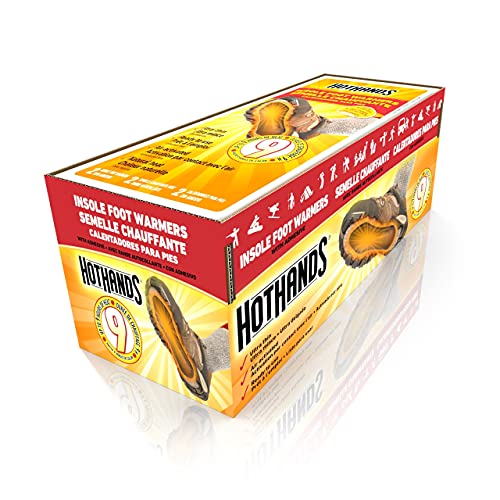
| Disposable chemical foot warmers | 5–10 hours | About 30–50 g per pair | Usually a universal adhesive or loose insert | No charging | Single-use; no washing required |
Runtime: size the battery for your shift, not the advertising maximum
Manufacturers normally quote the longest runtime on the lowest setting. A pack advertised for 18 hours may provide much less heat at its highest setting, particularly in freezing weather. For all-day work, aim for a rated low-to-medium runtime at least 25 percent longer than your planned shift.
For example, suppose an insole battery is rated for 10 hours on the setting you expect to use, and your shift lasts 8 hours. The nominal reserve is:
10 hours − 8 hours = 2 hours, or a 25 percent reserve. That is a sensible minimum because cold reduces effective battery performance and breaks, walking speed, and boot insulation change heat demand. A six-hour battery is a poor match for an eight-hour shift even if you can recharge it during lunch.
Two separate battery packs are usually preferable to one shared pack. They reduce cable routing, let each foot receive power independently, and make replacement easier. The trade-off is extra weight around the ankles or boot cuffs.
Fit matters more than maximum temperature
Heated insoles need contact with the bottom of the foot, but a boot that becomes too tight can reduce comfort and restrict normal movement. Before ordering, remove the existing insole and measure its length. Compare that measurement with the heated insole’s trim template rather than relying only on your shoe size.
- Leave toe clearance: never cut beyond the manufacturer’s final trim line. The heating element and wiring may extend farther than the visible marking suggests.
- Check volume, not just length: a battery-powered footbed can add roughly 4–8 mm under the foot. If your boot already feels snug, use a thinner insole or size up only when the boot manufacturer permits it.
- Account for work socks: thick wool socks can consume the clearance needed for both warmth and circulation.
- Route cables safely: place external batteries where they cannot catch on machinery, ladders, or vehicle controls. Follow the system’s instructions for ankle straps or boot-top pockets.
- Keep the original insoles: they are useful when the heated pair is drying or being recharged.
Which heating layout should you choose?
Full-length heating
Full-length models spread warmth beneath the toes, forefoot, and sometimes the arch. They are the strongest choice for stationary work, winter commuting, and long periods in cold boots. They also take more room and can feel less natural if the heating element creates a ridge beneath the arch.
Toe heating
Toe-heated designs concentrate power where many people notice cold first. They are useful in close-fitting ski, hunting, and work boots, but they do not warm the heel or arch. A toe model is not automatically less expensive once batteries and chargers are included.
App-controlled systems
Bluetooth control is convenient when the battery is inside a boot cuff or under several clothing layers. It is not essential for warmth. Physical buttons are often faster with gloves, while an app can make gradual temperature changes easier. Treat connectivity as a convenience feature rather than a runtime feature.
Washability and maintenance: the detail that determines ownership cost
Most heated insoles are not ordinary washable footwear. Remove batteries before cleaning, disconnect detachable cables, and follow the product’s care label. If the insole is described as washable, that commonly means gentle hand washing or a brief rinse—not a hot washing-machine cycle or tumble drying.
- Disconnect and remove every battery and charger lead.
- Brush off grit while the insole is dry; abrasive dirt can wear the top fabric and expose wiring.
- Wipe or hand-wash with mild soap according to the instructions.
- Press out water with a towel. Do not twist the insole, use a radiator, or apply a hair dryer.
- Air-dry completely before reconnecting power.
- Store lithium-ion batteries partly charged, in a cool dry place, rather than leaving them in a hot vehicle.
The top fabric and heel foam generally wear before the heating element. Repeated sharp folding, walking on a removed insole, trapped gravel, and drying beside intense heat are common causes of early failure. If a cable becomes hot, damaged, or intermittently powered, stop using the system and replace the affected component.
Decision matrix for buying
| Your situation | Best choice | Why | What to compromise |
|---|---|---|---|
| Eight- to twelve-hour outdoor shifts | High-capacity Hotronic or Therm-ic system | More useful runtime reserve and replaceable battery options | Higher cost and more battery bulk |
| Occasional winter jobs, tight budget | Basic USB rechargeable kit or chemical warmers | Lower upfront cost and simple setup | Shorter runtime, more cable clutter, or single-use waste |
| Close-fitting boots | Thin toe-heating model | Less added foot volume | Less even heat across the foot |
| Frequent wet or muddy work | Removable-battery system with wipe-clean upper | Electronics can be removed before cleaning and drying | Do not expect full machine washability |
| Several pairs of boots | One system with detachable batteries | Move the insoles or batteries between compatible footwear | Repeated trimming and transfer can shorten insole life |
Charging options and replacement costs
USB charging is convenient in a truck, workshop, or power bank, but check whether the supplied cable charges both batteries simultaneously. Proprietary chargers can be faster or better matched to the pack, yet they are inconvenient to replace. A spare battery often provides more practical value than a second pair of insoles, provided the manufacturer sells compatible replacements.
Premium rechargeable systems commonly fall in the general market range of about $150–$350 for insoles, batteries, and charging equipment. Basic rechargeable sets are often around $40–$120, while disposable warmers cost less initially but must be replaced for every outing. A $60 disposable-warmers supply used 30 times costs about $2 per use; a $220 rechargeable system used 100 times costs about $2.20 per use before replacement batteries, then becomes cheaper with continued use.
Bottom line
Choose the best heated insoles by matching real runtime and available boot volume before comparing heat settings. Therm-ic is a strong fit for slim everyday work boots, Hotronic is well suited to extended outdoor use and configurable battery setups, and a basic USB kit is adequate for occasional cold-weather jobs. Whichever system you select, verify the trim size, measure your existing insole, keep a full charging cycle in reserve, and treat washability as “careful hand cleaning” unless the manufacturer explicitly states otherwise.


Write Your Review
No reviews yet. Be the first to share your experience!