

Key takeaways
- Crossfaders and channel faders: These receive repeated movement and can eventually develop noise or inconsistent output. Avoid spilling drinks and do not spray cleaner directly into the controls.
- Jog-wheel surfaces: Finger oils and dust reduce grip. Wipe them with a soft, lightly dampened cloth and keep abrasive cleaners away from displays and touch-sensitive surfaces.
- USB sockets: Cable strain is a common failure source. Use a short, flexible cable, secure it so it cannot hang from the port, and disconnect by the plug rather than pulling the wire.
- Power and audio connections: Label cables and carry spares for gigs. Intermittent audio is often caused by a damaged cable or incorrect output selection rather than a failed controller.
- Library preparation: Analyze tracks and create backups before an event. A controller cannot rescue a disorganized library, missing files, incompatible formats, or a laptop that begins updating during setup.
The best DJ controllers for most beginners are the Pioneer DJ DDJ-FLX4 or Hercules DJControl Inpulse 500, while aspiring club DJs should consider the AlphaTheta DDJ-FLX10, RANE FOUR, or a standalone four-deck system such as the Denon DJ PRIME 4+.
The right choice depends less on the number of buttons than on three practical questions: how large you want the jog wheels to feel, which software you intend to use, and whether the controller will stay on a bedroom desk or travel to gigs.
Our top picks


As an Amazon Associate we earn from qualifying purchases at no extra cost to you. Ratings are shown as listed on Amazon.
Best DJ controllers at a glance
| Controller | Best for | Jog-wheel size | Approx. weight | Software focus | Typical market range |
|---|---|---|---|---|---|
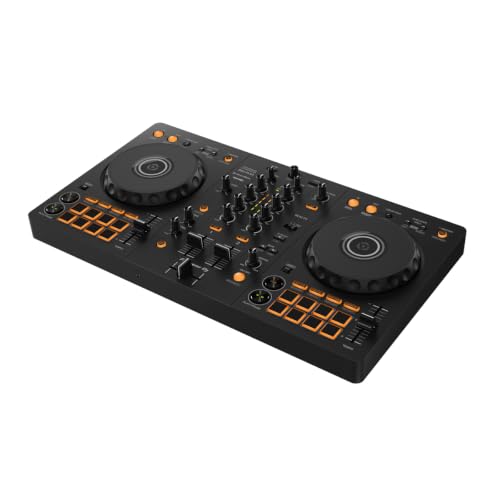
| Pioneer DJ DDJ-FLX4 | First controller and small spaces | 5.9 inches | 2.1 kg | rekordbox, Serato DJ Lite | $300–$350 |
| Hercules DJControl Inpulse 500 | Learning fundamentals | 5.5 inches | 3.2 kg | DJUCED, Serato DJ Lite | $250–$350 |
| Numark Mixtrack Platinum FX | Budget performance features | 6 inches | 2.4 kg | Serato DJ Lite | $250–$350 |
| AlphaTheta DDJ-FLX10 | Club-style four-deck mixing | 7.2 inches | 6.7 kg | rekordbox, Serato DJ Pro | $1,300–$1,600 |
| RANE FOUR | Serato performance and stems | 8.5 inches | 7.2 kg | Serato DJ Pro | $1,400–$1,700 |
| Denon DJ PRIME 4+ | Mobile DJs wanting standalone operation | 6 inches | 9.7 kg | Engine DJ; computer use also supported | $2,000–$2,500 |
Dimensions and prices can vary slightly by region, bundle, and revision. Jog-wheel diameter is only part of the feel: platter tension, display feedback, pitch-fader length, and the amount of surrounding space also affect how precisely a controller handles.
Best beginner controller for a bedroom: Pioneer DJ DDJ-FLX4
The DDJ-FLX4 is the safest all-round recommendation for a new DJ who wants a compact controller with a path toward more advanced equipment. Its two-channel layout is simple enough to learn, but it includes performance pads, beat effects, microphone input, and outputs suitable for home speakers or headphones.
Its 5.9-inch jog wheels are small compared with club media players, but they are large enough for cueing, nudging, and basic scratching. The controller is approximately 19 inches wide, so it can fit on many desks without requiring a dedicated table.
The key buying decision is software. The FLX4 works with rekordbox and Serato DJ Lite, and the exact unlocked features depend on the software and computer platform. Choose rekordbox if you want to become familiar with a Pioneer-style library and club workflow. Choose Serato if you prefer its interface, beat-making integrations, or scratch-oriented ecosystem. A beginner should not buy a controller without first checking whether the preferred software runs on their laptop.
Best for learning with guidance: Hercules DJControl Inpulse 500
The Inpulse 500 is a strong choice for beginners who want physical teaching aids rather than the smallest possible footprint. Its beat-alignment guides and learning-oriented DJUCED software can help explain timing, phrasing, and transitions while you develop your ears.
The 5.5-inch jog wheels are responsive for normal mixing, and the controller has a sturdy metal top panel, useful when it will be moved regularly. It is wider and heavier than the DDJ-FLX4, so it suits a dedicated desk or practice table better than a crowded bedroom workstation.
It is particularly appealing when you want to learn manual beat matching. Software sync is convenient, but practicing tempo adjustment and listening for phase drift builds skills that transfer to more advanced club equipment.
Best low-cost option for effects: Numark Mixtrack Platinum FX
The Mixtrack Platinum FX gives a budget user relatively large 6-inch jog wheels, long pitch controls, and dedicated effect controls. Small displays in the jog wheels provide useful track and position information without forcing you to look constantly at the laptop.
It is primarily a Serato DJ Lite controller, so it makes the most sense for someone already committed to the Serato workflow. The controller is light enough for occasional transport, but its plastic construction calls for sensible handling: use a padded bag, avoid carrying it by the jog wheels, and do not leave it connected where cables can snag the controls.
When a larger jog wheel is worth paying for
Jog-wheel size matters most when you manually cue, scratch, make long nudges, or perform without relying heavily on sync. A larger platter gives your fingers more physical travel, which can make subtle speed corrections less abrupt. It does not automatically make a controller more professional, and a large wheel cannot compensate for poor headphone monitoring or badly prepared tracks.
| Use case | Practical jog-wheel target | Why |
|---|---|---|
| Bedroom mixing with sync | 5.5–6 inches | Compact, affordable, adequate for cueing and nudging |
| Manual beat matching | 6–7.2 inches | More room for controlled pitch corrections |
| Frequent scratching | 7.2–8.5 inches | More hand space and a feel closer to larger performance decks |
| Club-style preparation | 7 inches or larger | Closer physical spacing and handling to professional systems |
Best upgrade for club-style mixing: AlphaTheta DDJ-FLX10
The DDJ-FLX10 is aimed at DJs who have outgrown a two-channel beginner layout but still want a computer-based controller. It provides four channels, larger 7.2-inch jog wheels, extensive performance controls, and support for rekordbox and Serato DJ Pro.
Four channels are valuable for layering acapellas, loops, drum tracks, and transition tools, but they also increase preparation time. You will need to understand routing, channel assignment, effects selection, and gain staging rather than simply adding more tracks. It is a better purchase for a DJ who already mixes regularly than for someone still learning phrasing and basic EQ.
For a bedroom, check the width and depth before buying. A controller of this class can occupy most of a standard desk, and its weight makes it inconvenient to move every evening. A dedicated stand or sturdy table is preferable to a lightweight folding desk that flexes during use.
Best for Serato performance: RANE FOUR
The RANE FOUR is a compelling choice for DJs who prioritize Serato DJ Pro, stems, scratching, and hands-on performance. Its 8.5-inch motorized-style-feeling performance platters provide more room than most midrange controllers, while its four-channel layout supports complex open-format sets.
It is a substantial piece of equipment rather than a casual laptop accessory. The larger platters and performance controls are useful for scratch routines and vocal or instrumental separation, but they add cost, size, and setup complexity. Confirm that your laptop meets the current Serato DJ Pro and stems requirements before buying; real-time separation can be demanding on older computers.
Best for mobile and computer-free use: Denon DJ PRIME 4+
The PRIME 4+ is better described as a standalone DJ system than a conventional controller. It can run sets from Engine DJ media without requiring a laptop, while also offering four channels, a built-in display, independent zone output, and substantial connectivity for mobile work.
This makes it attractive for weddings, parties, and frequent mobile use where a laptop on the table is inconvenient. The tradeoff is weight: at roughly 9.7 kg, it needs a proper flight case or padded transport bag. Its 6-inch jog wheels are not unusually large, but the standalone workflow and screen reduce dependence on a computer.
Decision matrix: match the controller to your situation
| Your situation | Recommended type | Reason | What to avoid |
|---|---|---|---|
| Under $400, learning at home | DDJ-FLX4 or Inpulse 500 | Low cost, two channels, compact learning setup | Buying four channels before mastering basics |
| Small desk and occasional use | DDJ-FLX4 or Mixtrack Platinum FX | Lightweight and easy to store | Large standalone units that stay unplugged |
| Weekly club preparation | DDJ-FLX10 or a four-channel equivalent | More realistic channel layout and larger controls | A controller tied to software you do not plan to learn |
| Scratch and stems performance | RANE FOUR | Large platters and Serato performance controls | Small jog wheels if detailed scratching is the priority |
| Mobile events without a laptop | PRIME 4+ | Standalone playback and event-friendly connections | Ignoring case, transport, and power requirements |
Portability: calculate the real carrying burden
Do not compare controller weight alone. Add the controller, laptop, headphones, power supply, cables, and case. For example, a 6.7 kg controller plus a 2 kg laptop, 1 kg of headphones and cables, and a 3 kg padded case creates a roughly 12.7 kg load. If you carry it up stairs every week, a lighter two-channel model may be the better long-term choice even if the larger controller offers more features.
For home use, portability also means setup friction. A controller that takes two minutes to connect is more likely to be used than one that requires a case, external hub, multiple cables, and a separate audio interface. For gigs, however, robust outputs, a microphone input, booth monitoring, and independent channel control may justify the extra size.
Durability and ownership details
- Crossfaders and channel faders: These receive repeated movement and can eventually develop noise or inconsistent output. Avoid spilling drinks and do not spray cleaner directly into the controls.
- Jog-wheel surfaces: Finger oils and dust reduce grip. Wipe them with a soft, lightly dampened cloth and keep abrasive cleaners away from displays and touch-sensitive surfaces.
- USB sockets: Cable strain is a common failure source. Use a short, flexible cable, secure it so it cannot hang from the port, and disconnect by the plug rather than pulling the wire.
- Power and audio connections: Label cables and carry spares for gigs. Intermittent audio is often caused by a damaged cable or incorrect output selection rather than a failed controller.
- Library preparation: Analyze tracks and create backups before an event. A controller cannot rescue a disorganized library, missing files, incompatible formats, or a laptop that begins updating during setup.
Final buying advice
Choose the DDJ-FLX4 for the most balanced beginner purchase, the Inpulse 500 if guided learning and a sturdier practice unit matter most, and the Mixtrack Platinum FX if larger jog wheels and Serato effects are the priority on a budget. Move to the DDJ-FLX10 or RANE FOUR when you understand why you need four channels and larger performance controls. Choose the PRIME 4+ when avoiding a laptop at mobile events is worth the higher cost and carrying weight.
The best DJ controller is therefore not the one with the most controls. It is the one whose software, jog-wheel feel, size, and connection options fit the way you will actually practice and perform.


Write Your Review
No reviews yet. Be the first to share your experience!