

Key takeaways
- Compare the best coping saws for coping joints and curved cuts, with frame depth, blade TPI, tensioning and handle specs for trim and joinery work.
- Top Pick: Bahco 301 6-1/2 Inch Coping Saw
- Runner-up: IRWIN Tools ProTouch Coping Saw (2014400)
- Also consider: JORGENSEN Pro Coping Saw Set
A coping saw earns its place in the shop on work no power saw handles gracefully: following the profile of crown molding into an inside corner, clearing waste from dovetails, and cutting tight curves in thin stock. Its thin pinned blade stretches across a deep frame, turns to follow a line in any direction, and slips through a drilled starter hole for interior cutouts. For trim and joinery work, it remains the simplest route to a tight-fitting coped joint.
The five saws below cover the main ways buyers use this tool. They include a traditional European frame, a comfort-grip jobsite staple, a deep-frame set with spare blades, a multi-blade kit for mixed materials, and a simple hardwood-handle classic. Each entry lists the maker-stated frame depth, blade length, and tooth count, because those numbers decide how far the saw reaches and how cleanly it leaves the cut edge.
As an Amazon Associate, we earn from qualifying purchases.
Quick answer
For most trim and joinery work, the Bahco 301 is the safest single buy, with a rigid nickel-plated frame and a fine 14 TPI blade. The IRWIN ProTouch suits long coping sessions, the JORGENSEN set adds spare blades and the deepest frame here, while the KATA kit covers three tooth counts and the IVY Classic keeps things simple and traditional.
Bahco 301 6-1/2 Inch Coping Saw

The Bahco 301 is the traditional pattern done properly: a nickel-plated steel frame, a lacquered beechwood handle, and a blade held on retaining pins at both ends. Bahco fits it with a hardened and tempered carbon steel blade at 14 TPI, a tooth count that balances speed in softwood trim against a clean edge on harder molding profiles. The blade rotates a full 360 degrees, so the frame can stay clear of the workpiece while the teeth follow a curve or a coped profile.
Specs
- Frame: Nickel-plated steel
- Handle: Beechwood
- Blade length: 6-1/2 inches
- Blade: Hardened and tempered carbon steel, 14 TPI
- Blade rotation: 360 degrees
- Weight: 9.2 ounces
- Tier: Mid-range
Tension comes from twisting the handle, which pulls the blade taut against the frame pins. That simple system has few parts to wear, and replacement blades are a standard size. Choose the Bahco if you want one saw for general coping and joinery that feels balanced in the hand and holds its line without constant adjustment. Skip it if you want spare blades in the box, because it ships with the single fitted blade.
IRWIN Tools ProTouch Coping Saw (2014400)

The IRWIN ProTouch is built around comfort for repetitive trim work. Its flat-bar frame resists the twisting that makes thin blades wander, and the DuraSteel pins hold the blade ends securely under tension. The fitted high-speed steel blade runs 17 TPI, finer than most saws here, which suits painted molding and MDF profiles where a coarse tooth would chip the edge. The cushioned ProTouch handle fills the palm and softens the push stroke over a long run of baseboard.
Specs
- Frame: Flat-bar steel
- Handle: ProTouch cushioned grip
- Blade length: 6-1/2 inches
- Blade: High-speed steel, 17 TPI
- Frame depth: 5-1/2 inches
- Blade pins: DuraSteel
- Warranty: Lifetime, maker-stated
- Tier: Budget
The 5-1/2 inch frame depth is shallower than the deepest frames in this guide, so wide crown and tall baseboard profiles reach its limit sooner. Within that reach, the fine blade and rigid bar frame make it the easiest saw here to keep on a pencil line. It is a sensible first coping saw for trim work, and a comfortable spare for installers who cope joints all week. Standard pinned replacement blades fit, so keeping spares on hand is simple.
JORGENSEN Pro Coping Saw Set
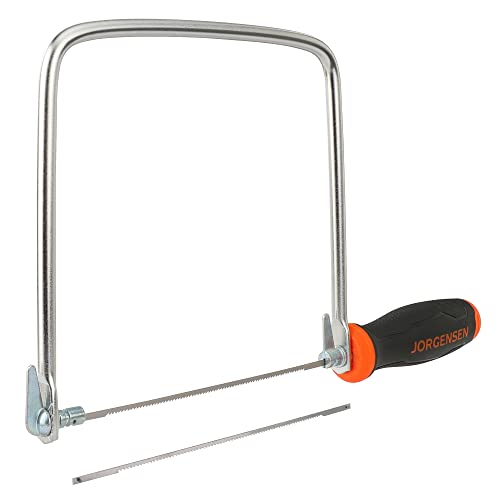
The JORGENSEN Pro set is the deep-reach option. Its frame depth of 6-1/4 inches is the greatest in this guide, which matters when a cut starts far from the edge of a board or a molding profile runs wide. The fitted blade is high-speed steel at 15 TPI, and the box adds two replacement blades, so a snapped or dulled blade mid-job does not end the work. The maker rates the saw for wood, plastic, rubber, and soft metal.
Specs
- Frame: Alloy steel
- Handle: Ergonomic plastic grip
- Blade length: 6-1/2 inches
- Blade: High-speed steel, 15 TPI
- Frame depth: 6-1/4 inches
- Included: Saw plus two replacement blades
- Blade changes: Tool-free, by twisting the handle
- Weight: 9.3 ounces
- Tier: Mid-range
Blade changes need no tools: twisting the handle releases tension, the old blade lifts off its pins, and the new one drops on. That speed helps when switching between rough profile cuts and fine fitting passes. The trade-off for the deep frame is a slightly larger tool to maneuver in tight cabinet work. For coping wide crown, shaping furniture parts, and general curved cuts in sheet stock, the extra reach and spare blades make this the most forgiving set here.
KATA 6.5 Inch Coping Saw

The KATA takes a kit approach: instead of one blade, it ships with six replaceable blades in three tooth counts, so the same frame covers fast roughing cuts and fine detail work. The blades are 65Mn steel in 14, 18, and 24 TPI. The coarsest suits quick profile removal in softwood, the mid-range blade handles general trim, and the finest leaves the smoothest edge in thin stock and plywood faces. A rigid steel frame keeps the chosen blade under steady tension.
Specs
- Frame: Rigid steel
- Handle: TPR grip
- Blade length: 6-1/2 inches
- Blades included: Six 65Mn steel blades
- Tooth counts: 14, 18, and 24 TPI
- Materials: Wood, plastic, and soft metal, per the maker
- Tier: Mid-range
The TPR grip gives a secure hold for scroll-style work, and swapping blades to match the material is faster than owning several saws. The maker does not rate this saw for hard metal, so keep it to wood, plastic, and soft metals. Buyers who cut a mix of trim, craft plywood, and decorative shapes will get the most from the blade assortment. If you only ever cope one molding profile, the extra blades are capacity you may never use.
IVY Classic 11110 6-1/2 Inch Coping Saw

The IVY Classic 11110 is the traditionalist’s pick, pairing a hardwood handle with the most varied blade bundle here. Five assorted blades cover fine work in veneers and thin wood, a medium blade for hardwood, a coarse blade for fast cuts in any wood, and a hacksaw blade for metal. The blade can turn to any angle for intricate shapes, and tension is adjusted through the hardwood handle in the classic manner.
Specs
- Frame: Steel
- Handle: Hardwood
- Blade length: 6-1/2 inches
- Cutting depth: 4-3/4 inches
- Blades included: Five assorted, including a hacksaw blade for metal
- Blade rotation: Turns to any angle
- Tier: Budget
The 4-3/4 inch cutting depth is the shallowest in this guide, which limits how far from an edge a cut can start, but the shorter frame also feels nimble on small parts and tight inside corners. The included hacksaw blade makes it the only saw here that arrives ready for light metal cutting alongside wood. Choose it for craft work, veneer, and mixed small jobs around the shop. For wide molding profiles, one of the deeper frames above is a better fit.
How to choose
Start with frame depth. Depth is the distance from the blade to the back of the frame, and it caps how far into a board a cut can reach. Depths here run from 4-3/4 inches on the IVY Classic to 6-1/4 inches on the JORGENSEN. Measure the widest molding or panel you plan to cut and leave room to spare.
Match the blade to the material. Tooth count drives finish: 14 to 15 TPI blades cut quickly in softwood and general trim, 17 TPI leaves a cleaner edge on painted or fragile profiles, and blades at 24 TPI and finer suit thin stock and veneer. Every saw here takes standard 6-1/2 inch pinned blades, so tooth count is a blade choice, not a saw choice.
Check the tensioning system. A blade that stays taut tracks straight and resists bowing on curves. Twist-handle systems, as on the Bahco and JORGENSEN, are simple and quick; screw systems work too but take longer between changes. If you swap blades often for interior cutouts, tool-free changes save real time.
Finally, weigh the handle and the extras. A cushioned grip pays off over a full room of baseboard, while a hardwood handle gives traditional feedback on fine joinery. Spare blades in the box, like the JORGENSEN and KATA sets include, keep a job moving when a blade snaps.
Who should skip these
A coping saw is a specialist. Skip this whole category if your work is mostly straight cuts in lumber, where a backsaw or a power miter saw is faster and more accurate. Skip it for high-volume joinery waste, where a bandsaw clears material far quicker, and for metal fabrication, where a hacksaw is the right tool. If your curved work is large exterior shapes in thick stock, a jigsaw will serve you better. These five saws are for controlled, close work: coped joints, curves, and cutouts in thin to moderate stock.
FAQ
What is a coping saw used for?
Its main job is coping: cutting the profile of one molding piece so it nests tightly against the face of another at an inside corner. The same thin, turning blade also cuts curves, clears dovetail waste, trims dowels, and makes interior cutouts when passed through a drilled starter hole.
What TPI blade is best for coping molding?
Most molding work sits comfortably between 14 and 18 TPI. A 14 or 15 TPI blade removes the profile quickly in softwood, while 17 or 18 TPI leaves a cleaner edge on painted trim and MDF. For very thin or delicate stock, move finer still; the KATA kit reaches 24 TPI.
Can a coping saw cut metal?
Only with the right blade and only within limits. Standard wood blades handle soft, thin non-ferrous metal at best. The IVY Classic includes a dedicated hacksaw blade for metal, which is the correct setup for light metal cutting. For regular metal work, a hacksaw remains the better tool.
How deep can a coping saw cut?
Depth is set by the frame, not the blade. The saws here reach from 4-3/4 inches to 6-1/4 inches from the edge of the workpiece. If a cut must start farther in than the frame allows, the options are a deeper fretsaw frame, a scroll saw, or repositioning the work so the cut begins closer to an edge.
Final verdict
For a single saw that covers most coping and curved work, the Bahco 301 is the balanced choice, with the IRWIN ProTouch close behind for anyone who values a cushioned grip and a finer blade. The JORGENSEN set is the pick for wide profiles and buyers who want spares included, the KATA kit suits mixed materials and tooth counts, and the IVY Classic keeps a traditional hardwood-handle saw ready for wood and light metal. Match the frame depth to your widest workpiece first, then pick the blade assortment that fits your material.
More from Amazon
Programs that pair well with the guide above. Offers and eligibility are set by Amazon and may change.
A free business account with business pricing and bulk-buying tools for work, shop or home office.
Create a business accountFree shipping on eligible items, Prime Video and more. Eligible new members can start with a free trial.
Start a Prime free trialAudiobooks and podcasts to listen to on the go. Eligible new members can start with a free trial.
Try Audible freeAd-free music streaming. Eligible new subscribers can start with a free trial.
Try Music Unlimited freeAs an Amazon Associate we earn from qualifying purchases.


Write Your Review
No reviews yet. Be the first to share your experience!