

Our Top Picks
 POWERTEC 71395 Taper/Straight Line Jig for Table Saws32"40.55 x 8.66 x 2.36 inches8.82 poundsCheck on Amazon
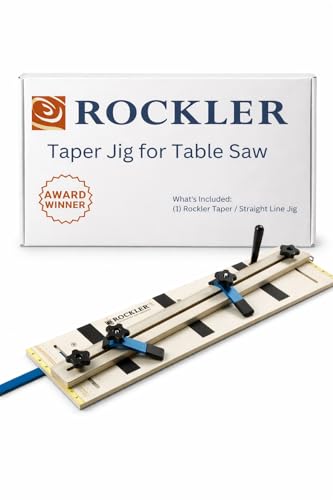 Rockler Taper Jig & Straight Line Wood Cutting31.6 x 7.75 inches7.87 x 36.22 x 1.18 Inches6.7 poundsCheck on Amazon
- Top Pick: POWERTEC 71395 Taper/Straight Line Jig
- Runner-up: Rockler Taper Jig/Straight Line Jig
- Also consider: WoodRiver Taper Jig
Tapered legs are the detail that separates a plain table or chair from a finished piece of furniture, and a taper jig is what makes those angled rip cuts repeatable on a table saw. Instead of marking every leg and steering it freehand past the blade, the jig holds the workpiece at a fixed, settable angle, so the second, third and fourth legs come out matching the first. A good jig also keeps hands clear of the blade and registers the stock against a stop, which matters most on narrow leg blanks.
Commercial taper jigs fall into two families. Hinged rail jigs are two bars joined at one end that open like scissors and ride against the rip fence, while sled-style jigs carry the workpiece on a flat base that runs in the miter slot and clamps it down. This guide compares five current models across budget, mid-range and premium tiers, looking at angle range, capacity, clamping and saw compatibility so you can match a jig to the legs and panels you actually cut.
As an Amazon Associate, we earn from qualifying purchases.
Quick answer
For most shops, the POWERTEC 71395 is the easiest taper jig to live with: a wide melamine sled, two hold-down clamps and an indexed fence on a standard miter bar. Budget shops should look at the hinged WoodRiver or POWERTEC 71035 rail jigs, while the MICROJIG Microdial bundle suits repeat, dial-set tapers.
POWERTEC 71395 Taper/Straight Line Jig
The POWERTEC 71395 is a sled-style jig built around a 32-inch melamine-coated MDF base that runs in the miter slot on a 36-inch aluminum miter bar. An adjustable fence sets the taper angle, two hold-down clamps pin the workpiece to the base, and abrasive grip strips add friction so stock stays put during the cut. Two self-adhesive tape measures and an indexed scale help you return to a previous setting, and the same sled doubles as a straight-line ripping jig for putting a clean first edge on rough boards.
Specs:
- Base: 32 x 7-7/8 in, 1/2 in MDF with melamine coating on both sides
- Miter bar: aluminum, 3/4 x 3/8 in, 36 in long
- Fence: adjustable, 32 in long
- Clamps: two 5-1/2 in hold-down clamps
- Push knob: 4 in tapered knob
- Extras: two self-adhesive tape measures, abrasive grip strips
- Miter slot fit: standard 3/4 x 3/8 in slot; slot-to-blade ranges of 3-3/4 to 4-3/8 in, 5 to 5-5/8 in, or 6-1/4 to 6-7/8 in
- Weight: 8.82 lb
Choose it if your saw has a standard miter slot and you taper furniture legs regularly; the clamping sled format is the most forgiving for repeat work. Skip it if your saw’s slot-to-blade distance falls outside the listed ranges, as happens with many compact jobsite saws.
Rockler Taper Jig/Straight Line Jig

The Rockler jig follows the same sled format with a few refinements. Its base is half-inch MDF faced with a low-friction laminate, and the angle is set with indexed marks where each mark equals one degree of taper, backed by dual tape measures for setting by dimension instead. Heavy-duty hold-down clamps and a large ergonomic handle keep the work and the sled under control. The first cut trims the base edge to the blade, giving zero-clearance support along the cut line, and removing the miter bar converts the jig to a straight-line ripping jig.
Specs:
- Model: Rockler RK-21597
- Base: 31-5/8 x 7-3/4 in, 1/2 in MDF with low-friction laminate
- Miter bar: 36 in aluminum with adjustable nylon set screws; fits a 3/4 x 3/8 in miter slot
- Angle setting: indexed marks, one mark per degree of taper
- Measuring: dual tape measures on the base
- Clamps: heavy-duty hold-down clamps
- Capacity: workpieces up to 2 in thick and 5-3/4 in wide
- Saw fit: left edge of the right miter slot 3-3/4 to 4-3/8 in, or 5 to 5-5/8 in, from the blade
- Weight: 6.7 lb
This is a strong pick for woodworkers who set tapers by degrees and want the zero-clearance edge. Check your slot-to-blade distance before ordering, since the fit ranges are narrower than the POWERTEC sled’s.
WoodRiver Taper Jig

The WoodRiver Taper Jig is the classic hinged design sold by Woodcraft: two aluminum guide rails joined at the front, with a push handle at the back and an adjustable stop that sets how far the rails open. There is no base and no miter bar; the jig rides against the rip fence while the workpiece rests against the angled rail and its end stop. It is the simplest format here, with nothing to assemble beyond setting the stop, and it stores flat in a drawer.
Specs:
- Manufacturer: Woodcraft Supply (WoodRiver brand)
- Model: 03R22W
- Construction: aluminum guide rails
- Design: hinged two-rail jig with push handle
- Angle setting: adjustable stop block
- Guidance: rides against the rip fence; no miter slot required
- Use: tapering legs and straight-lining board edges
Pick it for occasional tapering on any saw with a straight rip fence, including saws whose miter slots are non-standard. Skip it if you want clamps: the workpiece is steadied against the rail by the operator rather than locked down, so very small or slick pieces are better handled by a clamping sled.
POWERTEC 71035 Table Saw Angle Cutting Jig

The POWERTEC 71035 takes the same hinged-rail idea and adds a laser-etched scale, so the angle reads directly off the rail instead of being measured with a protractor. The two 24-inch aluminum rails open to a maximum of 15 degrees of taper, an ergonomic handle gives you something positive to push, and a lock knob holds the setting while an adjustable stop registers the end of the workpiece. Because it references the rip fence rather than a miter slot, it works on saws regardless of slot size.
Specs:
- Rails: two 24 in lightweight aluminum rails
- Angle range: 0 to 15 degrees
- Scale: laser-etched angle scale
- Hardware: ergonomic handle, lock knob, adjustable stop
- Design: hinged two-rail jig, fence-referenced
- Guidance: rides against the rip fence; no miter slot required
This is a good budget step up from an unmarked hinged jig when you set angles by degrees. Skip it for long panels or wide stock, since the open-rail format supports the workpiece along one edge only.
MICROJIG Microdial Tapering Jig TJ-5000 with GRR-RIPPER GR-100 Bundle

The MICROJIG Microdial TJ-5000 replaces guesswork with dials. Its ColorMatch system sets tapers two ways: a degree scale accurate to an eighth of a degree, or a Rise-over-Run dial that sets the taper directly in inches per foot, from zero to two inches per foot in sixteenth-inch steps, with 122 built-in presets. Two MemoryLock dials store a setting so you can leave it and come back later. Amazon lists the jig in a bundle with the GRR-RIPPER GR-100 3D Pushblock, the push block MICROJIG designs the jig to work with for feeding stock, and the jig also runs on router tables and band saws that have a fence.
Specs:
- Model: MICROJIG TJ-5000, bundled with the GRR-RIPPER GR-100 pushblock
- Degree adjustment: infinite, 0 to 10 degrees, accurate to 1/8 degree
- Rise-over-Run dial: 0 to 2 in per foot in 1/16 in increments
- Presets: 122 built-in settings; two MemoryLock dials
- Compatibility: table saws, router tables and band saws
- Weight: 3 lb 4 oz
- Origin: designed and made in the USA
Choose the Microdial if you taper legs in batches and need to return to exact settings days later. Skip it if you only taper the occasional leg; the dial system is more machinery than a once-a-year job needs.
How to choose
Start with your saw. Sled jigs need a standard 3/4 by 3/8 inch miter slot, and each model lists the slot-to-blade distances it fits, so measure from the left edge of the right slot to the blade before buying. Hinged rail jigs skip the slot entirely and reference the rip fence, which makes them the fallback for benchtop saws with undersized or non-standard slots.
Next, match capacity to your work. Leg blanks for tables and chairs are usually under two inches thick, which every jig here handles, but width and support differ: sled bases carry stock up to about five and three-quarter inches wide, while open rail jigs support long pieces along one edge only. The workpiece should sit fully on the base or rails at the start of the cut.
Then decide how you want to set angles. Indexed marks and etched scales are quick for one-off tapers. Dials that set rise-over-run directly are faster when a plan specifies taper in inches per foot, and memory settings pay off when a project has many matching legs. Finally, consider clamping: hold-down clamps keep both hands on the jig rather than the workpiece, which is the safer arrangement for short or narrow stock.
Who should skip
Skip a taper jig entirely if you taper legs only once in a great while; a shop-made hinged jig from scrap plywood does the same job for a single project. Skip sled models if your saw lacks a standard miter slot or its slot-to-blade distance falls outside the maker’s ranges, and skip rail jigs if most of your tapering is on short, narrow parts that need clamping. Production shops cutting tapers all day should also look past this class of jig toward a dedicated sled system or shaper setup, and anyone tapering very long architectural parts may be better served by a track saw and a straightedge guide.
FAQ
What size taper can these jigs cut?
The hinged rail jigs open to 15 degrees, the sled jigs set their angle with indexed marks or tape measures, and the Microdial covers 0 to 10 degrees or up to two inches per foot on its Rise-over-Run dial. Most furniture legs use gentle tapers well inside all of these ranges.
Will a taper jig fit my jobsite saw?
Sled models fit only if your saw has a standard 3/4 by 3/8 inch miter slot at one of the listed distances from the blade, which rules out some compact saws. Hinged rail jigs have no slot requirement at all and fit any saw with a straight rip fence.
Can a taper jig straighten a crooked board edge?
Yes. Both sled models double as straight-line ripping jigs: clamp or register the board so the straight portion overhangs the jig’s edge, and the first pass cuts a clean reference edge. Rail jigs do the same job with the rails set parallel.
How do I taper all four sides of a leg?
Cut the first two adjacent faces at the same setting, then rotate the leg and repeat for the remaining faces, keeping an uncut reference face against the jig until the last pass. A jig with memory settings or a positive stop makes it easier to return to the identical angle for each batch of legs.
Final verdict
For most woodworkers, the POWERTEC 71395 sled is the best balance of clamping, capacity and easy setup, with the Rockler close behind for its indexed degree marks and zero-clearance edge. On a budget, the WoodRiver is the simple classic, and the POWERTEC 71035 adds a readable scale to the same hinged format. If tapering is a weekly, repeat job, the MICROJIG Microdial bundle earns its premium tier with dial-set angles you can store and return to exactly.
More from Amazon
Programs that pair well with the guide above. Offers and eligibility are set by Amazon and may change.
A free business account with business pricing and bulk-buying tools for work, shop or home office.
Create a business accountFree shipping on eligible items, Prime Video and more. Eligible new members can start with a free trial.
Start a Prime free trialAudiobooks and podcasts to listen to on the go. Eligible new members can start with a free trial.
Try Audible freeAd-free music streaming. Eligible new subscribers can start with a free trial.
Try Music Unlimited freeAs an Amazon Associate we earn from qualifying purchases.


Write Your Review
No reviews yet. Be the first to share your experience!