

Key takeaways
- The cutter wears first. Dull teeth increase feed force, heat, and the chance of damaging the arbor. Replace or resharpen cutters before forcing the machine.
- Clean the magnetic base every time. A single steel chip under the base can create a gap and reduce holding force. Wipe the base and work surface before positioning.
- Protect the slide and rack. Chips packed into the slide increase play and make feeding uneven. Brush debris away rather than washing it deeper into the mechanism.
- Use cutting fluid appropriately. Flooding is not always practical, but a suitable cutting lubricant reduces tooth temperature and extends cutter life. Keep liquid away from electrical controls.
- Expect batteries to be consumables. Cordless ownership includes spare packs and eventual battery replacement. Compare the total system cost, not just the bare tool price.
- Inspect the safety equipment. Check the chain, switches, cable, arbor, pilot pin, and magnet function before each job, particularly after moving the drill between sites.
The best magnetic drill presses for most buyers are the Hougen HMD900 for compact everyday steelwork, the Milwaukee M18 FUEL magnetic drill for cordless site work, the Evolution EVO42 for larger annular cutters, and the FEIN JHM1 for a lighter professional machine with a strong balance of capacity and portability.
A magnetic drill press, or mag drill, is chosen less by headline motor power than by whether its magnet, stroke, cutter capacity, and weight suit the steel you actually drill. A small machine can be ideal on 6 mm plate and awkward on thick structural sections; a heavy machine may be unnecessarily cumbersome for ladder or overhead work.
Our top picks
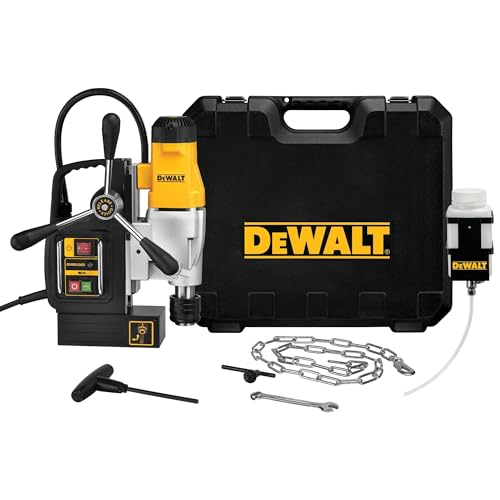


As an Amazon Associate we earn from qualifying purchases at no extra cost to you. Ratings are shown as listed on Amazon.
Best magnetic drill presses compared
| Machine | Magnetic holding force | Typical annular cutter capacity | Twist-drill capacity | Stroke | Weight | Best suited to |
|---|---|---|---|---|---|---|
| Hougen HMD900 | About 1,530 lb / 694 kg | 1-1/2 in / 38 mm diameter, 2 in / 51 mm depth | Up to about 3/4 in / 19 mm with suitable tooling | Approximately 8 in / 203 mm | About 30 lb / 13.6 kg | General fabrication and maintenance |
| FEIN JHM1 | About 2,250 lb / 1,020 kg | 1-1/2 in / 38 mm diameter, commonly 2 in / 50 mm depth | Up to about 1 in / 25 mm, depending on setup | Approximately 10-1/4 in / 260 mm | About 27 lb / 12.2 kg | Portable professional drilling |
| Milwaukee M18 FUEL 2787-20 | Published holding force varies by position and material; about 2,000 lb is commonly specified | Up to 1-1/2 in / 38 mm diameter with compatible cutters | About 1-1/2 in / 38 mm with the appropriate chuck and tooling | Approximately 11 in / 279 mm | About 63 lb / 28.6 kg with battery; varies by configuration | Remote work where mains power is inconvenient |
| Evolution EVO42 | About 2,800 lb / 1,270 kg | 1-5/8 in / 42 mm diameter, commonly 2 in / 50 mm depth | Up to about 1 in / 25 mm with suitable chuck | Approximately 8-1/4 in / 210 mm | About 35 lb / 16 kg | Frequent large-hole work and structural steel |
Specifications can change between regional versions, motor packages, and included accessories. Treat the table as a buying comparison, then confirm the exact manual before ordering cutters, chucks, or replacement arbors.
Our picks by working situation
Best all-rounder: Hougen HMD900
The HMD900 is a strong choice when you want a conventional corded mag drill that is compact enough for maintenance work but capable of cutting useful holes in structural steel. Its 1-1/2-inch annular-cutter rating covers common cable-tray, fabrication, and bolting jobs, while its moderate weight is easier to position than a large industrial machine.
Its practical advantage is not maximum holding force; it is a mature, widely supported cutter and arbor ecosystem. Hougen-style annular cutters are easy to find in common diameters, and the machine is a sensible fit for users who need predictable performance several times a month rather than the largest possible hole.
Best for portability: FEIN JHM1
The JHM1 offers a useful combination of relatively low machine weight and high stated magnetic force. That matters when the drill must be carried up stairs, positioned on a beam, or used repeatedly at shoulder height. The longer stroke also gives more room for a cutter, pilot pin, and thicker workpiece.
Choose it over a smaller economy machine when the drill will be used professionally and the cost of repositioning or replacing a strained tool is significant. It remains a corded machine, so it needs a safe power source and a cable-management plan on site.
Best cordless option: Milwaukee M18 FUEL magnetic drill
A cordless mag drill earns its premium where access to mains power is difficult: plant maintenance, steel erection, outdoor fabrication, and repair work in locations with no convenient outlet. The M18 FUEL model removes the extension cord and can be especially useful when several holes must be drilled from a lift or temporary platform.
The trade-off is mass. Battery, charger availability, and spare packs add weight and cost, while long runs of large holes can consume batteries quickly. It is a poor value if the machine will stay beside a fabrication bench with reliable mains power. For intermittent field use, however, the saved setup time can justify the higher ownership cost.
Best for large annular cutters: Evolution EVO42
The EVO42 is aimed at users who regularly need holes larger than the 1-1/2-inch range. Its approximately 42 mm cutter capacity provides more headroom for structural connections, pipe supports, and heavy fabrication. The higher magnetic force is valuable on thick, clean steel, but the machine is also more demanding to carry and position.
Do not select it merely because its maximum hole is larger. Large cutters require greater feed control, more clearance around the hole, and a workpiece rigid enough not to vibrate. If most of your holes are 20 to 30 mm, a lighter 38 mm-class machine may be faster in real work.
How steel thickness changes the choice
Magnetic holding force is only useful when the magnet has enough clean, continuous steel beneath it. Thin plate, rusty surfaces, paint, gaps, curved surfaces, and narrow edges reduce the effective grip. A machine advertised at 2,000 lb of holding force does not exert that force unchanged on every job.
| Steel condition | Practical concern | Preferred machine characteristic |
|---|---|---|
| 4–6 mm plate | Magnet may have reduced grip; breakthrough can snag the cutter | Compact machine, sharp cutter, low feed pressure, safety strap |
| 8–12 mm plate | Good general-purpose range for many mag drills | 1-1/2 in cutter capacity and adjustable feed control |
| 16–25 mm plate | Longer cutting time and more slug resistance | Higher magnetic force, rigid arbor, generous stroke |
| Over 25 mm or stacked plate | Requires deep-cut tooling and careful chip evacuation | Heavy machine, 2 in depth cutters, and controlled coolant delivery |
On thin steel, use a secondary safety chain or strap whenever the manufacturer permits it. A magnet is not a substitute for restraint, especially when drilling overhead or on a painted, wet, or contaminated surface. Never assume the magnet will hold safely if only part of its base sits on the workpiece.
Annular cutters, twist drills, and actual capacity
Annular cutters remove a ring of metal rather than turning the entire hole into chips. They are normally the fastest way to make through-holes in steel and place less demand on the motor than a full-size twist drill. Their stated depth, commonly 2 inches, is a hard practical limit: a 2-inch cutter cannot finish a hole through a 2-1/2-inch solid section in one pass.
Twist-drill capacity is less decisive than it appears. A machine may accept a chuck and a large drill, but drilling a large solid hole generates substantially more torque and heat than using an annular cutter. For repeated holes above roughly 20 mm, budget for suitable annular cutters, pilot pins, cutting fluid, and replacement arbors rather than relying on a chuck alone.
Check the arbor standard before buying accessories. Some machines use a common Weldon-shank system, while others need a manufacturer-specific adapter or have different requirements for cutter length. A cutter that fits the diameter but has the wrong shank, pilot-pin length, or cutting depth is not compatible in practice.
A simple sizing calculation
Suppose a job requires 24 holes through 12 mm steel. A 1-1/2-inch-class machine is already large enough for the diameter, and a 2-inch-depth cutter has ample depth. The more useful calculation is consumable life: if one cutter is conservatively rated for 60 holes in this material, the job uses 24 ÷ 60 = 0.4 cutter. Buying a spare is sensible, but buying a 42 mm machine solely for this job adds carrying weight without improving the hole size.
If the same job changes to 40 mm holes through 25 mm steel, the larger Evolution-class machine becomes more appropriate. The cutter is close to the machine’s maximum diameter and the thicker section leaves less margin for poor feed, dull teeth, or inadequate coolant.
Ownership costs and maintenance realities
- The cutter wears first. Dull teeth increase feed force, heat, and the chance of damaging the arbor. Replace or resharpen cutters before forcing the machine.
- Clean the magnetic base every time. A single steel chip under the base can create a gap and reduce holding force. Wipe the base and work surface before positioning.
- Protect the slide and rack. Chips packed into the slide increase play and make feeding uneven. Brush debris away rather than washing it deeper into the mechanism.
- Use cutting fluid appropriately. Flooding is not always practical, but a suitable cutting lubricant reduces tooth temperature and extends cutter life. Keep liquid away from electrical controls.
- Expect batteries to be consumables. Cordless ownership includes spare packs and eventual battery replacement. Compare the total system cost, not just the bare tool price.
- Inspect the safety equipment. Check the chain, switches, cable, arbor, pilot pin, and magnet function before each job, particularly after moving the drill between sites.
What to buy
Choose the Hougen HMD900 for the best balance of size, capacity, and accessory support. Choose the FEIN JHM1 when portability and professional build quality matter more than the lowest purchase price. Choose Milwaukee’s M18 FUEL model when eliminating the power cord materially improves access. Choose the Evolution EVO42 when large annular cutters and thick structural steel are routine.
For occasional home fabrication, avoid paying for a maximum-capacity machine you will rarely lift or use. Match the drill to your largest regular cutter, the thinnest steel that must hold the magnet safely, and the way power reaches the workpiece. Those three details predict real-world performance better than motor wattage alone.



Write Your Review
No reviews yet. Be the first to share your experience!