

The best cabinet saws for a woodworking shop are 3 HP, 230-volt, 10-inch saws with a cast-iron top, an enclosed cabinet and a 30 to 52 inch rip fence, and the SawStop 3 HP Professional Cabinet Saw is the one to beat if safety technology matters to you. If your shop has only 120-volt power, the Powermatic PM1000 and the JET ProShop II give you cabinet-style build without a new circuit. This guide ranks seven saws by shop type, shows how to size the electrical circuit and rip capacity, and covers sliding tables and panel saws for shops that outgrow a standard cabinet saw. We did not personally use these saws; picks come from maker specifications, retailer listings and published spec summaries.
Our top picks

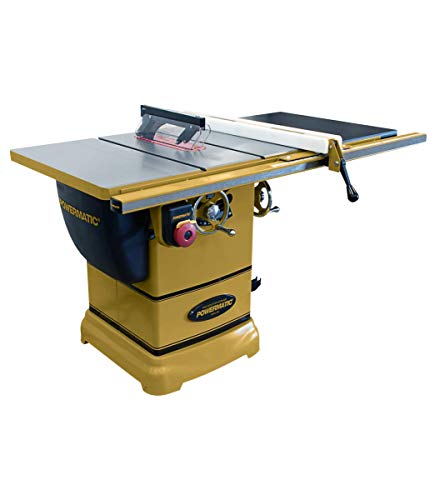 Powermatic 10-Inch Table Saw
- Ergonomically-designed 7" handwheels provide momentum, making blade height…
- Arbor lock allows for one-handed blade changes with…
- Exclusive Accu-Fence provides rigidity and precision


As an Amazon Associate we earn from qualifying purchases at no extra cost to you.
Key takeaways
- A 3 HP single-phase cabinet saw runs on a 230-volt circuit (the SawStop lists 13 amps and the JET XACTA 14.5 amps); plan a dedicated circuit before you order.
- 30 inches of rip capacity covers halving a sheet; 50 to 52 inches lets you trim a full 48-inch panel lying right of the blade.
- Cabinet saws weigh roughly 330 to 500 pounds with fence and rails. You need a mobile base, a helper and a plan for the doorway.
- The 1-3/4 HP, 120-volt saws in this list are hybrids or lighter cabinets, a middle ground for shops without 240-volt service.
- A sliding table is the upgrade for cutting sheet goods and wide panels; some shops add one to a cabinet saw, others buy a dedicated slider.
Best Cabinet Saws at a Glance
| Pick | Motor | Voltage | Rip right of blade | Best for | Price tier |
|---|---|---|---|---|---|
| SawStop 3HP Professional (36 in. fence) | 3 HP | 230 V, 1 ph | 36 in. | Safety-first shops | Premium |
| Powermatic PM2000B | 3 HP | 230 V, 1 ph | 50 in. | Router lift and sheet goods | Premium |
| JET Deluxe XACTA JTAS-10DX | 3 HP | 230 V, 1 ph | 30 in. | All-round production shop | Upper |
| Laguna F3 Fusion | 3 HP | 220 V | 36 in. | Mid-range 3 HP | Upper |
| Grizzly G0651 | 3 HP | 220 V | See listing | Value cabinet saw | Upper |
| Powermatic PM1000 | 1-3/4 HP | 115/230 V | 30 in. | Flexible shop voltage | Upper |
| JET ProShop II JPS-10 | 1-3/4 HP | 120 V | 30 or 52 in. | Entry cabinet-style, 120 V | Mid to upper |
1. SawStop 3 HP Professional Cabinet Saw: Best Overall for Safety
- 3 HP · 1-phase · 230 V · 13 A · 10 inch blade · 5/8 inch arbor
- Max depth of cut 3-1/8 inches at 0 degrees, 2-1/4 inches at 45 degrees
- Rip right of blade 30, 36 or 52 inches by fence package; 12 inches to the left
- 335 pounds for the saw alone, about 426 pounds with the 36 inch fence, per spec summaries
- SawStop’s flesh-detection brake system
Best for: shops with students, family members or employees who share the saw, and woodworkers who simply want the added safety margin. Skip if: your budget is the main limit; this is the premium tier.
Pros: a safety brake system built into a solid cabinet saw; well-supported accessories, including fences and router table options; a smooth fence system. Cons: the highest price on this list; replacement brake cartridges and dado brake cartridges are an ongoing cost after a trigger; heavy.
2. Powermatic PM2000B: Best for Router Lift and Large Panels
- 10 inch · 3 HP · 230 V single-phase · 50 inch rip
- Router lift included in the listing’s configuration
- Check the maker’s page for the exact motor and wing options on your version
Best for: woodworkers who want a router table built into the saw and plan to cut large panels with the fence at 50 inches. Skip if: you do not need the extra rip capacity; the smaller PM1000 does the cut for less.
Pros: the long rail and the integrated router lift save floor space; a high-end brand with a long track record. Cons: premium tier; configuration details vary by seller, so confirm what is in the box; takes floor space with the long rails.
3. JET Deluxe XACTA JTAS-10DX: Best All-Round Production Saw
- 10 inch · 3 HP · 230 V · 14.5 A · 30 inch rip with cast-iron wings (model JTAS-10DX)
- 4,300 RPM arbor · max depth 2-1/8 inches at 45 degrees as listed in spec summaries
- Quick-release riving knife · push-button arbor lock · Poly-V drive belt · rail-mounted magnetic switch
- About 330 pounds net per retailer listings; larger-rail variants weigh more (about 490 to 510 pounds)
Best for: a working shop that wants a well-known cabinet saw with a quick-release riving knife and a track record. Skip if: you need a rip over 30 inches in this model; the XL versions carry longer rails.
Pros: a mature design with wide parts and dealer support; easy blade changes; a solid fence. Cons: the base 30 inch rail is shorter than the SawStop 36 and the Powermatic 50; weights vary by variant, so check your exact model number.
4. Laguna F3 Fusion: Best Mid-Range 3 HP Saw
- 10 inch · 3 HP · 220 V · 36 inch rip
- Fusion line: a modern take on the cabinet design
- Third-party reviews put it around 425 pounds; confirm against the maker’s spec sheet
Best for: woodworkers who want 3 HP and a 36 inch rip at a lower price tier than the SawStop. Skip if: you need a safety brake system, which the SawStop offers and this saw does not.
Pros: a good power-to-price ratio at 3 HP; 36 inch rip as listed; strong brand in woodworking machinery. Cons: accessory options are narrower than SawStop and JET; check the exact specs because sources vary.
5. Grizzly G0651: Best Value 3 HP Cabinet Saw
- 10 inch · 3 HP · 220 V · heavy-duty cabinet saw
- Check the listing for the fence and rail package included
Best for: hobbyists and small shops who want a cabinet saw with a 3 HP motor without paying for a premium brand. Skip if: you want local dealer support, since Grizzly sells direct.
Pros: the cast-iron cabinet design at an upper-mid price tier; direct sales and a long product line. Cons: fit and finish vary from brand to brand; confirm the fence version and rails; you handle service through the maker.
6. Powermatic PM1000: Best for Shops With Flexible Voltage
- 10 inch · 1-3/4 HP · 115/230 V single-phase · 30 inch rip (a 52 inch version also exists)
- Accu-Fence · arbor lock · Poly-V belt drive · ergonomic handwheels
Best for: shops that run on 120 V today and might move to 240 V later. Skip if: you cut thick hardwood all day; a 3 HP saw is smoother.
Pros: a wiring option for either voltage; a recognized brand; 30 inch rip handles most cabinet-shop work. Cons: less power than the 3 HP saws; 120 V draws high current for a small motor, so use a dedicated circuit.
7. JET ProShop II JPS-10: Best Entry Cabinet-Style Saw on 120 Volts
- 10 inch · 1-3/4 HP · 120 V · 15 A (about 1,800 W) · 4,000 RPM arbor
- 30 or 52 inch rip versions · steel or cast-iron wings
- A contractor-style or hybrid saw, not a full cabinet saw; weights range from the 270s to over 350 pounds by configuration
Best for: woodworkers who want the cabinet-saw experience without 240 V service. Skip if: you cut lots of 8/4 hardwood; the motor will bog.
Pros: runs on a standard dedicated 120 V circuit; cast-iron top; lower weight than full cabinet saws. Cons: not a true cabinet saw; the 1-3/4 HP motor gives up power to 3 HP models; check which wing and rail option you are buying.
Also Consider
- Laguna F2 Fusion (1.75 HP, 110 V, 36 inch rip): the 120-volt sibling of the F3 for smaller shops.
- Shop Fox W1837 10 in. 2 HP Open-Stand Hybrid: a hybrid saw at a mid price tier.
- Oliver 12 inch table saw, 7.5 HP, 3-phase, 36 inch rail: an industrial option for shops with three-phase power.
- BORA PM-1100 Mobile Base Kit: a universal adjustable base that makes a heavy saw movable.
Best Cabinet Saws for Woodworking: How Voltage and Circuit Size Work
The motor’s amp draw sets the circuit you need. A 3 HP 230-volt saw lists about 13 amps (SawStop) to 14.5 amps (JET XACTA). Makers typically recommend a dedicated 20-amp, 240-volt circuit for such a saw, and an electrician can confirm the wire gauge and breaker for your run and your local code. A 1-3/4 HP, 120-volt saw such as the JET ProShop II draws about 15 amps at full load, which is a full 15-amp circuit by itself; a 20-amp circuit gives more room. Never run a saw like this on an extension cord or share the circuit with a dust collector.
Worked Example: Is 3 HP Worth the Rewiring?
- Motor draw: 120 V x 15 A = 1,800 W for the ProShop; 230 V x 13 A = about 3,000 W for a 3 HP saw. The 3 HP saw has roughly 65 percent more input power.
- Circuit: the 120 V saw needs a 20 A circuit for comfort; the 240 V saw needs a 20 A, 240 V circuit with a two-pole breaker and appropriate wire.
- Cost: for a shop already near the panel, running a new 240 V line is often a small job for an electrician; for a detached shop it can be more.
- Result: if you cut 8/4 hardwood or run a dado stack, the 3 HP saw is worth the circuit; for 4/4 stock and sheet goods, a 1-3/4 HP saw is adequate.
Rip Capacity: How Much Do You Need?
| Rip right of blade | What it handles | Typical saw |
|---|---|---|
| 30 inches | Splitting a 4×8 sheet in half (24 in.), cabinet sides and face frames | JET XACTA JTAS-10DX, Powermatic PM1000 |
| 36 inches | Wider panels and desk tops with margin | SawStop with 36 inch fence, Laguna F3 |
| 50 to 52 inches | Trimming a full 48 inch panel that lies right of the blade, with outfeed support | Powermatic PM2000B, SawStop 52 inch package |
If you routinely cut full sheets, add outfeed support behind the saw; rip capacity alone does not hold up a 4×8 panel. For very large sheets, many shops move to a sliding table or a panel saw.
Sliding Table Saws and Panel Saws: When a Cabinet Saw Is Not Enough
A sliding table runs alongside the blade on a precision carriage, so you push the workpiece on the table instead of against the fence. It lets one person cut large, heavy panels square. Some cabinet saws accept a sliding-table accessory, and dedicated sliding-table saws are separate machines that cost far more and need floor space. Panel saws are different: vertical or horizontal saws designed for sheet goods, a good fit if your shop is mostly plywood and melamine and not solid wood. If you rip solid lumber most of the time, a cabinet saw with a good fence is the more flexible tool, and a crosscut sled or outfeed table closes most of the gap for panels.
Best Saws for a Wood Shop: Where a Cabinet Saw Fits
A cabinet saw is the center of a shop, but not the only saw you need. A bandsaw handles resawing and curves, a miter saw or crosscut sled handles trim and long boards, and a track saw breaks down sheets before they reach the table saw. If you have room for one big machine and plan to build furniture, a cabinet saw is the right starting point; if you work on sites or have a small garage, a jobsite saw is more practical.
First-Week Setup for a New Cabinet Saw
Even a good saw needs a day of setup before it makes accurate cuts. Work through these steps in order and write down your readings so you can compare them later.
- Clean the top. Remove the shipping coating from the cast iron with a solvent the maker recommends, then protect the surface with a paste wax. Rust prevention is easier than rust removal.
- Level the cabinet. Set the saw on a flat floor or the mobile base and shim it so it does not rock. A saw that rocks will drift out of alignment and vibrate.
- Check blade-to-slot parallelism. Measure from the miter slot to the front and back of the blade, using the same tooth, and adjust the trunnion until both readings match within a few thousandths of an inch. This keeps the blade from binding or burning on the back side of the cut.
- Square the fence. Lock the fence and check that it is parallel to the miter slot, with a hair more clearance at the back if the maker advises it. A fence that points into the blade causes kickback.
- Align the riving knife. It should sit in line with the blade and close to the teeth. Follow the manual for the exact gap.
- Set the stops. Verify 90 and 45 degree stops with a reliable square and adjust the stop bolts.
- Make a trial cut. Cut a piece of scrap and check it with a square and a straightedge before you work on real stock.
What a Cabinet Saw Costs to Own
The purchase is only part of the budget. Plan for a good combination or rip blade (a thin-kerf blade is easier on 1-3/4 HP saws, a full-kerf blade suits 3 HP saws), a dado set if you cut joinery, a mobile base, outfeed support, a dust collector with enough airflow, and push sticks and featherboards for the cuts that pass close to the blade. If you choose the SawStop, add a spare brake cartridge to the list, since a trigger event ruins one. A drive belt is the main wear part on most saws and lasts for years with regular cleaning; keep the cabinet vacuumed so dust does not pack around the motor.
How We Chose
We did not personally use these saws. We compared maker specifications, retailer listings and published spec summaries, and we picked saws that cover the main choices a shop faces: 3 HP and 230 V, 36 to 50 inch rip, router lift, and 120 V options. Weights and some specs differ between retailers, so we gave ranges where sources conflict and told you which numbers to confirm. Always check the maker’s spec sheet for the exact model and fence package.
Buying Guide: What to Check Before You Buy a Cabinet Saw
Motor and Power
3 HP is the standard for a full cabinet saw and handles thick hardwood and dado stacks with ease. 1-3/4 to 2 HP saws are enough for general work but slow down in thick hardwood. If you have three-phase power, industrial 5 to 7.5 HP saws exist, but most home shops do not need them.
Fence and Rails
A good fence locks square at both ends and holds its setting. T-style fences are common; look at how smoothly the fence slides and how firmly the lock holds. Rails come in lengths; pick one that matches the rip you need and the floor space you have.
Trunnions and Cast Iron
In a cabinet saw, the trunnions that hold the arbor are mounted to the cabinet, not to the table, so the top can be removed for adjustment. Cast-iron wings and a cast-iron top resist flex and damp vibration. Check flatness and whether the saw comes with a cast-iron or steel extension wing.
Riving Knife and Guard
A riving knife that moves with the blade, and a guard you will actually use, are basic safety features. Quick-release versions let you swap them in seconds, which encourages their use.
Dust Collection
Cabinet saws trap most dust in the enclosed base, and a 4-inch port plus a blade guard with a dust connection helps. Plan for a dust collector with enough airflow rather than a shop vacuum.
Weight, Delivery and Moving
A cabinet saw with fence and rails runs from about 330 pounds for the lighter versions to 450 pounds and above for the larger ones. It arrives on a pallet in a large crate. Plan the route from the truck to the shop, the door width, the floor strength and how you will lift the top. A mobile base such as the BORA PM-1100 lets you move the saw once it is in position.
Warranty and Service
Look at the warranty on the motor and the cabinet, the parts availability and whether the maker offers a local dealer. A big machine is easier to own when parts are one call away.
Frequently Asked Questions
What are the best cabinet saws for woodworking?
The SawStop 3 HP Professional, Powermatic PM2000B and JET XACTA JTAS-10DX are strong choices at 3 HP, with different strengths: safety brake, router lift and a long track record. For tighter budgets, the Laguna F3 Fusion and Grizzly G0651 offer 3 HP at a lower tier.
What are the best cabinet table saws if I only have 120 V?
The Powermatic PM1000 (115/230 V) and JET ProShop II (120 V) give cabinet-style build on a standard circuit. They are less powerful than 3 HP saws, so they suit 4/4 stock and sheet goods best.
Is a cabinet saw worth it over a hybrid?
If you cut thick hardwood and run dado stacks often, a 3 HP cabinet saw is worth it. A hybrid saves money and weight and is enough for many hobby shops.
Do I need a sliding table on my cabinet saw?
Not unless you cut sheet goods and wide panels daily. A crosscut sled and outfeed support handle most of those cuts, and a sliding table is an upgrade for production work.
What size rip fence do I need?
30 inches covers most cabinet work; 36 inches gives margin; 50 to 52 inches suits shops that trim full 48 inch panels. Outfeed support matters more than the extra inches.
How much does a cabinet saw weigh?
The SawStop PCS lists 335 pounds for the saw alone and about 426 pounds with the 36 inch fence. JET XACTA models range from about 330 to 510 pounds depending on the rail length. Check your exact model.
Does a cabinet saw need 240 V?
3 HP saws are normally wired for 230 or 240 V single-phase. Some 1-3/4 HP saws run on 120 V, and a few such as the PM1000 can be wired for either. Ask an electrician to confirm your circuit.
Which One Should You Buy?
Choose the SawStop 3 HP Professional if safety and accessories are your priority. Choose the Powermatic PM2000B for a router lift and 50 inch rip, the JET XACTA for a well-supported all-round saw, and the Laguna F3 or Grizzly G0651 if you want 3 HP at a lower tier. If you only have 120 V, pick the Powermatic PM1000 or JET ProShop II.
Sources: SawStop, Powermatic, JET, Laguna and Grizzly product pages and specification sheets; retailer listings for SawStop PCS31230 and JET XACTA models; published spec summaries.
Last updated: November 2026
More from Amazon
Programs that pair well with the guide above. Offers and eligibility are set by Amazon and may change.
A free business account with business pricing and bulk-buying tools for work, shop or home office.
Create a business accountFree shipping on eligible items, Prime Video and more. Eligible new members can start with a free trial.
Start a Prime free trialAudiobooks and podcasts to listen to on the go. Eligible new members can start with a free trial.
Try Audible freeAd-free music streaming. Eligible new subscribers can start with a free trial.
Try Music Unlimited freeAs an Amazon Associate we earn from qualifying purchases.




Write Your Review
No reviews yet. Be the first to share your experience!